

This article will look at the Best CoW Swap Competitors for MEV Protection, comparing leading platforms that assist traders in preventing front-running, sandwich attacks, and damaging MEV.
We’ll look at their MEV protection, execution models, liquidity and routing, supported networks, and key trading features, to help you find the best alternative for secure and efficient decentralized trading.
Key Points & Best CoW Swap Competitors for MEV Protection
| CoW Swap Competitor | Explanation |
|---|---|
| 1inch | Aggregates liquidity across DEXs to optimize execution and reduce MEV exposure. |
| UniswapX | Uses permissionless fillers and auctions to improve swaps while limiting MEV impact. |
| Odos | Splits trades across liquidity sources for better pricing and efficient execution. |
| Hashflow | Uses RFQ-based trading to provide predictable prices and reduce sandwich attacks. |
| Velora | Provides intent-based trading infrastructure focused on efficient, protected cross-chain transactions. |
| MEV Blocker | Routes transactions privately to protect users from front-running and sandwich attacks. |
| Flashbots Protect RPC | Sends transactions privately, preventing public mempool exposure and reducing harmful MEV extraction. |
| Shutter Network | Uses threshold encryption to hide transactions and prevent frontrunning before execution. |
| KyberSwap | Aggregates decentralized liquidity while offering routing designed for competitive swap execution. |
| Jupiter | Solana-based aggregator optimizing routes across markets for efficient, lower-impact token swaps. |
10 Best CoW Swap Competitors for MEV Protection
1. 1inch
1inch Fusion uses intent-based orders and a Dutch auction where professional resolvers compete to execute trades and reduce exposure to harmful MEV. Execution model. Users sign off-chain orders and resolvers settle on-chain with associated gas costs.
Liquidity/routing: 1inch leverages Fusion’s competitive resolver network with broad liquidity access to execute efficiently. Front-running/sandwich protection: Fusion orders are paired directly with resolvers and bundled prior to being included on-chain, which aids in preventing conventional mempool front-running and sandwich attacks.
Supported chains: 1inch is available on many EVM networks such as Ethereum, Arbitrum, Base, Optimism, Polygon, BNB Chain, Avalanche and more. Fusion also gives it cross-chain capabilities.
1Inch Features
- MEV-aware trade execution with Intent-based Fusion mode.
- The resolver competition helps you find a competitive order execution.
- Combines liquidity from various decentralized exchanges.
- Supports protection against traditional front-running and sandwich attacks
2. UniswapX
UniswapX MEV mechanism: UniswapX uses intent-based competitive auctions where fillers bid to execute user orders instead of exposing traditional swap transactions. Execution model Users submit signed orders for desired outputs and auction parameters, and permissionless fillers compete to fill them. Liquidity/routing UniswapX can route trades through AMMs and other public or private sources of liquidity, so fillers can pick the right execution strategies.
Front-running/sandwich protection: Its auction-based design and filler competition mitigate exposure to traditional front-running and sandwich-style MEV and allow for gas-free swaps. Supported chains: UniswapX currently supports Ethereum, Arbitrum, Base, Avalanche, BNB Smart Chain, Unichain, Ink, Monad, Robinhood Chain, Arc and Tempo.
UniswapX Features
- Competitive filler auctions for intent based trading.
- Connects to AMM and other liquidity sources.
- Reduces exposure to user orders in the public mempool.
- Allows gasless swaps with its filler-based execution model
3. Odos
Odos is not an active competitor in October 2026. The app’s operating company said it will go read-only on July 27, 2026, and all services will be permanently shut down on July 30. MEV mechanism: Odos has historically been more about smart-order routing than CoW-style native batch-auction protection.
Execution model Its routing engine could take complex multi-token inputs and outputs and combine them into optimized transactions. Liquidity/routing: It aggregated liquidity from multiple decentralized exchanges and optimized complex paths.

Front-running/sandwich protection: Odos was an execution optimizer, not a dedicated MEV-protection protocol. Chains supported : It used to support multiple EVM networks. So it should be listed as a past competitor, not a current recommendation.
Odos Features
- Advanced smart-order routing across multiple liquidity sources.
- Split trades between pools for optimization.
- Supports multiple tokens in complex swap strategies.
- Historically focused on execution efficiency, not dedicated MEV defense;
4. Hashflow
MEV Mechanism Hashflow utilizes DeFi-native RFQ infrastructure with professional market makers providing cryptographically signed quotes, rather than just AMM pricing. Execution model: Traders request quotes, market makers compete on pricing, signed quote is executed via Hashflow contracts.
Liquidity/ Routing: Hashflow routes RFQs to available market makers and utilizes their liquidity and off-chain pricing strategies to find competitive execution. Front-running/sandwich protection: Signed quotes are fixed for the duration of the trade,
Providing guarantyd pricing and preventing the quoted trade from being front-run or sandwiched in the traditional AMM fashion. Supported Chains: Hashflow supports Ethereum, Arbitrum, Optimism, Polygon, BNB Chain, Avalanche, Base, Solana and other supported networks.
Hashflow Features
- RFQ trading with professional market makers.
- Gives quotes for prices before a transaction is executed.
- Fixed quotes reduce exposure to sandwich attack.
- Its interoperability infrastructure supports cross-chain swaps
5. Velora
Velora MEV mechanism Intent based execution with Delta of Velora where users tell what they want to get done and agents compete privately to fill orders Execution model: Rather than a traditional swap transaction being exposed up front, users provide consent to an intent that is then processed through the agent-based execution infrastructure of Velora.

Liquidity/Routing: Velora combines its aggregation capabilities with competitive agent execution to find efficient routes and fills across connected liquidity sources. Front-running/sandwich protection: As the user’s raw transaction is not publicly broadcasted before an agent prepares settlement,
Delta limits exposure to the public mempool, thus reducing front-running and sandwich attacks. Supported chains: Velora is available on multiple EVM networks, with Delta enhancing intent-based and cross-chain execution capabilities.
Velora Features
- Intent-based execution through competitive agents.
- Aggregates liquidity for optimized trade execution.
- Reduces exposure to public mempool exploitation.
- Supports cross-chain transaction and swap execution.
6. MEV Blocker
MEV Blocker MEV Blocker uses a private RPC and an order-flow auction to protect transactions, preventing searchers from exploiting transactions through harmful MEV. Execution model: Instead of the normal public transaction broadcast path, users or applications send transactions through MEV Blocker’s RPC endpoints.
Liquidity/routing: Not a DEX aggregator but routes protected transaction flow to participating searchers and block builders. Front-running/sandwich protection Searchers can compete for backrunning opportunities, but cannot use that access to front-run or sandwich protected transactions.

Users may also receive rebates for eligible backrunning activity . Supported Chains MEV Blocker’s documented protection is currently limited to Ethereum Mainnet, with several RPC endpoints supporting different configurations of privacy, rebate and revert-protection
MEV Blocker Features
- Private RPC protects transactions from public mempool exposure.
- Prevents searchers from front-running protected transactions.
- Supports backrunning while blocking harmful sandwiching.
- Can return MEV-generated rebates to users.
7. Flashbots Protect RPC
Flashbots Protect uses a private transaction route in which submitted transactions are not visible to public mempool searchers. Execution model: Users connect their wallet or app to the Protect RPC which privately forwards transactions for inclusion in a block, instead of exposing them through the standard public mempool.
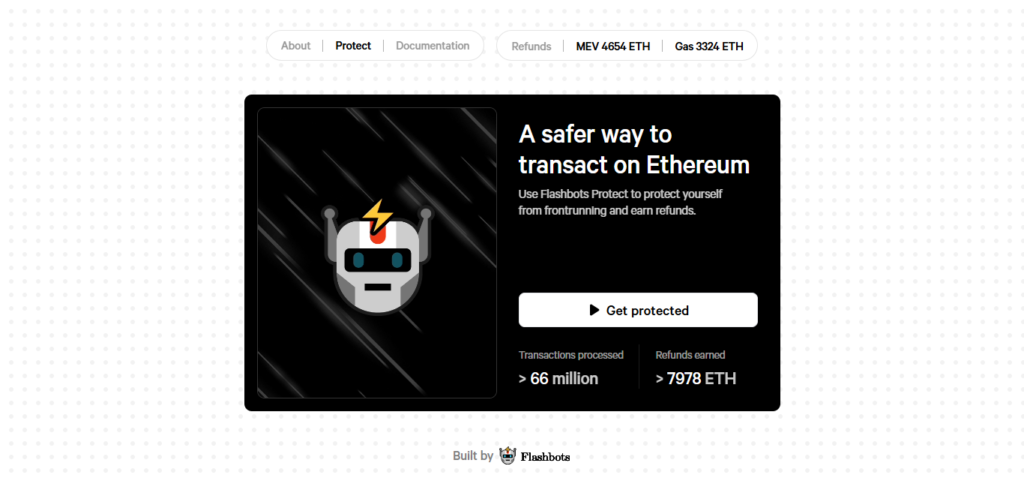
Liquidity/routing: Flashbots Protect is an RPC protection layer, not a swap aggregator. It does not aggregate DEX liquidity on its own, nor does it select swap routes. Front-running/sandwich protection: Private transaction submission stops bots from seeing transactions early enough to copy or sandwich them.
Protect can also offer MEV and gas refunds. Supported chains : The documented Protect RPC is primarily for Ethereum Mainnet, but we have a separate Sepolia endpoint for testing.
Flashbots RPC Security Features
- Avoids public mempool by submitting private transactions.
- Defends against common sandwich attacks on swaps.
- Supports MEV and gas refunds for qualifying transactions.
- Integrates with compatible wallets and decentralized applications
8. Shutter Network
MEV mechanism: Shutter applies threshold encryption and distributed key generation to conceal transaction information until block inclusion. Execution model: Transactions are encrypted at submission and are not readable until the right decryption conditions are met through Shutter’s decentralized Keyper network.
Liquidity/routing: Shutter is infrastructure and not a DEX aggregator. It doesn’t route swaps between liquidity pools or market makers.
Front-running/sandwich protection: Since transaction details are hidden during the critical mempool period, searchers cannot easily identify trades early enough to front-run, sandwich or back-run them maliciously.
Supported chains Shutter’s technology is designed to be blockchain infrastructure that can be integrated into compatible networks and applications, rather than a traditional multi-chain swap interface.
Shutter Network Features
- Uses threshold encryption to hide the details of the transaction.
- Distributed Keypers decrypts the transactions.
- Hides trades from searchers until after they’ve been executed.
- Built to prevent front-running and toxic MEV
9. KyberSwap
MEV mechanism: KyberSwap’s focus is on aggregation and execution optimization. Ethereum users can use MEV-protected RPC options such as Flashbots and MEV Blocker. Execution model: Its aggregator computes routes across connected decentralized exchanges and prepares transactions for execution.
Kyber Liquidity/RoutingAggregate liquidity across many DEXs and allow the user to customize which decentralized exchanges are considered when calculating routes. Front-running / Sandwich protection:
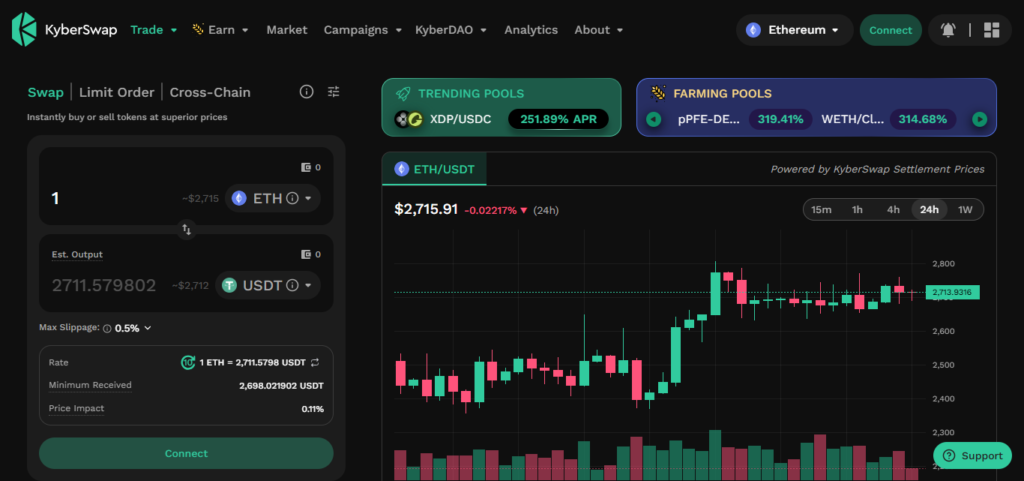
This protection is provided by MEV-protected RPCs through transaction ordering modifications and a reduction in the risk of malicious MEV strategies. Chains supported: KyberSwap is compatible with a wide range of networks such as Ethereum, Arbitrum, Avalanche, Base, BNB Chain, Cronos, Linea, Optimism, Polygon, Scroll, zkSync Era etc KyberSwap Support Center
KyberSwap Features
- Combines liquidity from multiple decentralized exchanges.
- Smart routing aims for efficient swaps
- Supports RPC configurations with MEV protection.
- Customizable DEX and routing preferences are offered.
10. Jupiter
MEV mechanism Jupiter is a Solana smart-order router (not batch-auction protocol like CoW), leveraging Solana’s transaction architecture and execution environment to optimize swaps. Execution model Users send swap instructions to Jupiter, who then bundles them into a single transaction that can be atomically executed on Solana according to the route chosen.
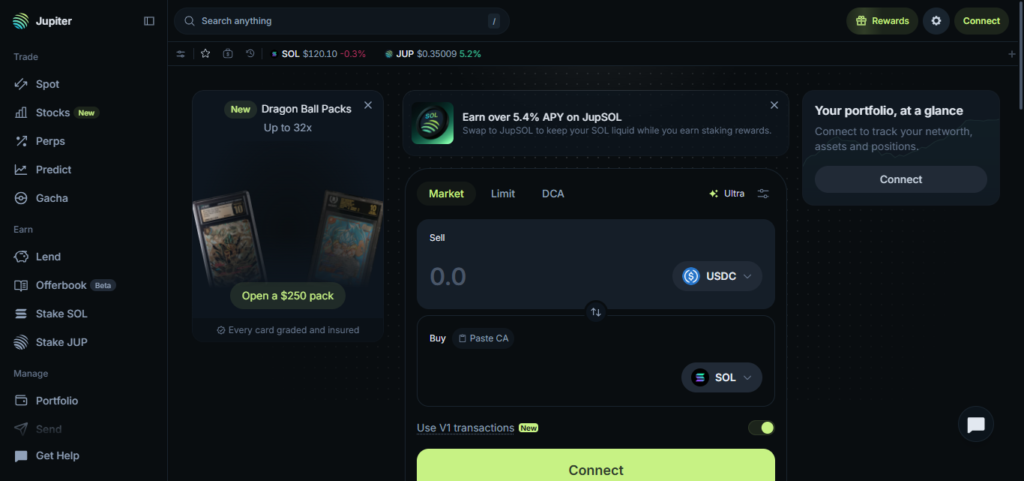
Liquidity/routing: Jupiter’s routing infrastructure scans numerous Solana liquidity venues and can split trades across multiple pools and paths to improve execution. Front-running/sandwich protection. Jupiter’s protection features differ from Ethereum private-mempool systems because of Solana’s different transaction architecture.
Traders should look at route execution and slippage controls rather than treating Jupiter as equivalent to CoW’s batch auctions. Supported chains: Jupiter is on Solana and not multi-chain EVM execution.
Jupiter Features
- Smart-order routing across Solana liquidity venues.
- Splits trades across multiple pools and routes.
- Provides slippage controls for improved execution.
- Built specifically for Solana-based decentralized trading.
Conclusion
To put it simply, the best CoW Swap alternatives for MEV protection to choose from will depend on your network of choice, execution model, liquidity access and security needs. There are several solutions to mitigate harmful MEV such as 1inch
UniswapX, Hashflow, Velora, MEV Blocker and Flashbots Protect. Traders can compare their protection mechanisms, routing methods and supported chains, to find the solution that better fits their DeFi trading strategy and execution needs.
FAQ
Leading alternatives include 1inch, UniswapX, Hashflow, Velora, MEV Blocker, Flashbots Protect, and Shutter Network.
1inch and UniswapX are strong choices because they use intent-based execution models.
Yes, 1inch Fusion uses intent-based execution and resolver competition to reduce harmful MEV exposure.
UniswapX uses competitive filler auctions, reducing direct exposure to traditional public-mempool execution.