


In this article, I will talk about the Best Sherlock Rivals for Smart Contract Exploit Coverage. Here we will talk about the leading blockchain security companies and platforms that help identify smart contract vulnerabilities and potential exploits.
I will evaluate their key features, audit methodologies, protocol coverage, strengths and weaknesses to help readers determine which solutions offer dependable security for Web3 projects.
Key Points & Best Sherlock Rivals for Smart Contract Exploit Coverage
| Company | Explanation |
|---|---|
| Code4rena | Competitive security audits leveraging independent researchers to uncover vulnerabilities through collaborative code reviews. |
| Cyfrin | Specialized smart contract security audits combining expert researchers, tooling, and practical exploit analysis. |
| Spearbit | Elite security researchers providing deep manual audits and sophisticated smart contract vulnerability detection. |
| Immunefi | Leading bug bounty platform incentivizing researchers to discover and responsibly disclose critical exploits. |
| CertiK | Blockchain security firm offering automated auditing, formal verification, and continuous security monitoring. |
| Trail of Bits | Advanced security consultancy delivering rigorous audits, exploit research, and cutting-edge vulnerability detection. |
| Guardian | Smart contract auditing specialists focused on identifying vulnerabilities and strengthening protocol security. |
| Halborn | Blockchain cybersecurity firm providing penetration testing, smart contract audits, and threat assessments. |
| BlockSec | Blockchain security company specializing in smart contract audits, attack detection, and incident response. |
| Quantstamp | Established blockchain security firm delivering smart contract audits and comprehensive protocol risk assessments. |
10 Best Sherlock Rivals for Smart Contract Exploit Coverage
1. Code4rena
Code4rena has historically been a strong competitor to Sherlock, with its community-driven competitive smart contract auditing model. It has a platform that connects independent security researchers called Wardens, who review project codebases and find vulnerabilities for sponsored rewards. Depending on the scope of each competition, coverage has included DeFi protocols, lending platforms, decentralized exchanges, bridges and other blockchain applications.

The unique strength is that it combines multiple independent reviewers, public findings, severity-based judging and competitive incentives to uncover bugs that traditional reviews may miss. Code4rena’s website currently says that the platform is winding down and closing its doors, so its current availability is subject to verification.
Pros & Cons Code4rena
Pros
- Crowdsourced contests put hundreds of wardens on one codebase, so coverage is wide.
- Time-boxed contests (usually 3 to 14 days) make turnaround fast.
- Payouts are tied to valid findings, so you pay for results.
- Public reports and a transparent leaderboard make quality easy to judge.
Cons
- Results depend on who joins, so findings quality is not guaranteed.
- Many duplicate and low-severity submissions create noise to triage.
- Wardens have little context on your protocol, so complex logic can be missed.
- Contests are short and one-off, with no ongoing relationship or retesting.
Code4rena Feature
| Feature | Details |
|---|---|
| Competitive Audits | Uses independent security researchers called Wardens to identify smart contract vulnerabilities through competitive audits. |
| Vulnerability Detection | Researchers investigate critical bugs, logic errors, access-control issues, and potential exploit paths. |
| Protocol Coverage | Has covered DeFi, lending, DEXs, cross-chain projects, and blockchain applications. |
| Unique Strength | Combines independent researchers, competitive rewards, public findings, and severity-based judging. |
2. Cyfrin
Cyfrin is a Web3 security company providing professional smart contract audits, blockchain security assessments, and competitive vulnerability discovery via its CodeHawks platform. It contains protocol for DeFi applications, lending and staking systems, token contracts, decentralized exchanges and blockchain infrastructure on several supported networks.
Cyfrin’s researchers assess contract logic, control of access, upgrade procedures, tokenomics, and integration risks through manual reviews, fuzz testing and proof-of-concept exploit testing. The unique combination of experienced security researchers and developer-focused tooling, including Aderyn
A Solidity static analyzer, and Solodit, a vulnerability research database. The combination supports pre-deployment auditing and continuous security improvement for evolving blockchain protocols.
Pros & Cons Cyfrin
Pros
- Its auditors are strong on Solidity and DeFi, with a good reputation for quality.
- It offers private audits plus the CodeHawks competitive audit platform.
- Open-source tooling such as Aderyn (a static analyzer) supports its work.
- Its education arm (Updraft) builds trust and a talent pipeline.
Cons
- It is a younger firm, with a shorter track record than veterans like Trail of Bits.
- Mostly focused on EVM/Solidity, with less coverage of other ecosystems.
- Quality private audit slots can have waiting lists.
- Premium pricing comes without the brand recognition of larger firms.
Cyfrin Feature
| Feature | Details |
|---|---|
| Smart Contract Audits | Provides professional security audits, manual code reviews, and vulnerability assessments. |
| Security Tools | Offers Aderyn for Solidity static analysis and Solodit for vulnerability research. |
| Protocol Coverage | Supports Ethereum, Arbitrum, Base, Optimism, Polygon, Solana, Sui, Avalanche, and other networks. |
| Unique Strength | Combines competitive audits through CodeHawks, professional auditing, security tools, and developer education. |
3. Spearbit
Spearbit is part of the Cantina security ecosystem, offering specialized smart contract auditing through its network of experienced independent blockchain security researchers. Depending on the engagement assigned, its coverage ranges from DeFi protocols, decentralized exchanges, lending markets and cross-chain infrastructure to cryptographic systems and complex blockchain applications.
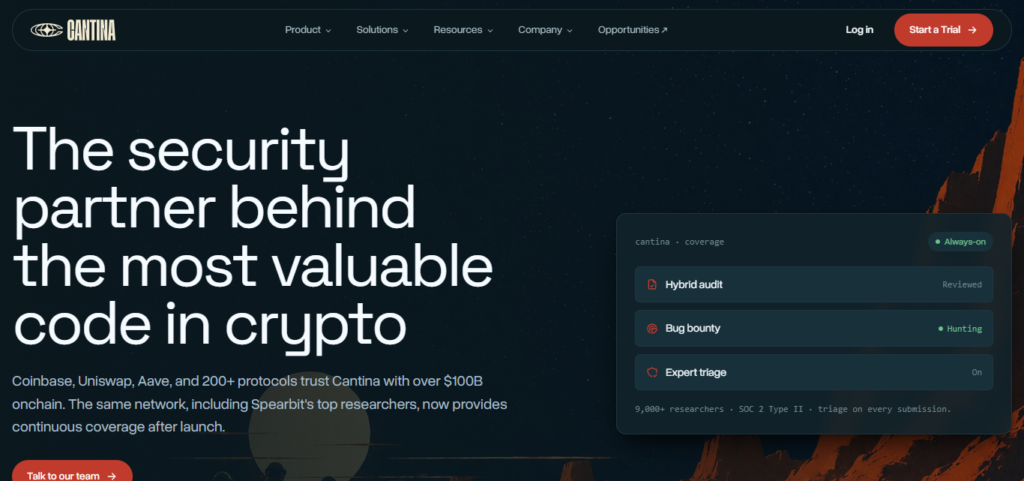
Researchers also perform extensive manual code reviews for flaws in business logic, weaknesses in access control, vectors for economic attacks, protocol integrations and mistakes in implementation. Its unique strength is that it matches specialized researchers to projects that need particular technical expertise,
rather than relying only on generalized automated scanning. This approach, led by researchers, helps uncover sophisticated vulnerabilities, especially in complex DeFi architectures, financial mechanisms and new blockchain technologies.
Pros & Cons Spearbit
Pros
- It curates a network of elite independent security researchers.
- Auditors are matched to your project’s tech, which gives deep expertise.
- It has audited major protocols, which adds credibility.
- Its Cantina marketplace adds flexible options, including contests and bounties.
Cons
- Pricing is at the high end, which may not suit early-stage teams.
- Team composition varies by engagement, so quality depends on who is assigned.
- Scheduling is hard because top researchers are in demand.
- Distributed independent researchers can make coordination less seamless than one in-house team.
Spearbit Feature
| Feature | Details |
|---|---|
| Expert Security Audits | Provides specialized smart contract reviews through experienced independent security researchers. |
| Vulnerability Detection | Examines contract logic, economic attacks, access controls, and complex protocol vulnerabilities. |
| Protocol Coverage | Relevant to DeFi, lending, decentralized exchanges, cryptography, and cross-chain infrastructure. |
| Unique Strength | Researcher-led auditing matches specialized security expertise with technically complex projects. |
4. Immunefi
Immunefi is a Web3 security platform specializing in bug bounty programs, audit competitions, and ongoing vulnerability finding for blockchain protocols. It covers DeFi apps, crypto exchanges, bridges, wallets, Layer 1 and Layer 2 ecosystems, and other on-chain infrastructure that takes part in its security programs.
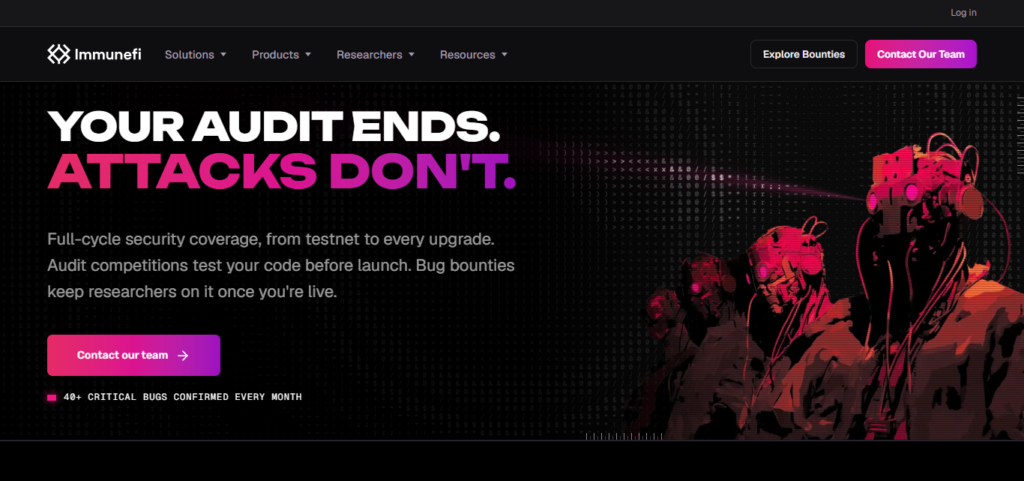
Rather than rely on planned audits, Immunefi connects protocols to a large network of independent security researchers who look for vulnerabilities and report confirmed finds responsibly. Its unique strength lies in offering sustained security incentives via monetary rewards, severity-based bounty programs, and coordinated vulnerability disclosure.
Projects can use this method to identify vulnerabilities that can be exploited both before and after deployment, in addition to traditional smart contract audit services.
Pros & Cons Immunefi
Pros
- It is the largest bug bounty platform in web3, with a big researcher community.
- Continuous coverage catches issues that appear after launch, including upgrades.
- Rewards are paid only for valid vulnerabilities, so the model is cost-efficient.
- It offers triage, mediation and a standardized severity system.
Cons
- It is not a full audit: bounties are no substitute for a pre-launch review.
- Large critical bounties are needed to attract top researchers.
- Triage and dispute handling can cause friction over severity and payouts.
- It does not guarantee a bug will be found before an attacker finds it.
Immunefi Feature
| Feature | Details |
|---|---|
| Bug Bounty Programs | Connects blockchain projects with independent researchers through financial vulnerability rewards. |
| Exploit Detection | Encourages researchers to discover and responsibly report security vulnerabilities. |
| Protocol Coverage | Supports DeFi, bridges, wallets, exchanges, blockchain networks, and Web3 applications. |
| Unique Strength | Provides continuous vulnerability discovery through incentivized security research and bounty programs. |
5. CertiK
CertiK is a blockchain security company that offers smart contract auditing, formal verification, security assessments, and ongoing monitoring solutions for Web3 projects. It covers DeFi platforms, decentralized exchanges, token systems, NFT applications, blockchain networks and other decentralized finance infrastructure.
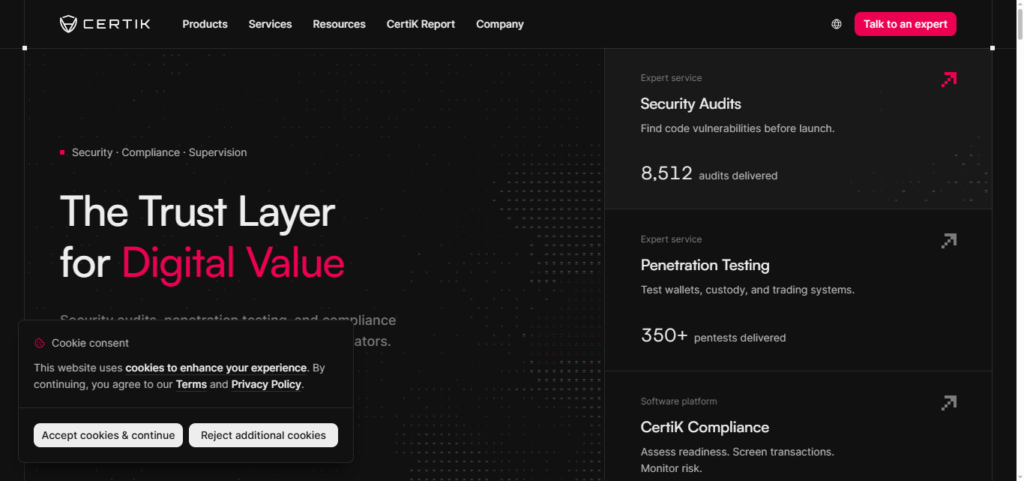
Its auditing methodology uses expert code reviews, automated security analysis, mathematical verification techniques and comprehensive vulnerability reporting to assess contract correctness. CertK’s unique advantage is the integration of formal verification with a comprehensive suite of blockchain security services to help developers identify critical logic errors and weaknesses in contract execution.
Its Skynet platform also offers continuous security monitoring and project risk insights, providing protection beyond individual pre-deployment audits.
Pros & Cons CertiK
Pros
- It is one of the largest and best-known firms, with a huge audit volume.
- It offers a broad service range, including formal verification, penetration testing and monitoring.
- Its brand recognition and Skynet score are valued by exchanges and investors.
- It supports many chains and languages.
Cons
- Its large volume has drawn criticism over inconsistent audit depth.
- Some audited projects were later hacked, which hurt credibility.
- The brand is sometimes seen as marketing-driven rather than purely technical.
- Pricing and add-ons can be expensive for smaller teams.
CertiK Feature
| Feature | Details |
|---|---|
| Smart Contract Audits | Conducts manual code reviews, automated analysis, and comprehensive security assessments. |
| Formal Verification | Uses mathematical verification techniques to evaluate smart contract functionality and correctness. |
| Protocol Coverage | Covers Ethereum, BNB Chain, Polygon, DeFi platforms, NFTs, and other blockchain ecosystems. |
| Unique Strength | Combines expert auditing, AI-powered analysis, formal verification, and Skynet security monitoring. |
6. Trail of Bits
Trail of Bits is a cybersecurity research and consulting company, specializing in advanced blockchain security assessments, smart contract audits and vulnerability research. It supports protocols for DeFi apps, blockchains, bridges, consensus, cryptography, and zero knowledge proofs.
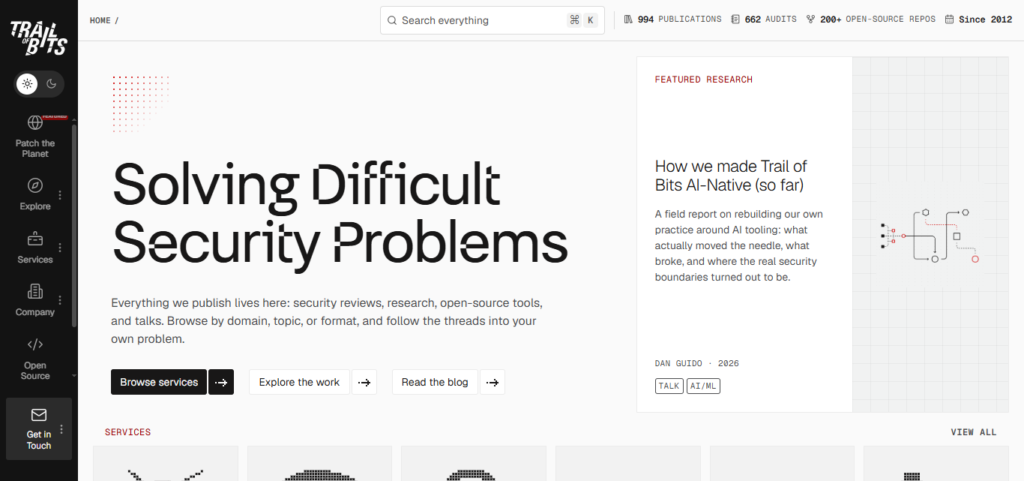
Its researchers analyze contract execution, protocol architecture, cryptographic assumptions, control of access, and complex attack scenarios using manual analysis and advanced testing methodologies. Its unique strength is the development and maintenance of widely used open source security tools, including
Slither for static analysis, Echidna for property-based fuzzing and Medusa for smart contract testing. These research-based capabilities are particularly valuable for technically complex blockchain systems.
Pros & Cons Trail of Bits
Pros
- It has deep, research-driven expertise and is highly respected in security.
- It built widely used open-source tools like Slither and Echidna.
- It does thorough manual review and also covers cryptography and infrastructure.
- It publishes detailed reports and security research.
Cons
- Cost is among the highest in the industry.
- Scheduling waits can be long because of high demand.
- Engagements can be heavier than a fast-moving startup needs.
- It is less web3-native in culture than some crypto-first firms.
Trail of Bits Feature
| Feature | Details |
|---|---|
| Security Audits | Provides advanced blockchain security reviews, smart contract assessments, and cryptographic research. |
| Vulnerability Detection | Uses static analysis, fuzzing, symbolic execution, and manual security research. |
| Protocol Coverage | Covers smart contracts, blockchain nodes, bridges, Solidity, Vyper, and zero-knowledge systems. |
| Unique Strength | Develops open-source tools including Slither, Echidna, and Medusa for advanced security testing. |
7. Guardian
Guardian is a blockchain security company that conducts smart contract audits, penetration testing and exploit-focused protocol audits. Protocol coverage includes DeFi applications, lending platforms, decentralized exchanges, financial infrastructure and other on-chain systems on supported blockchain networks.
The auditing methodology includes architectural reviews, threat modeling, invariant testing, fuzzing and manual security research to uncover weaknesses in protocol logic, accounting, governance, permissions and upgrade mechanisms.

What sets it apart is the mix of independent manual researchers, AI-assisted security analysis and invariant fuzzing in a multi-layered audit process. This allows for the detection of complex vulnerabilities such as economic exploits, integration shortcomings and unexpected execution paths that might be missed in a typical code review.
Pros & Cons Guardian
Pros
- It is a newer, crypto-native team with strong DeFi and Solidity focus.
- It offers a mix of private audits and competitive audits.
- Its hands-on approach often includes invariant and fuzz testing.
- It tends to be agile, so engagement and communication are quick.
Cons
- It has a shorter track record than established firms.
- Smaller team capacity can limit how many audits it takes on.
- Brand recognition with investors and exchanges is lower.
- Ecosystem coverage beyond EVM is limited.
Guardian Feature
| Feature | Details |
|---|---|
| Smart Contract Audits | Reviews protocol architecture, contract logic, permissions, governance, and upgrade mechanisms. |
| Invariant Fuzzing | Builds reusable testing suites covering accounting, solvency, rounding, and critical protocol properties. |
| Protocol Coverage | Supports multiple blockchain networks, smart contract languages, and on-chain applications. |
| Unique Strength | Combines expert manual auditing, AI-driven analysis, and exhaustive invariant fuzzing in parallel. |
8. Halborn
Halborn is a cybersecurity blockchain firm that provides smart contract audits, penetration testing, security assessments, and protection of blockchain infrastructure. Besides DeFi apps, wallets and digital asset platforms, its protocol support includes Ethereum, Solana, Cosmos, Avalanche, Sui, Stellar and other blockchain ecosystems.
Its security researchers manually review code, investigate contract logic, assess privileged functions and test potential exploitation scenarios to locate vulnerabilities before attackers can exploit them. Its unique strength is the combination of specialized blockchain expertise with offensive security capabilities
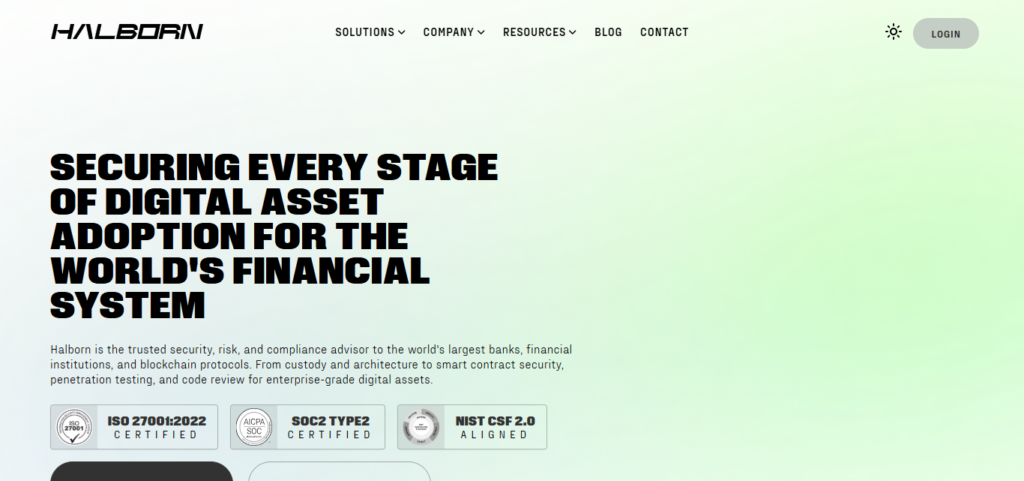
like penetration testing and broader infrastructure assessments. That makes Halborn a good alternative to Sherlock for projects that want more in-depth security reviews than just the smart contract code.
Pros & Cons Halborn
Pros
- It covers a wide range of services: smart contracts, penetration testing and red teaming.
- It has a large client base across many blockchains.
- It offers offensive security and infrastructure testing, not just code review.
- It provides remediation support and retesting.
Cons
- Report depth can vary between engagements.
- Its broad scope can mean less specialization in niche DeFi logic.
- Less research and tooling reputation than Trail of Bits.
- Pricing can be high for full-stack engagements.
Halborn Feature
| Feature | Details |
|---|---|
| Security Audits | Provides smart contract assessments, manual code reviews, and blockchain security evaluations. |
| Penetration Testing | Simulates real-world attacks to identify weaknesses across applications and blockchain infrastructure. |
| Protocol Coverage | Supports Ethereum, Solana, Cosmos, Avalanche, Sui, Stellar, and other blockchain ecosystems. |
| Unique Strength | Combines experienced blockchain security researchers with offensive security and penetration testing expertise. |
9. BlockSec
BlockSec is a full-stack blockchain security company. We provide smart contract audits, attack monitoring, incident investigation and automated threat prevention. Its protocol coverage includes DeFi applications, decentralized exchanges, lending protocols, blockchain networks, wallets, Layer 1 and Layer 2 infrastructure and cross-chain systems.

Its security audits cover contract architecture, business logic, economic models, tokenomics, permissions, governance, upgradeability and external integrations. Its unique strength is in the combination of pre-deployment auditing and Phalcon Security that provides real-time threat detection
Alerts, transaction analysis and automated attack-blocking capabilities. This dual approach allows for pre-launch vulnerability prevention and active defense against suspicious transactions and exploitation attempts post-deployment.
Pros & Cons BlockSec
Pros
- It has strong expertise in attack analysis and incident response.
- Its Phalcon platform provides real-time attack monitoring and transaction analysis.
- It offers MetaSleuth for fund tracing and on-chain forensics.
- It has solid experience with DeFi exploits and an active security research output.
Cons
- Brand awareness in Western markets is lower than for some competitors.
- Its focus on monitoring and response may mean less visibility as a pure auditor.
- Smaller scale can limit availability for large audits.
- Less established with institutional clients.
BlockSec Feature
| Feature | Details |
|---|---|
| Security Audits | Provides smart contract, Layer 1, Layer 2, and wallet security assessments. |
| Attack Detection | Uses Phalcon Security for real-time monitoring, suspicious transaction alerts, and automated blocking. |
| Protocol Coverage | Supports DeFi protocols, blockchain infrastructure, wallets, and cross-chain applications. |
| Unique Strength | Combines pre-deployment security auditing with post-deployment exploit monitoring and attack prevention. |
10. Quantstamp
Quantstamp is a leading blockchain security company that provides smart contract audits, security assessment, formal verification & protocol risk analysis. It covers the protocol on Ethereum, Solana, Polygon, Avalanche, Arbitrum, Binance Smart Chain, Aptos, Sui and other supported blockchains.
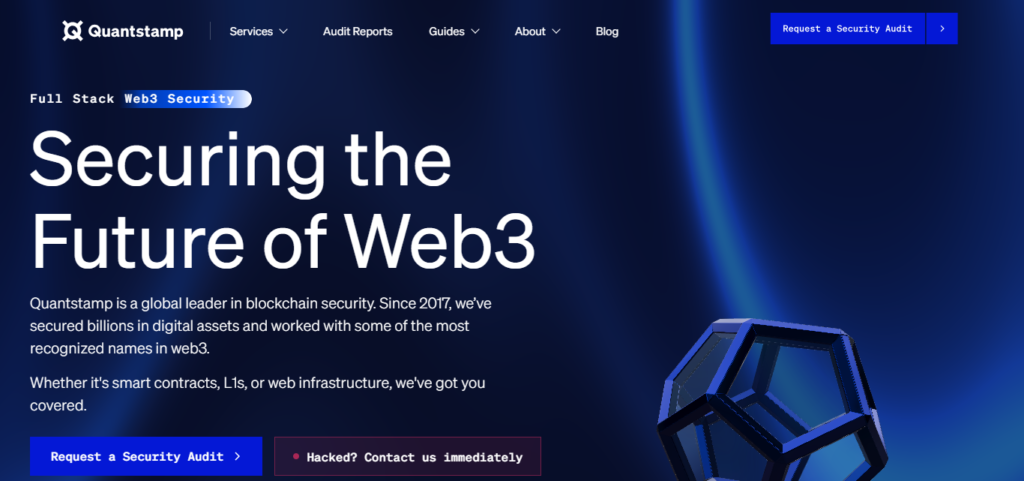
Its researchers are looking at DeFi protocols, NFT marketplaces, exchanges, Layer 1 and Layer 2 infrastructure, and decentralized applications to find implementation defects and security vulnerabilities.
Its unique strengths are its blockchain-agnostic auditing experience, wide programming-language support, and the combination of formal verification, static analysis and manual security reviews. With these capabilities, Quantstamp becomes a viable alternative for projects that need security assessments for several networks and complicated protocol architectures.
Pros & Cons Quantstamp
Pros
- It is one of the earliest web3 audit firms, with a long history since 2017.
- It has audited many well-known protocols and has a large report archive.
- It offers audits across multiple chains and languages.
- Its established reputation gives it credibility with investors.
Cons
- It has a lower public profile than newer, more active competitors.
- Audit quality has been questioned by some for past engagements.
- Newer firms are seen as moving faster on emerging DeFi risks.
- Pricing and turnaround may not be competitive for smaller teams.
Quantstamp Feature
| Feature | Details |
|---|---|
| Smart Contract Audits | Provides professional smart contract reviews and blockchain protocol security assessments. |
| Formal Verification | Applies mathematical verification to evaluate contract behavior and critical security properties. |
| Protocol Coverage | Supports Ethereum, Polygon, Avalanche, Solana, and other blockchain ecosystems. |
| Unique Strength | Combines manual security reviews, formal verification, and continuous assurance for evolving protocols. |
Conclusion
Conclusion Selecting the right Sherlock Rivals for smart contract exploit coverage is a function of the project’s requirements, security budgets and audit needs. Cyfrin, Spearbit, Immunefi, CertiK and Trail of Bits are platforms offering various security solutions.
By comparing their features, protocol coverage, auditing methodologies, pros and cons, blockchain projects can pick out suitable security partners to enhance smart contract security and prevent potential exploit risks.
FAQ
Cyfrin through CodeHawks offers competitive audits, while Code4rena historically provided crowdsourced security competitions.
Immunefi provides bug bounty programs that incentivize researchers to discover and responsibly report vulnerabilities.
Trail of Bits specializes in advanced security research, cryptographic assessments, and smart contract testing tools.
CertiK and Quantstamp offer formal verification capabilities to evaluate contract behavior against defined security properties.