

In this article I will discuss the Best Direct Wallet Connectivity Cards such as Oobit. Specifically, I will talk about cards that connect crypto wallets to everyday payments.
I’ll break down their wallet compatibility, the cryptocurrencies they support, how you can spend and convert them, fees, availability, transaction limits, security features and rewards. This comparison will help users to find the suitable wallet-connected cards for easy and flexible crypto spending.
Key Points & Best Direct Wallet Connectivity Cards like Oobit
| Best Direct Wallet Connectivity Cards | dExplanation |
|---|---|
| MetaMask Card | Connects MetaMask directly, enabling users to spend crypto through convenient card payments. |
| Oppi Wallet Card | Links Oppi Wallet directly, supporting convenient crypto spending through an integrated card. |
| Gnosis Pay Card | Connects Gnosis Pay with self-custody wallets, enabling seamless crypto-backed everyday payments worldwide. |
| Ether.fi Cash (Ether.fi Card) | Connects Ether.fi wallet balances, allowing users to spend crypto through Cash card. |
| Ledger Spend Card | Links Ledger wallets with spending functionality, combining hardware security and everyday payments. |
| Coinbase Card | Connects Coinbase accounts directly, allowing users to spend crypto using Coinbase Card. |
| Crypto.com Visa Card | Links Crypto.com Wallet and account balances, enabling convenient crypto spending through Visa. |
| Bybit Card | Connects Bybit accounts, allowing users to spend crypto directly through their card. |
| Nexo Card | Links Nexo accounts with card spending, enabling flexible crypto-backed purchases and payments. |
| Zypto Premium Visa Card | Connects Zypto wallet services, enabling users to spend crypto through Premium Visa payments. |
10 Best Direct Wallet Connectivity Cards like Oobit
1. MetaMask Card
The MetaMask Card communicates directly with MetaMask via supported networks like Linea, Base, Monad, and Solana, giving control to the user until the payment is made. Supported spend assets are mUSD, wETH, EURe, GBPe, USDC and USDT. Crypto is converted to local currency at checkout without needing a centralized exchange.
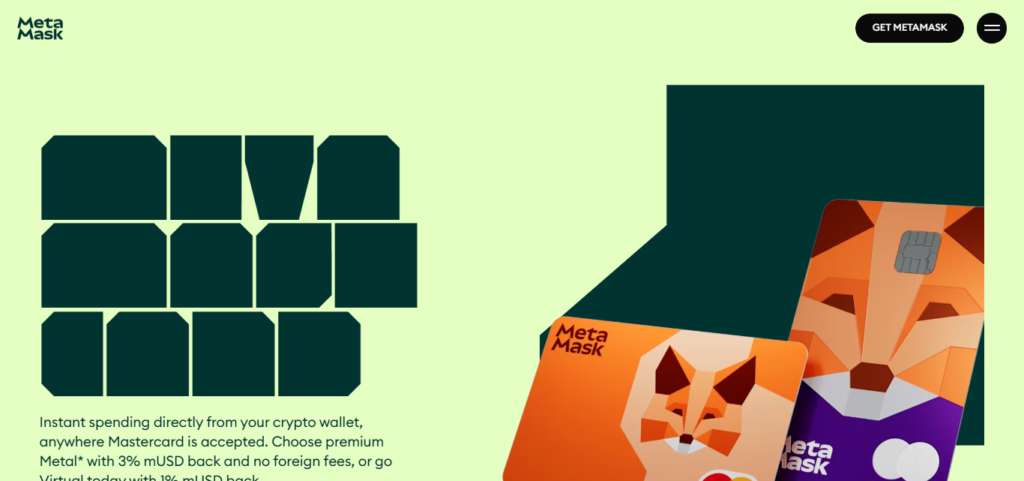
The Virtual Card has no annual or maintenance fee, while the Metal version costs $199 annually. It’s currently available in select countries in Europe, Latin America and elsewhere, with sign-ups for the U.S. and U.K temporarily suspended. Virtual has daily spending limits of $15,000, while Metal has daily spending limits of $30,000. Rewards of 3% or 1% mUSD.
MetaMask Card Pros & Cons
| Pros | Cons |
|---|---|
| Directly connects with the MetaMask wallet for convenient crypto spending | Availability is currently restricted to selected countries and regions |
| Supports spending from eligible self-custody wallet assets | Not every cryptocurrency in MetaMask can be used for card payments |
| Offers crypto cashback rewards on eligible purchases | Reward rates and eligible assets can vary by program |
| Provides virtual and physical card options | Metal card has a relatively high annual fee |
| Designed to preserve wallet-based control before transactions | Network and asset eligibility can limit direct spending |
2. Oppi Wallet Card
The Oppi Wallet Card integrates with Oppi’s self-custody wallet, meaning users hold their private keys until they decide to fund the card. We support Bitcoin, Ethereum, USDT, USDC and 40+ other cryptocurrencies on networks including Ethereum, Polygon, Solana, TRON and BNB Chain. On top-up, crypto is converted into a spendable card balance, and on purchase, the transaction is settled in local currency.
To activate the virtual card, you pay $10, $5 of which goes back to your balance. There are no monthly fees. There is a 2%-2.5% FX charge on foreign currency purchases. Available in 210+ countries (eligibility applies). Rewards include Oppi Points on purchases.
Oppi Wallet Card Pros & Cons
| Pros | Cons |
|---|---|
| Connects directly with Oppi’s self-custody wallet | Availability and eligibility can vary by jurisdiction |
| Supports multiple cryptocurrencies and blockchain networks | Crypto conversion and foreign-exchange fees can increase costs |
| Available for spending across a broad range of countries | Some features may depend on regional availability |
| Provides virtual card functionality for online payments | Physical-card availability may differ from virtual-card access |
| Rewards users through Oppi Points on eligible transactions | Rewards are not necessarily equivalent to direct cashback |
3. Gnosis Pay Card
The Gnosis Pay Card is built for self-custody, allowing users to connect their wallet to everyday Visa spending without relying on traditional exchange custody. Its spending model relies heavily on supported stablecoins like EURe, with purchases paid out at 1:1 value for eligible transactions.
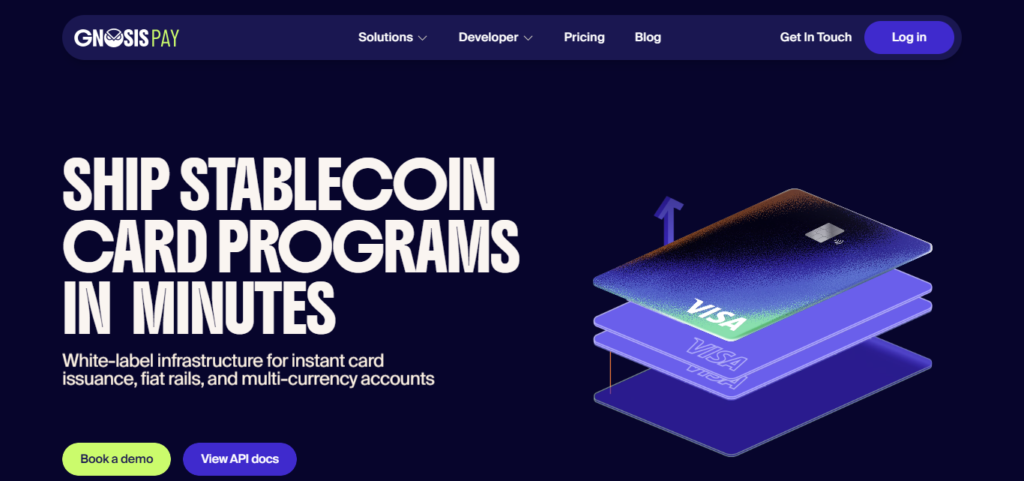
There are no transaction fees on card purchases, Gnosis Pay says, and in the case of foreign-currency transactions, Visa’s exchange rate applies with no extra Gnosis Pay FX fee. Currently available in select European and Latin American countries, with more to come. Geographic access varies.
Please check current eligibility before applying. The card rules and the user account determine the limits on spending, withdrawal and other transactions. The main advantage is wallet-based spending not traditional custodial funding
Gnosis Pay Card Pros & Cons
| Pros | Cons |
|---|---|
| Provides a strong self-custody wallet connectivity model | Supported assets are more limited than general crypto wallets |
| Enables direct spending without traditional exchange custody | Stablecoin-focused spending may not suit every crypto user |
| Uses Visa infrastructure for everyday payments | Availability remains restricted to supported countries |
| Designed for direct on-chain settlement and wallet-based payments | Users may need compatible wallets and networks |
| No additional Gnosis Pay transaction fee on eligible purchases | Limits and supported features can vary by region |
4. Ether.fi Cash Card
ether.fi’s Cash Card links spending to eligible assets held in an ether.fi Vault. In Direct Pay mode, USDC and LiquidUSD are automatically deducted from the Vault, but other assets are not eligible for this spending mode at this time.
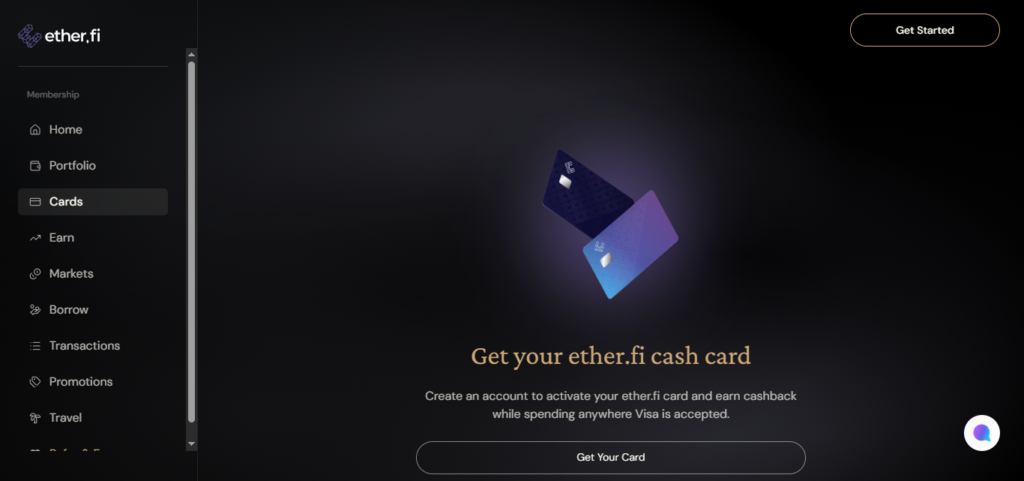
Transactions are settled in the local currency required at the point of sale. Standard transaction fees apply. For foreign currency transactions an FX base rate of approx. 1% is applied, plus a margin depending on the user’s tier. The default daily card spend limit is $5,000. ATM withdrawals are limited to $1,000 per transaction and $5,000 over five withdrawals in any rolling 24-hour period.
Ether.fi Cash Card Pros & Cons
| Pros | Cons |
|---|---|
| Connects eligible assets with ether.fi Vault-based spending | Direct Pay supports only selected assets |
| Allows eligible USDC and LiquidUSD balances to fund purchases | Users may need to understand ether.fi Vault functionality |
| Offers both spending and crypto-backed financial functionality | Fees can vary according to transaction type and user tier |
| Provides substantial daily card and ATM limits | Availability depends on supported markets |
| Integrates spending into the broader ether.fi ecosystem | Not all crypto assets can be spent directly from the Vault |
5. Ledger Spend Card
Powered by Mercuryo, Ledger Spend Card links to Ledger via Ledger Live and allows users to load the card with crypto from a Ledger hardware wallet. Once funded, the crypto is converted to fiat and added to the card balance for you to spend. The card is a Mastercard, and can be used for online and in-store purchases, including Apple Pay and Google Pay. It is now available for eligible EEA residents.
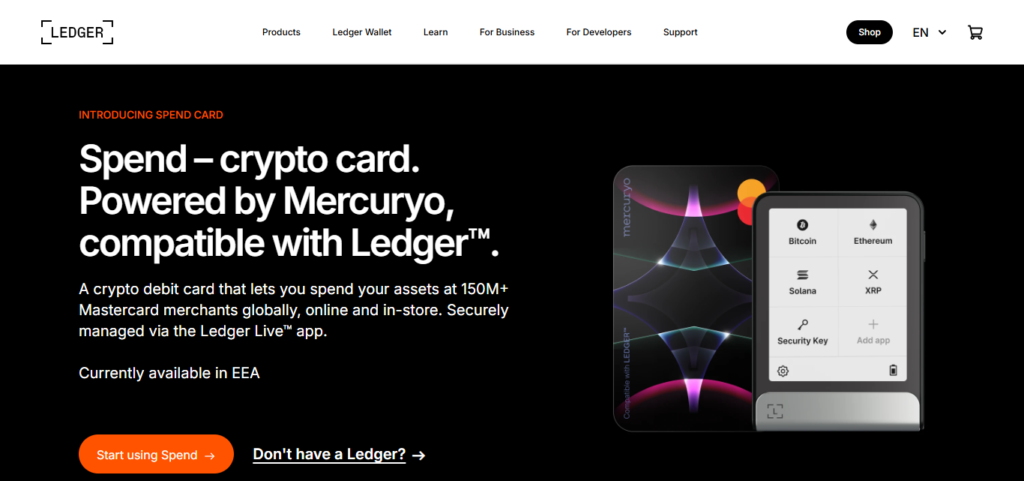
The card has limits of €5,000 per transaction, €10,000 per day and €40,000 per month, with higher limits available after further due diligence. Cards used regularly are free of charge under the stated fair use policy, maintenance fees might be applied after long periods of inactivity
Ledger Spend Card Pros & Cons
| Pros | Cons |
|---|---|
| Connects with Ledger hardware wallets through Ledger Live | Availability is primarily focused on eligible EEA users |
| Combines hardware-wallet security with everyday card spending | Requires Ledger hardware and compatible Ledger Live setup |
| Supports Mastercard payments for online and physical purchases | Crypto must generally be converted before spending |
| Offers Apple Pay and Google Pay compatibility | Fees can apply under inactivity or specific usage conditions |
| Provides relatively high transaction and monthly spending limits | Not every Ledger-supported asset is necessarily spendable |
6. Coinbase Card
The Coinbase Card links spending to a user’s Coinbase account, rather than offering direct self-custody wallet spending. Users can select the crypto or local currency they wish to use to make payment, with the cryptocurrency being converted as necessary to complete the purchase. There are no transaction fees for spending local currency, USDC, or supported crypto, but crypto conversion includes a spread and applicable taxes may apply.
There is no Coinbase fee on ATM withdrawals, however, ATM operators may charge separately. Spending and ATM withdrawal limits vary by customer and are available in the Coinbase account. Availability varies by country, some jurisdictions are restricted. The available cryptocurrency reward offers change monthly and expire, and users can choose them
Coinbase Card Pros & Cons
| Pros | Cons |
|---|---|
| Conveniently connects card spending with Coinbase balances | It is custodial rather than a direct self-custody wallet card |
| Supports crypto and local-currency payment sources | Crypto conversion includes a spread |
| No Coinbase transaction fee for certain eligible spending sources | ATM operators can still charge their own fees |
| Offers rotating crypto reward options | Rewards and eligible assets can change over time |
| Simple integration for existing Coinbase users | Availability and features depend on the user’s country |
7. Crypto.com Visa Card
The Crypto.com Visa Card connects spending with balances managed through the Crypto.com ecosystem rather than operating as a purely self-custodial wallet card. Supported funding and conversion options vary by region, so users should check the applicable local program before applying.
The card offers multiple tiers, with current U.S. limits showing aggregated top-ups of up to $25,000 monthly and ATM withdrawal caps reaching $10,000 monthly on higher tiers. Free ATM allowances range from $200 to $1,000 monthly depending on the tier.
Current rewards can reach 5% in CRO for qualifying everyday spending under the card program, while newer Level Up structures also introduce Bitcoin rewards in certain markets.
Crypto.com Visa Card Pros & Cons
| Pros | Cons |
|---|---|
| Integrates smoothly with the Crypto.com ecosystem | Requires users to operate within the Crypto.com ecosystem |
| Offers multiple card tiers for different spending levels | Higher-tier benefits may require greater platform commitment |
| Provides CRO rewards on qualifying purchases | Reward rates and conditions vary by card tier and market |
| Includes ATM withdrawal allowances | Free ATM limits depend on the selected tier |
| Widely recognized Visa acceptance supports everyday spending | Regional rules, fees, and availability can differ significantly |
8. Bybit Card
The Bybit Card connects spending with assets in the Bybit ecosystem, allowing users to convert crypto to fiat for everyday spending. Mastercard and Visa versions vary by market according to jurisdiction. Card type and payment network varies by market.
Current regional fee schedules indicate that crypto conversion fees can vary across different regions, with examples including 0.9% in Australia and select Asia Pacific markets. International or FX charges also depend on location. ATM fees may apply before regional free-withdrawal allowances.
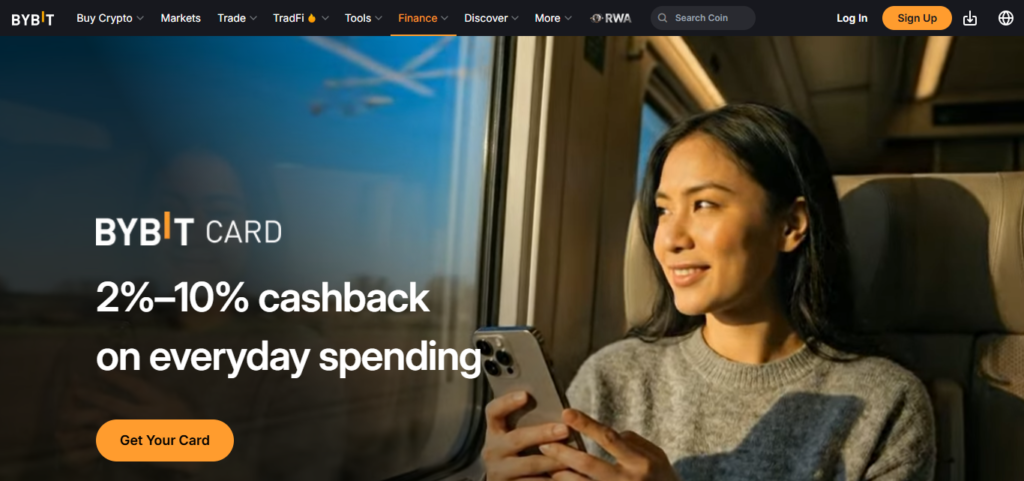
Availability in selected markets across Europe, the UK, UAE and other regions. Eligibility varies by country. Spending limits and fees vary by region, so users should consult their local schedule before applying. Rewards through Bybit’s card loyalty program and partner offers are on offer
Bybit Card Pros & Cons
| Pros | Cons |
|---|---|
| Connects spending with assets available through Bybit | Primarily suited to users already using the Bybit ecosystem |
| Supports crypto-to-fiat conversion for card transactions | Conversion and foreign-exchange fees may apply |
| Available in several international markets | Availability varies significantly by country |
| Offers rewards and promotional benefits for eligible users | Reward conditions can change over time |
| Supports everyday online and physical card payments | Spending and withdrawal limits depend on regional rules |
9. Nexo Card
The Nexo Card connects your spending to the Nexo platform and provides both a virtual and physical card. With the card available to eligible customers in select European markets, including the EEA and UK, it allows for crypto-backed spending through Nexo’s ecosystem.
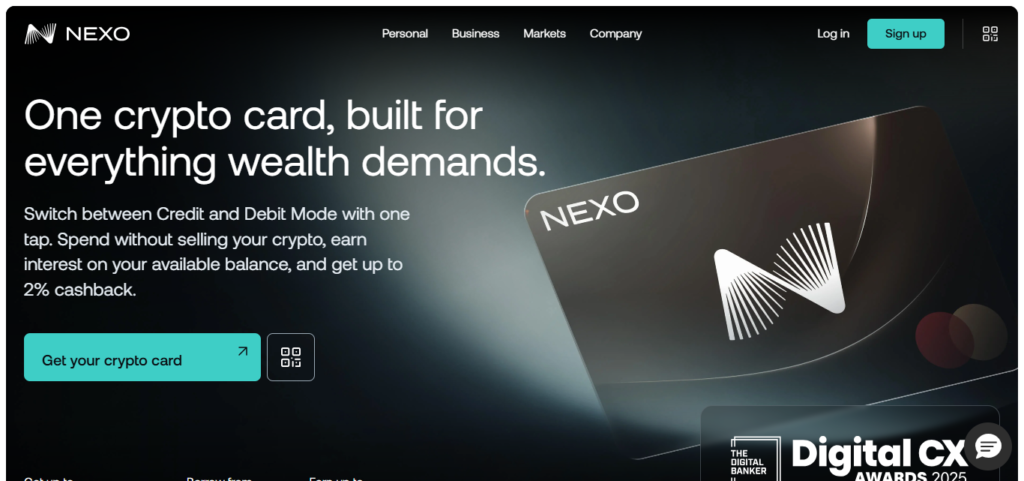
ATM allowances are based on the user’s Loyalty Tier: Base users can withdraw up to €200 or £180 free each month, and Platinum users up to €2,000 or £1,800. The minimum stated is after the free allowance and a 2% fee. FX fees are also regionally and weekday/weekend dependent. Rewards are tier-based and the historical program structures offer rewards in NEXO tokens or BTC depending on the Loyalty Tier.
Nexo Card Pros & Cons
| Pros | Cons |
|---|---|
| Connects card functionality directly with the Nexo ecosystem | Availability is concentrated in eligible European markets |
| Supports crypto-backed spending without necessarily selling assets | Users must understand Nexo’s credit-based spending model |
| Provides both virtual and physical card options | Borrowing-related costs can make spending more expensive |
| Offers loyalty-tier-based rewards and benefits | Better benefits generally require higher loyalty levels |
| Provides free monthly ATM allowances based on loyalty tier | Fees apply after exceeding the free withdrawal allowance |
10. Zypto Premium Visa Card
The Zypto Premium Visa Card bridges the gap between crypto spending via the Zypto app and is available as a virtual and physical card. You can manage the cards within the app and supported crypto funding is converted for Visa spend.
Premium cards have no monthly fee, but current pricing lists a $0.30 transaction fee, 1.75% foreign exchange fee and 3% crypto off-ramp fee. The physical Premium card costs $50 (including activation and shipping) and the virtual card is free to set up.
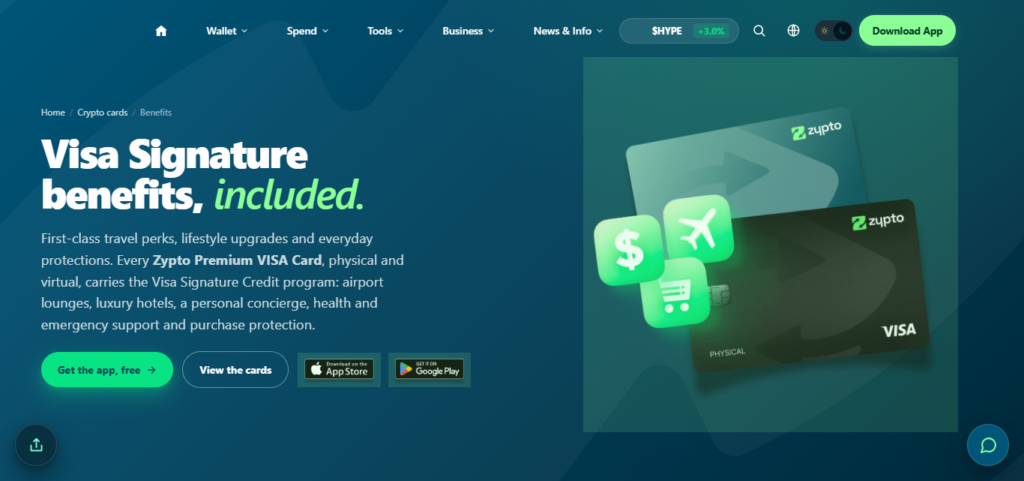
Premium cards are available in many countries such as the UAE, and are subject to jurisdictional restrictions. Both versions come with Apple Pay, Google Pay, Samsung Pay, 3D Secure and in-app freeze/unfreeze controls.
Zypto Premium Visa Card Pros & Cons
| Pros | Cons |
|---|---|
| Connects crypto spending through the Zypto application | Crypto off-ramp fees can increase the total transaction cost |
| Available as both virtual and physical Premium cards | Physical Premium card has an upfront cost |
| Supports Apple Pay, Google Pay, and Samsung Pay | Foreign-exchange fees apply to relevant transactions |
| Offers in-app card freeze and unfreeze controls | Availability depends on country and regulatory restrictions |
| No monthly Premium card fee | Per-transaction and crypto conversion fees still apply |
Conclusion
In conclusion, the choice of the best direct wallet connectivity cards, like Oobit, will depend on the wallet compatibility, supported assets, fees, availability, limits, security, and rewards.
Crypto spending is interpreted differently by cards such as MetaMask, Gnosis Pay, Ether.fi Cash, Ledger Spend, and Zypto. Compare wallet connectivity and conversion costs carefully before choosing a card that fits your spending needs, location and preferred level of control.
FAQ
They connect crypto wallets directly with cards for everyday spending.
MetaMask, Gnosis Pay, Ether.fi Cash, Ledger Spend, and Zypto offer connectivity.
They can provide greater wallet control and simplified crypto spending.
Yes, supported cryptocurrencies can typically fund purchases through wallet-linked transactions.
Fees vary by card, including conversion, foreign-exchange, withdrawal, and service charges.