

In this article, I give an overview of the best carbon offset verification software for Regenerative Agriculture Farms, which aid farmers in measuring, monitoring, and verifying sequestered carbon.
These platforms increase transparency, aid in the creation of carbon credits, and streamline adherence to sustainability standards. These software are capable of maximizing the potential for environmental impacts and the carbon market for small farms and large agricultural enterprises alike.
Key Poinst & Best Carbon Offset Verification Softwares for Regenerative Agriculture Farms
Verra Registry – Verifies carbon credits using trusted standards for regenerative farms.
Gold Standard Impact Registry – Tracks, validates, and certifies agricultural carbon offset projects globally.
Regrow Agriculture – Measures soil carbon sequestration with advanced farm data analytics.
Indigo Ag Carbon – Helps farmers quantify, verify, and monetize carbon sequestration efforts.
Nori Carbon Removal Marketplace – Verifies regenerative farming practices and carbon removal outcomes.
Cool Farm Tool – Calculates farm emissions and verifies sustainability improvement performance.
Agreena Carbon Program – Provides monitoring, reporting, and verification for carbon farming projects.
FarmTrace – Tracks agricultural data supporting transparent carbon offset verification processes.
Perennial Climate Platform – Uses satellite imagery to verify regenerative agriculture carbon impacts.
Climate FieldView – Collects farm data helping validate carbon reduction and sequestration activities.
10 Best Carbon Offset Verification Softwares for Regenerative Agriculture Farms
1. Verra Registry
Verra Registry is a major carbon credit verification platform for regenerative agriculture projects and for good reason. Their software is compatible with the Verified Carbon Standard (VCS), which allows farms to develop valid carbon credits via cover crops, tillage, and soil management.
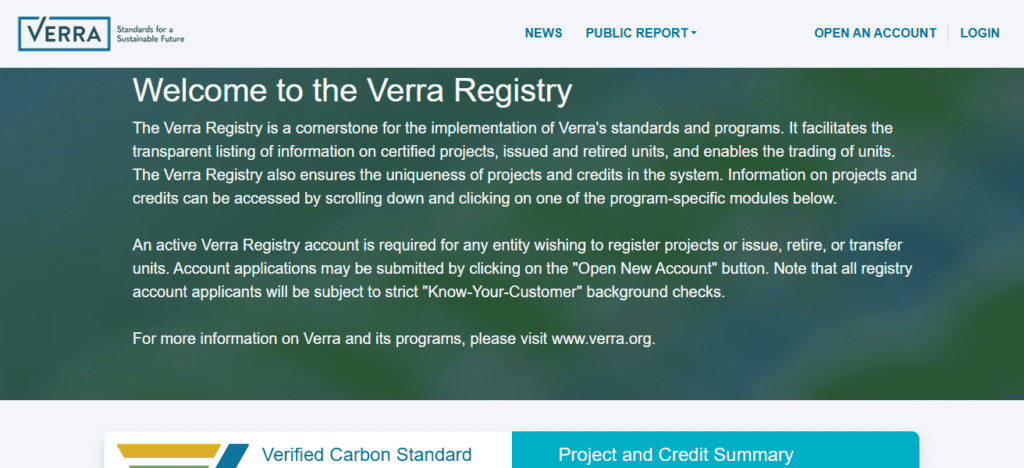
Their digital registry promotes transparency by documenting all carbon credits that have been issued, transferred, and retired. In the last few years, Verra has improved their methods for measuring soil organic carbon and the climate benefits of agriculture.
Due to the rigorous nature of their verification system, and the focus on data and the environment, verifiable projects and their investors have confidence in Verra’s methods and global acceptance.
Verra Registry – Pros & Cons
| Pros | Cons |
|---|---|
| Internationally recognized carbon credit standard. | The certification process can be time-consuming. |
| High credibility among investors and buyers. | Significant documentation requirements. |
| Strong transparency and traceability features. | Higher verification costs for small farms. |
| Supports multiple regenerative methodologies. | Complex compliance procedures. |
| Increases carbon credit marketability. | Approval timelines may delay project launches. |
2. Gold Standard Impact Registry
Gold Standard Impact Registry is a leading software for carbon offset project certification and the measurable benefits of both environmental and social value. For farms using regenerative practices, this software supports a verifiable, transparent system to monitor carbon sequestration and emission reduction, and sustainability impacts.
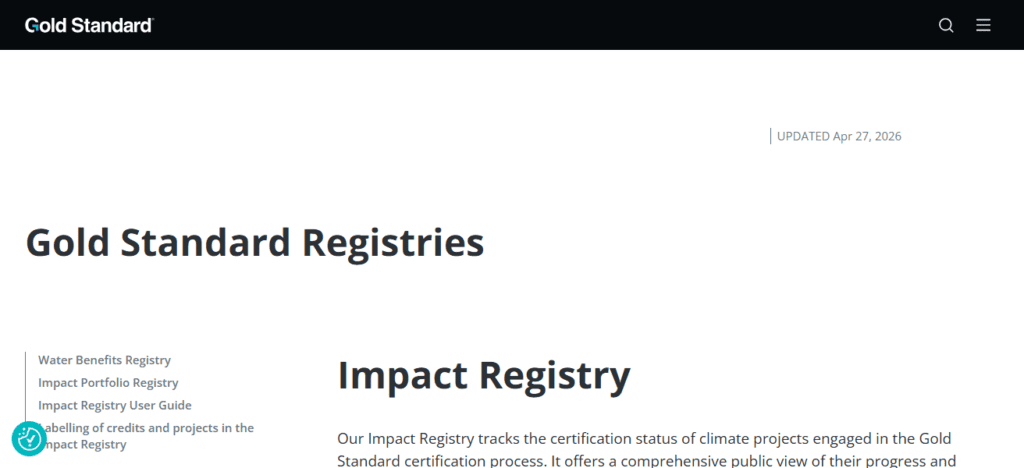
This software supports project developers in tracking their verification progress and maintaining supporting documentation throughout the project. A distinguishing strength of this software is the focus on co-benefits, which are the active protection of biodiversity, the preservation of water, and the development of rural communities.
Due to the increased interest in high-quality carbon credits, Gold Standard’s verification system is highly valued for its ability to support agricultural projects to achieve rigorous market demands and, consequently, improve confidence from buyers and project stakeholders.
Gold Standard Impact Registry – Pros & Cons
| Pros | Cons |
| Measures environmental and social benefits. | Strict eligibility requirements. |
| Trusted by sustainability-focused organizations. | Certification costs may be high. |
| Strong project tracking capabilities. | Extensive monitoring obligations. |
| Encourages biodiversity improvements. | Longer project validation periods. |
| Premium-quality carbon credits. | Less flexibility for certain project types. |
3. Regrow Agriculture
Regrow Agriculture specializes in the intersection of advanced farm analytics and remote sensing technologies with machine learning to ascertain carbon sequestration in regenerative farming systems. The platform integrates field operations data with the temporal and spatial matrices of climate and soil with satellite imagery to compute carbon impacts.
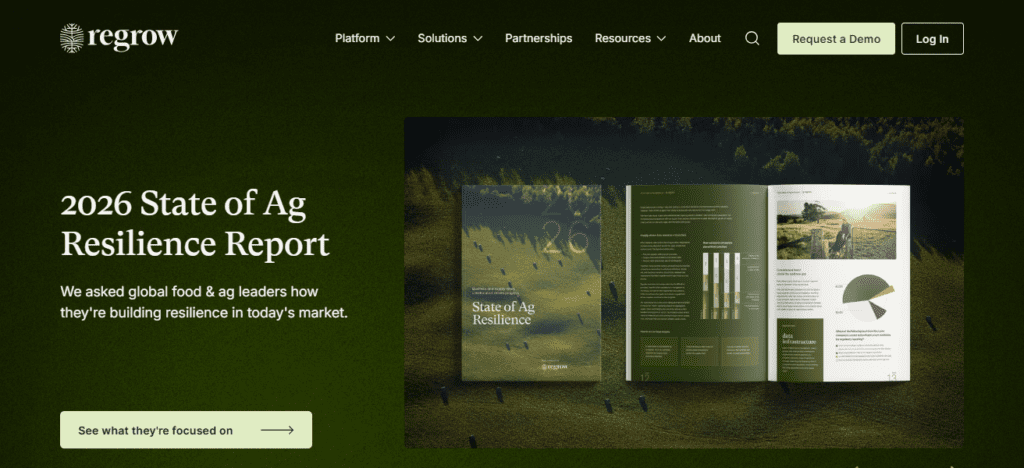
Their verification tools allow farmers to record their conservation efforts and the climate benefits that result from them. As carbon markets continue to open around the world, large agribusinesses have begun to adopt the platform for its scalable verification model.
Their highly iterative methods, coupled with the data-driven verification of carbon impacts, provide a significant improvement in the transparency and confidence of carbon credits.
Regrow Agriculture – Pros & Cons
| Pros | Cons |
| AI-powered carbon measurement technology. | Requires detailed farm data inputs. |
| Satellite-based monitoring improves accuracy. | Advanced features may increase costs. |
| Near real-time sustainability insights. | Learning curve for first-time users. |
| Scalable for large agricultural operations. | Dependent on data quality. |
| Strong analytics and reporting tools. | Internet access required for full functionality. |
4. Indigo Ag Carbon
Indigo Ag Carbon enables farmers to assess, verify, and monetize carbon sequestration resulting from their adoption of regenerative farming practices. Its software quantifies the reduction of greenhouse gases and the sequestration of carbon by integrating farm and regional agronomic data and soil samples.
Farmers learn to adopt methods that increase carbon sequestration in a productive manner. Their integrated carbon marketplace, where verified credits are matched to corporate buyers, is a crucial competitive edge.
Recent improvements in technology have simplified verification while increasing the precision of reporting. For farmers, this voluntarily integrates their farming operations into the carbon market and increases their farm’s revenue.
Indigo Ag Carbon – Pros & Cons
| Pros | Cons |
| Integrated carbon credit marketplace. | Program availability varies geographically. |
| Generates additional farm revenue opportunities. | Soil testing can increase expenses. |
| Farmer-focused support services. | Carbon prices fluctuate with market demand. |
| Reliable measurement and verification framework. | Long-term commitments may be necessary. |
| Access to corporate sustainability buyers. | Payment timelines can vary. |
5. Nori Carbon Removal Marketplace
Nori Carbon Removal Marketplace is constructing a method for buyers and sellers of carbon removal credits to interact directly, and, in doing so, is making it a lot easier for farmers to sell carbon removal credits based on the carbon removal verified via their regenerative ag activities.
Nori makes a large effort to quantify the carbon removal occurring in the soil via measuring the change occurring in the soil and gives farmers various ways to record operational data for the soil carbon, and the data collected is verified by Nori, which determines the removal obligations.
Unlike a lot of the traditional systems, Nori uses a verifiable ledger system to sell the carbon credits, adding to transparency and decreasing the participants’ and the farmers’ complexity.
Among their clients, Nori seems to be a good, credible, and verifiable solution to farm activities, addressing the demand for validated and justified soil carbon removals occurring in farming practices.
Nori Carbon Removal Marketplace – Pros & Cons
| Pros | Cons |
| Direct farmer-to-buyer marketplace model. | Smaller buyer network than competitors. |
| Blockchain-enhanced transparency. | Carbon removal prices can be volatile. |
| Focused exclusively on carbon removal. | Requires consistent long-term data reporting. |
| Simplified carbon credit transactions. | Limited recognition in some regions. |
| Strong traceability of issued credits. | Fewer project methodologies available. |
6. Cool Farm Tool
Cool Farm Tool is a popular platform for measuring greenhouse gas emissions and environmental performance at the farm level. Cool Farm Tool is a highly useful tool for farmers. With the help of scientists, food companies, and agricultural experts,
Cool Farm Tool calculates emissions from fertilizer, energy, crops, and land management. For the practices of regenerative agriculture, it is important to measure emissions.
This tool helps users to measure the length and magnitude of their sustainability improvements and find the ways that will lead them to the greatest decrease in their carbon footprint.
The tool has recently been improved, and therefore, it has become one of the most trusted tool farms for carbon verification and benchmarking sustainability.
Cool Farm Tool – Pros & Cons
| Pros | Cons |
| Easy farm emission calculations. | Not a dedicated carbon marketplace. |
| Widely used by agricultural companies. | Limited revenue-generation features. |
| Helps benchmark sustainability performance. | Requires accurate farm records. |
| User-friendly interface for growers. | Verification depends on data quality. |
| Supports environmental reporting goals. | Advanced analytics may be limited. |
7. Agreena Carbon Program
Agreena Carbon Program is the first of its kind, and therefore, the most popular and innovative carbon farming tool. This tool helps farmers create carbon credits by performing carbon farming.
This tool makes carbon farming easy by helping farmers manage and verify their carbon farming with a combination of farm management software, satellite data, and carbon science.
Farmers are able to perform and get help for cover cropping, low tillage, and crop rotation. Agreena is the best tool for carbon farming internationally because it is able to be used in many countries while being compliant with the carbon farming standards.
Because Agreena focuses on digital verification for carbon credits, farmers are able to earn money and partake in sustainable farming.
Agreena Carbon Program – Pros & Cons
| Pros | Cons |
| End-to-end carbon farming support. | Eligibility varies by farming region. |
| Automated monitoring and reporting tools. | Participation requirements can be strict. |
| Supports multiple regenerative practices. | Revenue depends on carbon market conditions. |
| Access to verified carbon credit markets. | The data submission process may be extensive. |
| Strong presence across European agriculture. | Verification timelines may vary. |
8. FarmTrace
FarmTrace has robust digital record-keeping and traceability tools. Their platform enables clear verification of carbon offsets in the farm sector.
FarmTrace has the ability to collect and systemize data on not just crop production and on-farm activities but also the farm inputs utilized and the farm’s sustainability efforts. This provides a foundation for the farm’s carbon accounting.
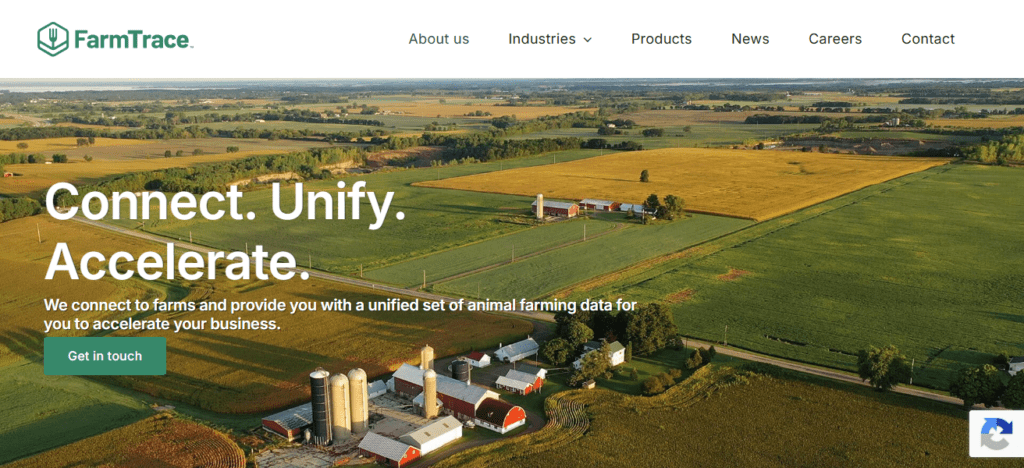
FarmTrace provides a way to record farm data and reduce the time and effort associated with recordkeeping. It also provides improved readiness for carbon project audits. This system is an excellent fit for farms that are regenerative in nature and looking to quantify their positive environmental impacts over many seasons.
The FarmTrace system has recently integrated multiple new agricultural data technologies, which improve its reporting. This provides a way for farm producers to present carbon credit assessment data directly to certification and purchase stakeholders.
FarmTrace – Pros & Cons
| Pros | Cons |
| Excellent farm data organization. | Limited direct carbon trading features. |
| Simplifies compliance documentation. | Requires regular manual data updates. |
| Enhances audit readiness. | Advanced reporting may need training. |
| Supports traceability and transparency. | Less focused on carbon modeling. |
| Suitable for farms of various sizes. | Integration options may vary. |
9. Perennial Climate Platform
The Perennial Climate Platform provides a verification solution for carbon outcomes of regenerative agriculture programs using advanced satellite imaging, remote sensing, and next-generation machine learning.
Unlike other verification systems that rely solely on active field inspections, this system physically assesses large regions of agriculture via passive monitoring of land use, crop and soil condition, and other critical factors.
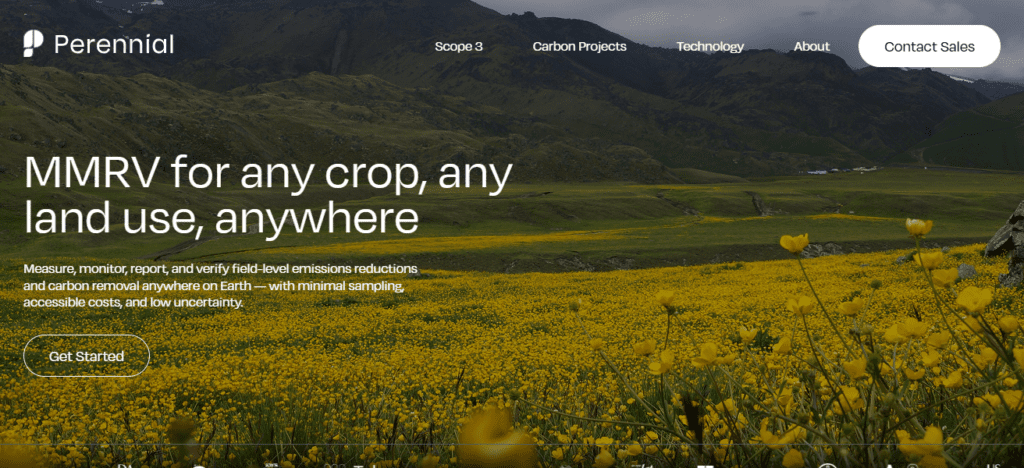
This system significantly enhances the scalability and verification economics of carbon farming. For clients who manage large tracts of land, such as 10,000 acres, monitoring each individual acre during the lifespan of a project, this system provides significant value.
As the science of remote sensing continues to evolve and improve, so too does the ability of this system to provide verification of carbon outcomes with greater precision, consequently increasing confidence of carbon credit purchasers and investors, as well as the project proponents.
Perennial Climate Platform – Pros & Cons
| Pros | Cons |
| Advanced satellite monitoring technology. | Relies heavily on remote sensing data. |
| Reduces need for frequent field visits. | Limited visibility into underground conditions. |
| Scalable across large land areas. | Accuracy may vary by region. |
| Supports continuous project monitoring. | Technology adoption may require expertise. |
| Efficient verification for large projects. | Premium solutions may increase costs. |
10. Climate FieldView
Leading the market, Climate FieldView is a platform for digital agriculture that focuses on utilizing cutting-edge software to collect data, analyze that data, and present it visually for the purpose of better decision-making and proactive carbon management.
The software assimilates data for planting, harvesting, application of fertilizers, and all other operations that take place in the field and displays it in a single window for the customer.
This software is quite useful for regenerative agriculture projects, as it provides a detailed operating record, which can help to verify the reduction of emissions and the activities related to carbon sequestration.
Climate FieldView is very easy to scale and collect a lot of data quickly because of the software’s ability to work with a large majority of the modern agricultural machinery.
Also, very recently, precision agriculture, as well as analytics, has advanced over their previous versions of the software to such an extent that the new versions of Climate FieldView are a lot more focused on the sustainable practices than the older versions.
Climate FieldView – Pros & Cons
| Pros | Cons |
| Integrates with modern farm equipment. | Primarily designed for farm management. |
| Comprehensive field-level data collection. | Carbon verification features are indirect. |
| Strong analytics and visualization tools. | Subscription costs may be high. |
| Improves operational decision-making. | Requires compatible hardware systems. |
| Supports sustainability reporting efforts. | Full value depends on data completeness. |
How We Choose Best Carbon Offset Verification Softwares for Regenerative Agriculture Farms
- Accuracy of Verification – Evaluated how well the software effectively identifies and verifies carbon sequestration.
- Verification and Endorsements – Evaluated software likely to have verified carbon standards and endorsement by trusted carbon
- Transparency of Data – Evaluated the clarity and traceability of carbon accounts.
- Verification and Endorsements – Evaluated the software likely to have verified carbon standards and endorsements by trusted carbon standards organizations.
- Adaptive Monitoring – Evaluated the software’s use of satellite imagery and remote sensing.
- Verification and Endorsements – Evaluated the software likely to have verified carbon standards and endorsements by trusted carbon standards organizations.
- Accessibility to Farmers – Evaluated the overall ease of use, the time required for onboarding the software, and the available farmer support.
- Access to Carbon Credit Verification and Trading – Evaluated how easily farmers can create and trade verified credits.
- Adaptability of Software – Evaluated software and platforms that can be used by both small-scale farms and large-scale farming operations.
- Innovative Software – Choose software that uses the latest advances in technology and analytics.
- Affordability of Software – Evaluated the cost of the software and associated services, the cost of verification, and the potential returns from using the software.
- Benefits to Regenerative Agriculture – Evaluated the focus of the software on the implementation of conservation practices and the soil health of the farming systems.
- Compliance with Standards – Evaluated the standards and frameworks of the verified carbon markets and sustainability.
- Tracing Credits – Evaluated the software’s ability to track carbon credits.
- Customer Satisfaction – Evaluated how widely the software is used, the reviews of the users, and the trust of the market.
- Sustainability of Technology and Services – Choose software that has a stable track record and ongoing improvements in technology.
Conclusion
To wrap up, selecting optimal carbon offset verification technology for regenerative agriculture corrects the assessment of environmental damage and generates legitimate carbon credits.
There are a number of options available: Verra Registry, Regrow Agriculture, and Agreena Carbon Program. Farmers are then able to optimize their sustainability practices and access carbon markets
While creating greater transparency and new financial opportunities within their business, all of which support the long-term sustainability of their climate and soil health goals.
FAQ
These tools help prove environmental impact and generate credible carbon credits for sale.
Verra Registry is among the most trusted and globally recognized verification platforms.
Yes, many platforms support farms of all sizes, including small and medium operations.
Indigo Ag Carbon, Nori, and Agreena provide access to carbon credit marketplaces.