

This article aims to highlight the most effective AI tools for enterprise scenario planning that assist firms in anticipating uncertainty, analyzing multiple results, and formulating data-informed tactical choices.
These tools utilize AI, predictive analytics, and current data to boost the precision of algorithms, flexibility, and assist companies in maneuvering through adaptive economic conditions with certainty.
Key Points & Best AI Platforms For Enterprise Scenario Planning
| AI Platform | Key Point |
|---|---|
| Anaplan | Cloud-native scenario modeling with strong financial planning and collaboration features |
| Oracle Fusion Cloud EPM | Integrated enterprise performance management with predictive AI for forecasting |
| SAP Analytics Cloud | Unified BI and planning with machine learning-driven scenario simulations |
| IBM Planning Analytics (TM1) | AI-powered multidimensional modeling for complex enterprise scenarios |
| Workday Adaptive Planning | User-friendly what-if analysis with strong HR and finance integration |
| Board International | All-in-one decision-making platform combining BI, planning, and predictive analytics |
| Jedox | Excel-friendly AI planning with strong integration and ease of adoption |
| Planful | Continuous planning workflows with automation and predictive insights |
| Drivetrain | Modern FP&A platform designed for agile scenario planning and growth modeling |
| Kubiya AI | Enterprise AI orchestration enabling workflow automation and decision intelligence |
10 Best AI Platforms For Enterprise Scenario Planning
1. Anaplan
Anaplan is a cloud-based and integrated platform designed with large organizations in mind and aimed at merging data, personnel, and action plans across Finance, Supply Chain, and Sales.
With its in-memory calculation engine and AI-based predictive modeling, Anaplan promotes dynamic scenario planning, empowering teams to simulate multiple outcomes and adjust their plans on the fly.
Its highly scalable architecture and collaborative orchestration allow businesses to forecast with more precision, promote alignment, and agilely respond to shifts in the market.
Features Anaplan
Connected Planning Engine – Provides real-time calculations and data refresh for dynamic scenarios.
In-Memory Technology – Processes large dataset rapidly for multiple business functions.
Collaborative Workflows – Different roles can plan and modify with alerts, comments, and versioning.
Predictive Analytics – Provides insight through forecasting and trends by AI/ML modeling.
| Pros | Cons |
|---|---|
| Highly scalable and cloud-native for complex enterprise planning. | Can be expensive for smaller teams or limited deployments. |
| Strong “what-if” scenario modeling with real-time calculations. | Requires training to master advanced modeling features. |
| Collaborative planning across functions improves alignment. | Customization may need specialist support. |
2. Oracle Fusion Cloud EPM
Automated data consolidation and scenario modeling that accelerates decision cycles and predictive forecasting are the benefits enterprises gain from Oracle Fusion Cloud EPM (as of October 2023).
Analytics and Artificial Intelligence (AI) paired with finance planning, budgeting, and forecasting help strengthen predictive forecasting and data analytics further.
Embedded summary helps simplifying complex organizations planning. Specific focused security features are valued by finance leaders when adapting from or with Oracle ERP.
Features Oracle Fusion Cloud EPM
Unified Planning Suite – Combines budgeting, forecasting, and financial close processes into one.
AI-Driven Forecasting – Machine learning improves predictions and identifies outliers.
Strong ERP Integration – Good connectivity with Oracle ERP and other operational data.
Scenario Modeling Tools – Capable of complex ‘what-if’ and driver-based analysis.
| Pros | Cons |
|---|---|
| Deep integration with Oracle ERP and financial systems. | Can be complex to implement without Oracle expertise. |
| AI/ML helps with forecasting accuracy and anomaly detection. | Higher total cost of ownership for some organizations. |
| Comprehensive planning + analytics in one suite. | User interface can feel overwhelming initially. |
3. SAP Analytics Cloud
SAP Analytics Cloud brings together BI, planning, and predictive analytics tailored for the enterprise application.
With the use of AI and machine learning, the software generates insights, predicts trends, and simulates various what-if models, all in real-time.
Users across the various functions can leverage the system for collaborative financial, operational and strategic planning.
The solution is integrated with the SAP ERP and other data sources to provide a single source of truth to help leaders navigate and make better business decisions.
Features SAP Analytics Cloud
All-in-One Platform – Business Intelligence, Planning, and Predictive Analytics.
Smart Predict Capabilities – Forecasting and insight provision for patterns through AI/ML.
Live Data Connectivity – Integrates directly with SAP and other third-party data sources.
Visual Scenario Exploration – Dashboards with simulations to make decisions interactively.
| Pros | Cons |
|---|---|
| Unified BI, planning, and predictive analytics. | Full value requires integration with SAP ecosystem. |
| Strong real-time scenario forecasting capabilities. | Licensing and cost can be high. |
| Intuitive visualizations enhance insight adoption. | Learning curve for non-technical users. |
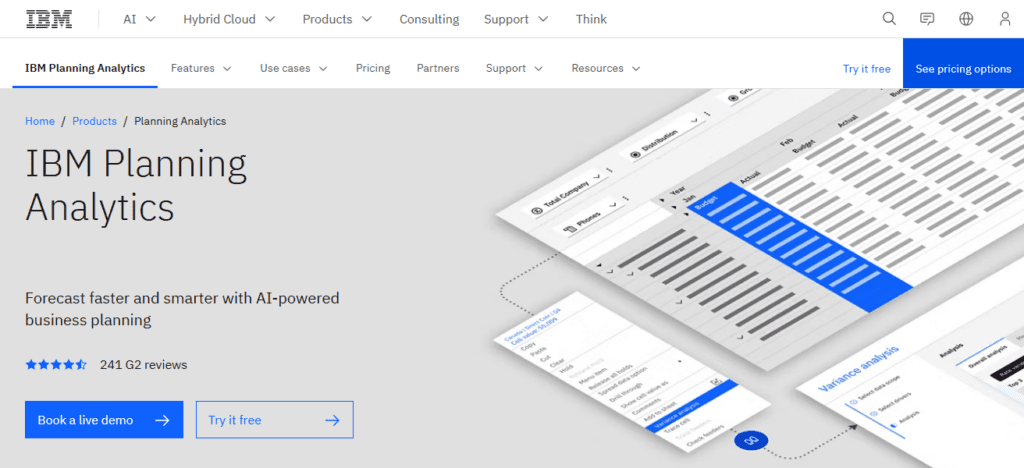
4. IBM Planning Analytics (TM1)
TM1’s IBM Planning Analytics is a top-tier corporate planning system that is designed to analyze forecasting and planning on a scenario basis.
TM1 uses AI and automation to build and analyze models more quickly and accurately, and integrates data more efficiently.
TM1 is able to create multidimensional models for flexible and scenario based forecasting for planners and analyze results immediately.
The embedded AI to recommend specific plans is a unique feature that allows TM1 to enhance scaled planning automation.
Users are able to quickly adapt to the system with the Excel add-ons and easy to understand AI embedded system dashboards.
Features IBM Planning Analytics (TM1)
Multidimensional Modeling – Complex scenario planning through flexible cubes.
AI & Automation– Streamlining of manual tasks by predictive metrics and automated info.
Excel Integration– Combines a user-friendly Excel-related interface and a powerful back-end.
Rule-Based Logic– Custom business rules apply to driver-based planning models.
| Pros | Cons |
|---|---|
| Excellent multidimensional modeling for scenario analysis. | Implementation complexity may require consulting help. |
| Strong automation and AI forecasting support. | Interface less modern compared with cloud-first platforms. |
| Seamless Excel integration for planner familiarity. | Training often required for advanced usage. |
5. Workday Adaptive Planning
Workday Adaptive Planning is a contemporary enterprise planning solution with a focus on improving budgeting, forecasting, and what-if scenario planning with predictive analytics and AI.
It allows finance and business teams to create flexible models and gives organizations the ability to confidently foresee a variety of possible future outcomes. forecast future outcomes.
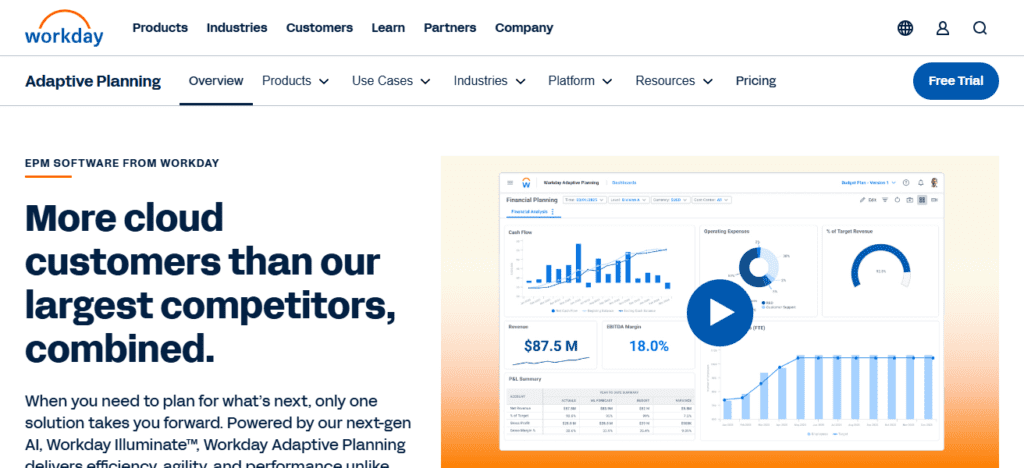
Predictive analytics, AI, and the platform’s ease of use and collaborative features of the platform predict future outcomes.
This collaborative solution also streamlines complex workflows, improving data accuracy and speeding up decision-making.
Features Workday Adaptive Planning
Intuitive Interface – Set up and use with a simple interface that utilizes drag-and-drop modeling.
Cloud-Native Collaboration – Provide shared planning workspaces with version history and task management.
Predictive Insights – Use AI to forecast and help refine budget and plan outcomes.
Cross-Functional Models – Consolidated financial, workforce, and operational planning.
| Pros | Cons |
|---|---|
| Intuitive user experience and collaboration capabilities. | Limited depth in non-financial modeling compared to others. |
| Faster deployment with cloud delivery. | Some advanced analytics require add-ons. |
| Good predictive analytics and scenario planning. | Data integration may need middleware for complex sources. |
6. Board International
Board International provides companies with a unique solution for enterprise decision making that incorporates BI, planning, predictive analytics, and AI.
It allows companies to create, and analyze highly complex scenario models which they can predict, and gain insights from all without needing to know code.
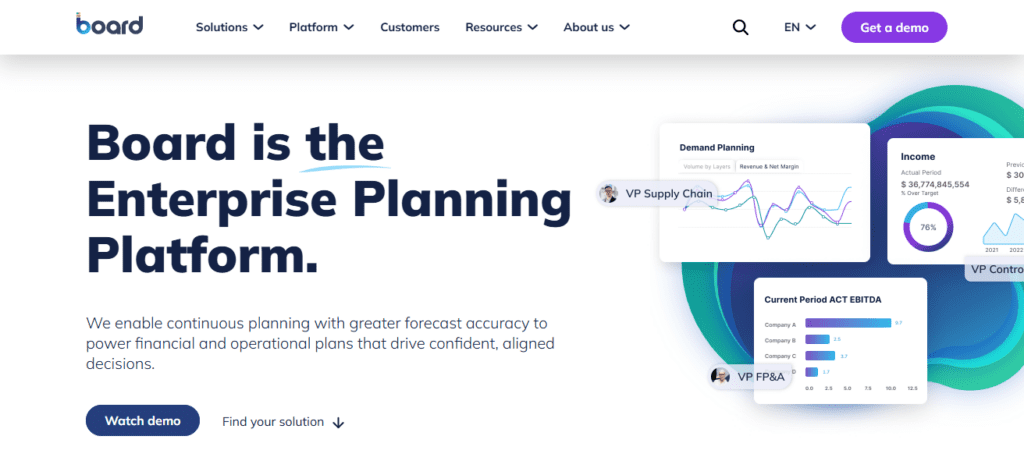
Because of Board’s hybrid in-memory engine, they can tackle large datasets highly efficiently. Board’s system enables datasets of all sizes to be visualized and used for exploratory
what-if scenario analysis. This system promotes simplicity and strategy driven decision making within companies.
Features Board International
No-Code Platform – Design and construct unique models and dashboards without the need for technical coding.
Hybrid In-Memory Engine – Designed for the agility of mid-sized enterprises while being able to seamlessly scale for enterprise data.
Integrated BI + Planning – Easy and seamless transition from analytics to planning.
Visual Scenario Designer – Easy drag-and-drop interface for scenario design.
| Pros | Cons |
|---|---|
| All-in-one BI + planning + predictive analytics. | Onboarding and model design can be complex. |
| Strong flexibility for building bespoke scenarios. | Performance can lag on very large datasets. |
| Visual, no-code modeling appeals to business users. | Support and community smaller than some competitors. |
7. Jedox
Jedox is a versatile enterprise planning and performance management tool which facilitates scenario planning thanks to its AI-based forecasting and modeling capabilities.
Martin, their integration specialist, states that “it connects to most ERP, CRM, and data warehouse systems, significantly streamlining interdepartmental planning.”
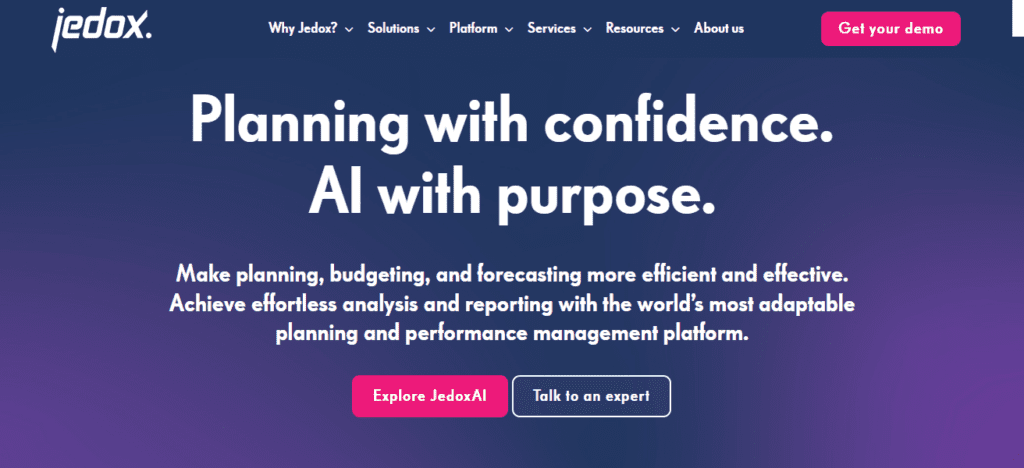
Jedox allows users to build and evaluate different forecasting scenarios based on user defined parameters, and then uses machine learning to predict optimal trends and outcomes.
Jedox enables users to shorten planning cycles and cross-finance/operations collaboration with its Excel-friendly layout and user-friendly visualizations.
Features Jedox
Excel-like Modeling – Modeling and environment interface that is easy for Excel users with a strong backend.
AI-Enhanced Forecasting – Predictive analysis of trends to assist in planning.
Flexible Integration – Able to connect with a variety of data sources, including ERP, CRM, and data warehouse.
Centralized Planning Hub – Consolidated platform for seamless budgeting and performance.
| Pros | Cons |
|---|---|
| Highly flexible with strong Excel compatibility. | Some features feel less polished than enterprise peers. |
| AI-driven forecasting enhances predictive planning. | UI/navigation can be improved. |
| Easy integration with multiple data sources. | Advanced use cases need expert configuration. |
8. Planful
Planful’s software works in multiple ways: from speeding up financial forecast to business operational planning.
Planful uses artificial intelligence, automation, and other tools to streamline, improve, and support automatic data entry scenario modeling.
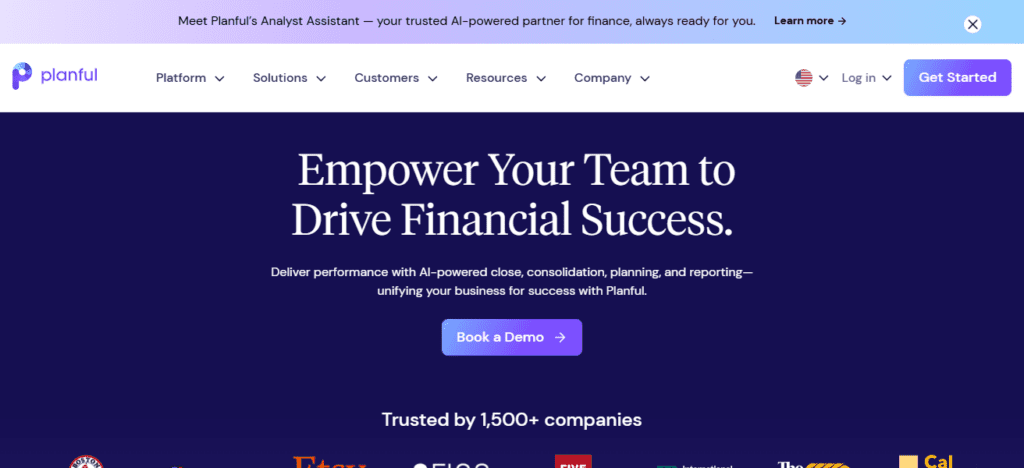
Through Planful, teams get to analyze various interactive dashboards, and data from multiple scenarios, and get data in real-time in order to adapt their strategy to the framework.
All these features improve collaborative efforts among finance leaders, enabling them to align various stakeholders, forecast and mitigate risks, and make evidence based decisions that improve business performance.
Features Planful
Continuous Planning Framework – Framework allows for real-time insight to ongoing updates to the plan.
Automation Tools – Automated consolidations, validations, and workflows.
Scenario Comparison – Evaluating impacts per scenario using side-by-side analysis.
Role-Based Dashboards – Customized views for finance and operations users.
| Pros | Cons |
|---|---|
| Automation reduces manual planning effort. | Limited customization options compared with top enterprise platforms. |
| Real-time insights and scenario comparisons. | Smaller ecosystem vs large vendors. |
| Strong finance planning and budgeting focus. | Less emphasis on non-financial operational planning. |
9. Drivetrain
Drivetrain focuses on transforming data into valuable and actionable strategies using machine learning and automation.
Drivetrain is a decision intelligence and enterprise planning platform augmented with AI. With a stream of automated prep and pattern recognition machine learning works to forecast and create scenarios enabling planners to visualize alternate futures.
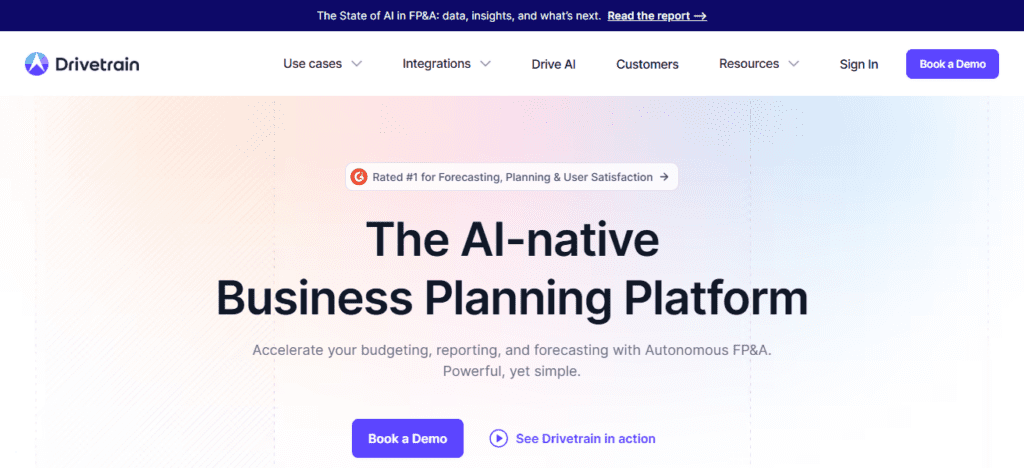
Predictive planning and analytics in real time empowers agile enterprise decision making. Natural language processing and human centered design make analytics and insights accessible to all.
Users can interrogate the model and ask questions to make data actionable instead of being passively responded to.
Features Drivetrain
AI-Centric Insights – Using machine learning for pattern identification and forecasting.
Real Language Questions – Simplistic dialogue for questions and analysis generation.
Unified Data Modeling – Integration of different data sources for scenario evaluation.
Real-Time Simulation – Future conditions can be explored using dynamic what-if scenarios.
| Pros | Cons |
|---|---|
| AI-first data preparation and pattern detection. | Relatively newer platform — smaller market presence. |
| Natural language and predictive scenario forecasts. | Learning curve for non-technical planners. |
| Intuitive UI promotes faster insight discovery. | Integrations may require development work. |
10. Kubiya AI
Kubiya AI enables planning teams to communicate with data and models through the use of natural language with the help of an intelligent business assistant.
It connects with planning tools like Anaplan to provide services for users to voice inquiries, create scenario simulations, and extract summaries without advanced technical competencies.
Kubiya improves productivity and enables mass scenario planning accessibility by reducing the entry threshold to complex analytical evaluations. AI-driven human dialogue improves enterprise decision-making.
Features Kubiya AI
Conversational AI Access – Using natural language to query planning data.
Integration with Planning Tools – Enhanced insights through compatible platforms such as Anaplan.
Automated Insight Delivery – UI for users to access AI-generated trends, predictions, and scenario analysis.
User-Friendly Interface – Simplistic design reduces technical complexities for business users.
| Pros | Cons |
|---|---|
| Natural language interface simplifies querying planning data. | Limited planning engine — works best with other systems. |
| Accelerates access to insights and forecasts. | Feature depth tied to connected planning tools. |
| Lowers technical barriers for business users. | Dependent on quality of existing data sources. |
How We Choose Best AI Platforms for Enterprise Scenario Planning
- AI & Predictive Capabilities – The capability of the tools to implement AI/ML for forecasting, trend spotting, etc., and modeling of scenarios was analyzed.
- Scenario Modeling Flexibility – Support for complex what-if, driver based, and multi-variable/ factors was analyzed.
- Enterprise Scalability – The ability to handle large datasets and multi-department planning was analyzed.
- Data Integration – The ability to integrate with ERP, CRM, and data warehouses was analyzed.
- Usability & Collaboration – Experience of the user, access based on roles, and collaborative tools for multiple users was analyzed.
- Real Reasons – Platforms that provided data on the fly and recalculated data instantaneously were given importance.
- Security & Compliance – Standard and enterprise security, governance and compliance were analyzed.
- Deployment & Cost – The complexity of implementation, readiness for the cloud, and cost were compared.
Cocnlsuion
To summarize, these are the top artificial intelligence solutions for enterprise scenario planning enabling firms to forecast changes, assess uncertainty, and make more informed strategic decisions.
With the right tools, firms will have the capability to improve scenario-based planning, integrate real-time data, and forecast using AI and improve agility and resilience.
These tools or solutions will help enterprise improve predictive planning, enhance teamwork and communication, and increase competitiveness in today’s volatile business environment.
FAQ
Software that uses AI and analytics to create, compare, and forecast multiple business scenarios for strategic decision-making.
AI improves forecast accuracy, automates modeling, detects patterns, and speeds decision cycles.
Examples include Anaplan, Oracle Fusion Cloud EPM, SAP Analytics Cloud, IBM Planning Analytics (TM1), and others.
AI-driven forecasting, real-time data, flexible scenario modeling, and seamless integration.
Yes — most offer strong financial planning, budgeting, forecasting, and reporting tools.