


The platforms changing the blockchain game that I discuss in this article are the Best RWA Crypto Platforms because they connect real world assets to decentralized finance. With these platforms you can tokenize real estate, bonds, and credit instruments, which increases liquidity and transparency.
I explain how each platform operates, the main features of each platform, and why RWA crypto is trending in the crypto space.
Introduction to RWA Crypto Platforms
Crypto platforms of Real World Assets (RWA) are systems built on blockchain technology used to tokenize physical and traditional financial assets (real estate, bonds, invoices, commodities, etc.)
These platforms link decentralized finance (DeFi) and traditional finance, releasing locked liquidity in illiquid markets. RWA platforms create greater investment opportunities by providing wider access and the ability to buy fractional stakes to both retail and institutional investors.
RWA platforms will form the backbone of future financial systems, as greater transparency is achieved, intermediaries are reduced, and efficiency is increased in the exchange of assets.
Key Points & Best RWA Crypto Platforms
- Centrifuge connects real world assets to DeFi lending and liquidity markets efficiently
- Maple Finance provides institutional crypto lending backed by real world collateral assets
- Goldfinch offers undercollateralized lending for emerging markets using blockchain credit systems platform
- TrueFi enables unsecured crypto lending based on onchain credit scoring models protocol
- RealT tokenizes fractional real estate ownership on blockchain for investors globally accessible
- Securitize provides digital securities infrastructure for compliant asset tokenization issuance management platform
- Clearpool offers decentralized institutional liquidity pools for real world assets efficiently scalable
- Polymesh is permissioned blockchain designed specifically for regulated security tokens issuance compliance
- MakerDAO RWA integrates real world collateral into decentralized stablecoin system governance framework
- Ondo Finance tokenizes real world assets enabling institutional grade DeFi yield exposure
10 Best RWA Crypto Platforms
1. Centrifuge
Centrifuge is a preeminent platform for tokenizing Real World Assets (RWA) that merges decentralized finance (DeFi) with traditional finance. Centrifuge allows businesses to convert invoice and other liquid and non-liquid assets into on-chain tokens.
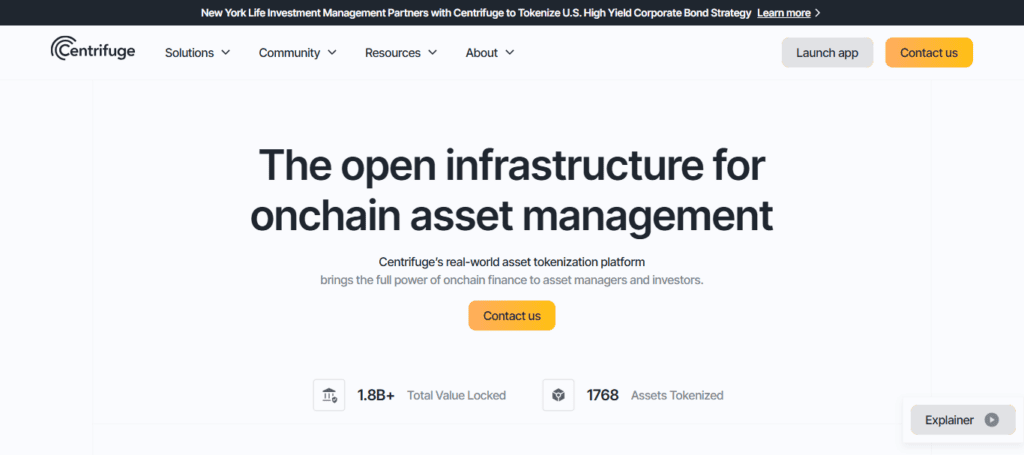
Centrifuge recently added more DeFi protocol integrations to encourage more institutions to use their platform. Pools in Centrifuge’s Tinlake earn users great yields; however, Centrifuge is built on the value of transparency and risk, and they aim to reduce lots of banking systems, making Centrifuge a great start for any RWA DeFi ecosystem.
Centrifuge – Features
- Real world assets can be tokenized.
- Allows lending via the Tinlake liquidity pools.
- Merges DeFi with the legacy financial system.
- On-chain credit risk tools and analysis are available.
- Offers institutional financing for real world assets.
Centrifuge – Pros & Cons
| Pros | Cons |
|---|---|
| Unlocks liquidity from real-world assets | Complex onboarding for new users |
| Strong DeFi integrations | Limited retail accessibility |
| Asset-backed lending via Tinlake | Depends on quality of off-chain assets |
| Transparent on-chain asset tracking | Regulatory uncertainty in some regions |
| Strong institutional adoption growth | Requires technical understanding |
2. Maple Finance
Maple Finance is a decentralized platform that institutionalizes lending by connecting crypto lenders to verified borrowers. Maple focuses on real-world credit assessment for under collateralized lending rather than the traditional over-collateralized lending.
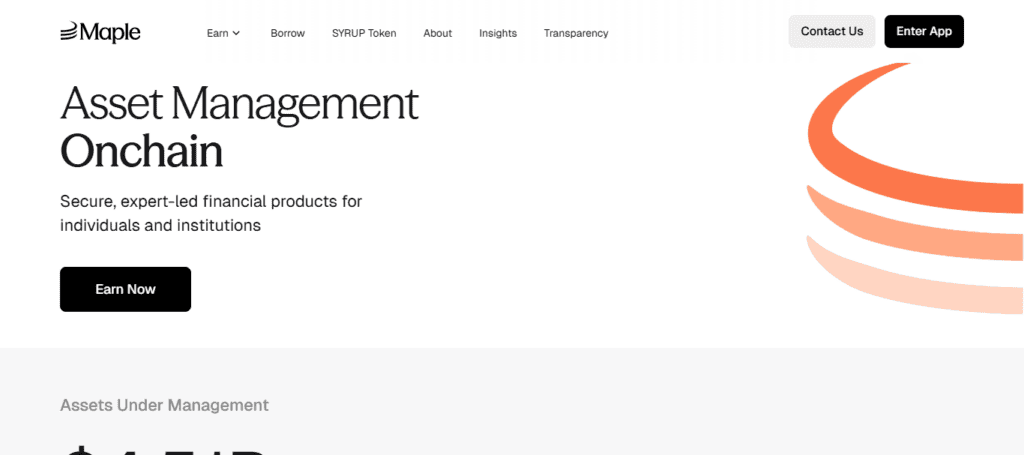
Maple has been progressing, especially in the RWA landscape, by teaming up with regulated financial firms to assist borrower credibility and default risk. This servicing is done by Pool Delegates who are in full control of lending strategy and risk. Maple Finance, in the RWA landscape, is being utilized by more hedge funds and trading firms.
Maple Finance – Features
- Undercollateralized crypto and real world lending is available.
- Risk is managed by professional pool delegates.
- Institutional borrowers have access to global crypto lending.
- Credit-based underwriting is used instead of overcollateralization.
- Capital efficiency for hedge funds and institutions is improved.
Maple Finance – Pros & Cons
| Pros | Cons |
|---|---|
| Institutional-grade lending platform | Higher risk due to undercollateralized loans |
| Professional pool delegates manage risk | Limited borrower access screening delays |
| Efficient capital utilization | Sensitive to market downturns |
| Real-world credit evaluation system | Smaller borrower base than CeFi lenders |
| Strong reputation in DeFi lending | Default risk remains present |
3. Goldfinch
Goldfinch makes uncollateralized loans using borrowers’ real-world credit. By using off-chain analysis, Goldfinch helps lending to businesses in emerging markets whom often lack essential banking services. Goldfinch has developed a global borrower network, with a particular focus on fintech and SME financing.
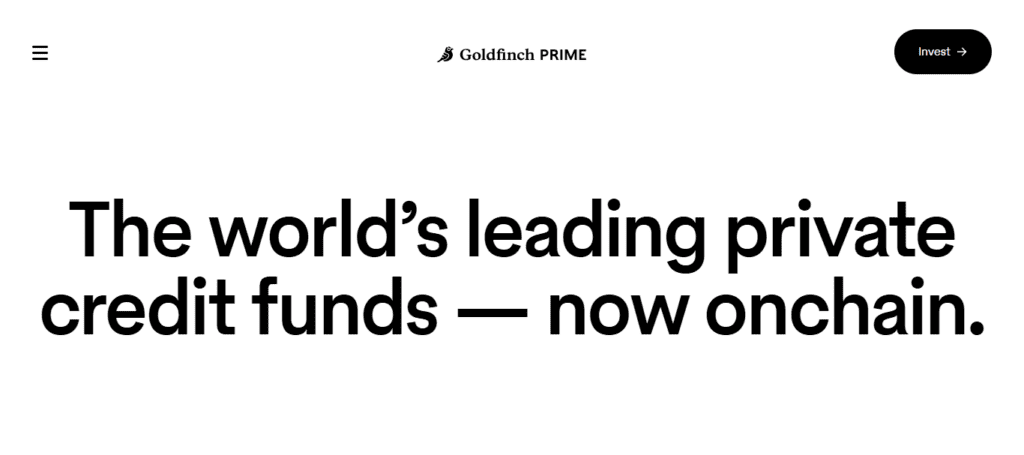
Innovative “trust through consensus” mechanisms are designed to allow both auditors and backers to approve borrowers.
Goldfinch bridges the gap between on-chain and off-chain by combining real world credit underwriting and on-chain transparency. It provides the means to transform access to credit in under-banked regions and to foster real economic development within the DeFi space.
Goldfinch – Features
- Crypto collateral is not needed to obtain a loan.
- Credit assessments of borrowers are done off-chain.
- Financing for SMEs and support for emerging markets is available.
- A decentralized system of consensus to assess borrowers is in place.
- Lending is done to promote financial inclusion and reach lending services worldwide
Goldfinch – Pros & Cons
| Pros | Cons |
|---|---|
| Enables lending without crypto collateral | Higher default risk exposure |
| Supports emerging markets | Requires strong trust in off-chain data |
| Promotes financial inclusion globally | Complex borrower verification process |
| Community-based credit validation | Returns can be volatile |
| Strong real-world economic impact | Limited transparency compared to pure DeFi |
4. TrueFi
TrueFi incorporates on-chain credit scores to enable decentralized, uncollateralized lending. Traditional DeFi lending protocols often rely on over-collateralized loans. TrueFi, however, looks to the reputation and history of repayment of potential borrowers, as well as their participation in governance, to assess the risk of lending.
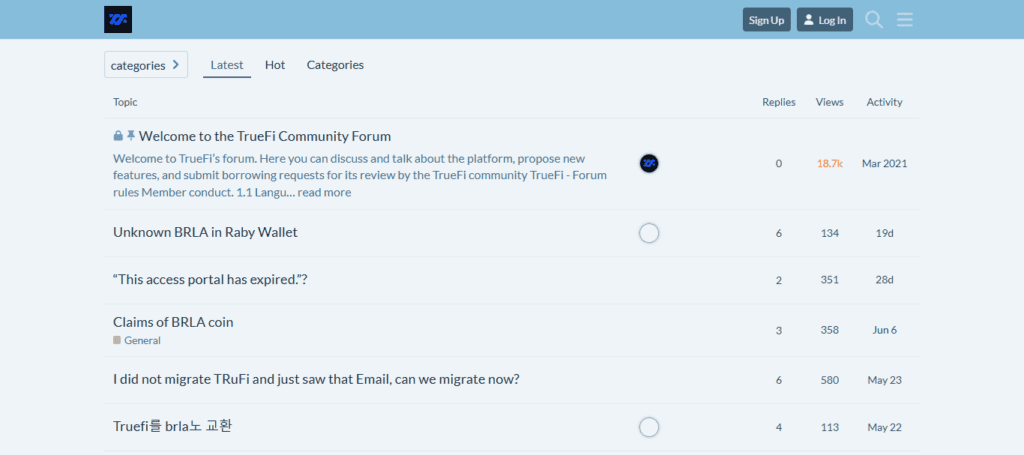
Because of the flexibility offered by this lending protocol, many institutional borrowers utilize the advantages of TrueFi. Risk modeling and performance of loans within the protocol will also improve with the incorporation of AI-based credit assessment and analytics.
TrueFi combines a community credit ecosystem with a governance model to incorporate a paradigm shift within DeFi by enabling a trust-based lending model over a capital-intensive collateral model.
TrueFi – Features
- Credit scoring on-chain enables lending that is unsecured.
- Loans are approved based on governance votes.
- Borrower reputation is cultivated along with a record of repayment.
- Lending is done through a decentralized credit infrastructure that is institutional in nature.
- Risk assessments are done using AI.
TrueFi – Pros & Cons
| Pros | Cons |
|---|---|
| On-chain credit scoring system | Governance-based delays in approvals |
| No overcollateralization needed | Risk of borrower default |
| AI-driven risk modeling | Limited borrower pool |
| Community governance participation | Market volatility impact |
| Institutional lending adoption | Requires strong trust framework |
5. RealT
RealT uses blockchain technology to offer fractional ownership of real estate. Properties are tokenized, and global investors are able to invest and receive rental income. RealT’s presence in multiple cities across the United States provides the opportunity for many people to financially participate in real estate with low investment amounts.
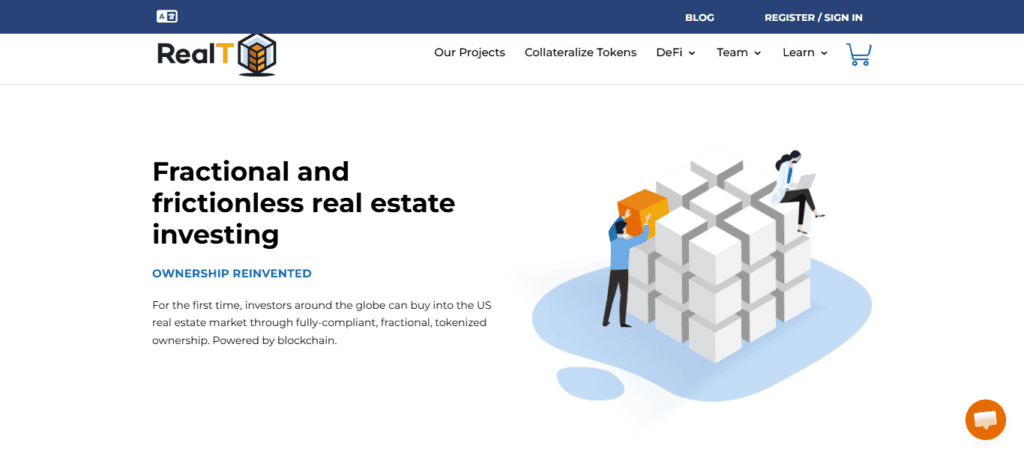
Smart contracts handle the self-execution of rental payments and the change of ownership, and automatically facilitate the removal of agents.
Those seeking to invest in real estate and earn rental income, with the convenience of no ownership responsibilities, are the target audience. RealT’s economic model is the fusion of the stable nature of real estate with the liquidity of blockchain.
RealT – Features
- Real estate can be owned in a fractional sense.
- Smart contracts execute the disbursement of rental income.
- Small capital investors are welcome to partake in the system.
- Intermediaries are removed when investing in property.
- Records of real estate are available on the blockchain.
RealT – Pros & Cons
| Pros | Cons |
|---|---|
| Fractional real estate ownership | Property market dependency risk |
| Passive rental income generation | Liquidity can be limited |
| Global investment accessibility | Regulatory restrictions in regions |
| Smart contract automation | Maintenance and property management risks |
| Low entry investment barrier | Limited diversification options |
6. Securitize
Securitize is one of the largest digital securities platforms. Securitize provides a regulatory compliant tokenization service for real-world assets, and offers a comprehensive solution for the issuance, management and trade of security tokens.
Securitize’s focus on compliance has won them the trust of many institutional clients and the successful rollout of their product in multiple jurisdictions. Securitize’s interests have begun to encompass private equity, real estate funds, and other alternative assets.
Their audit ready, transparent and blockchain-based services ensure protection for all participants within the financial services framework. Securitize’s services elevate the liquidity of global investing through its regulated offerings and intersection of finance and blockchain technology.
Securitize – Features
- Provides an easy-to-use security token platform
- Offers full service digital asset solutions
- Supports regulatory requirements for multiple jurisdictions
- Allows the tokenization of private equity and real estate funds
- Provides blockchain audit trails for greater transparency
Securitize – Pros & Cons
| Pros | Cons |
|---|---|
| Fully compliant tokenization platform | High regulatory dependency |
| Strong institutional trust | Limited decentralization |
| End-to-end asset management tools | Slower innovation due to compliance |
| High transparency and auditability | Complex onboarding for issuers |
| Multi-asset support (real estate, equity) | Higher operational costs |
7. Clearpool
The Clearpool ecosystem was created with the intent of allowing institutional borrowers access to uncollateralized liquidity from DeFi lenders. Through its lending pools, Clearpool employs dynamic interest rates that adjust according to the risk profiles of borrowers.

The company has developed permissioned liquidity pools that are designed with the needs of real world financial institutions in mind. In order to improve the depth of liquidity within its network, Clearpool collaborates with a large number of fintech companies and market makers.
Clearpool’s focus is on transparency and risk segmentation while maintaining an architecture that is capital efficient. It is Clearpool’s innovation to allow real world financial institutions access to DeFi liquidity without an institutional lending system’s collateralization requirements. As such, Clearpool is an important player in the institutional finance and decentralized credit markets.
Clearpool – Features
- Allows uncollateralized institutional borrowing within DeFi
- Implements a system of dynamic interest rates
- Provides permissioned liquidity pools for institutions
- Links decentralized lenders to fintech borrowing solutions
- Facilitates efficiency of credit markets
Clearpool – Pros & Cons
| Pros | Cons |
|---|---|
| Uncollateralized institutional lending | Higher credit default risk |
| Dynamic interest rate system | Sensitive to market liquidity |
| Permissioned liquidity pools | Limited retail participation |
| Efficient capital markets access | Dependence on institutional demand |
| Strong DeFi integration model | Regulatory uncertainty |
8. Polymesh
Polymesh is a blockchain solution for the tokenization of securities that employs a permissioned and purpose built design. Polymesh solves many of the problems with compliance in tokenization by embedding the concerns of identity and configurable governance and regulations into its blockchain. As a result Polymesh eliminates many of the burdens and needs for third party compliance.
Because of its innovative design Polymesh is a go to blockchain tech solution for compliant and safe tokenization of securities. Sticking to the Domain of security tokens and not expanding into general purpose use cases means
Polymesh has the capability of creating a robust and fast infrastructure for compliant security token market design. This also means Polymesh provides a foundational layer for the regulated tokenization of Real World Assets.
Polymesh – Features
- Infrastructure developed specifically for regulated security tokens
- Compliance and identity are integrated with the blockchain
- No longer demands external compliance solutions
- Asset issuance is secure and permissioned
- Supports the infrastructure for institutional security tokens
Polymesh – Pros & Cons
| Pros | Cons |
|---|---|
| Built for regulated security tokens | Not suitable for general DeFi apps |
| Strong identity & compliance system | Limited ecosystem diversity |
| High security architecture | Lower developer flexibility |
| Institutional-grade blockchain design | Smaller user base |
| Regulatory-ready infrastructure | Adoption still growing |
9. MakerDAO RWA Integration
MakerDAO’s focus in RWA has combined off-chain collateral with their decentralized stablecoin system. Using this strategy, DAI can be backed by real world assets such as U.S. Treasury bonds and corporate credit. The integration of RWA focuses in stability, yield, and sustainability of the protocol.
MakerDAO has collaborated with institutional asset managers to help manage real world portfolios with assured governance.
This is a clear sign of a new focus away from pure crypto collateral to hybrid systems. Combining DeFi and TradFi systems, MakerDAO balances the RWA scale of decentralized stablecoins and their reach in global finance.
MakerDAO RWA Integration – Features
- Allows real world assets to be used as collateral for DAI
- Includes U.S. Treasury Bonds and corporate debt
- Provides a stable system of decentralized finance and stablecoins
- Increased yield potential using TF assets
- Risk and asset management through governance
MakerDAO RWA Integration – Pros & Cons
| Pros | Cons |
|---|---|
| Stablecoin backed by real-world assets | Exposure to centralized assets |
| Improves DAI stability | Governance complexity |
| Generates yield from real-world bonds | Regulatory scrutiny risk |
| Diversifies collateral base | Limited transparency in some assets |
| Strong DeFi ecosystem influence | Dependence on external asset managers |
10. Ondo Finance
Ondo Finance is a rapidly evolving RWA platform that offers the tokenization of highly liquid assets such as bonds and money market funds with stable yields that carry low risk. Capital markets have higher risk and greater volatility.

Ondo Finance has entered the RWA space by offering institutional clients fixed income products. DeFi has grown by Ondo’s focus on trust, high compliance standards and secure custody of assets. Ondo Finance has greatly improved access to real world yield opportunities in decentralized finance.
Ondo Finance – Features
- Tokenized bonds and money market instruments
- Offers a stable yield suitable for institutions
- Bridges traditional finance to DeFi
- Works with asset managers for compliant exposure
- Offers low risk crypto investments
Ondo Finance – Pros & Cons
| Pros | Cons |
|---|---|
| Institutional-grade yield products | Requires regulatory compliance dependency |
| Tokenized bonds & money market funds | Limited access in some regions |
| Stable, low-risk returns | Lower returns compared to high-risk crypto |
| Strong partnerships with asset managers | Centralized custody reliance |
| Bridges TradFi and DeFi effectively | Market access restrictions |
Key Considerations When Selecting the 10 Best RWA Crypto Platforms
- Looked at security, audits, and the reliability of smart contracts.
- Looked at backing in real world assets and the quality of tokenization.
- Assessed liquidity, total value locked, and the extent of market adoption.
- Evaluated relationships with institutions nor partnerships nor collaborations and real world applications.
- Looked at and compared transparency, regulatory adherence, and the legal framework.
- Evaluated the systems of risks and the yields and/or APY given.
- Looked at and appreciated the innovations in DeFi and TradFi integrations.
- Assessed ease of use, accessibility, and the overall ease of use of the platform.
- Looked at and evaluated the interoperability of blockchains, network(s) supported, and more.
- Looked at and evaluated the reputation, community confidence, and long-term viability.
Conclusion
To summarize, best RWA crypto platforms are integrating traditional systems with blockchain tech and changing the global financial landscape. They pull liquidity from real world assets including real estate, bonds, and credit markets and improve transparency and access.
With utilization on the rise, increased numbers of institutional investors are likely to follow. While uncertainty including regulation and volatility are present, RWA crypto encompasses all of the aspects needed for future innovations of decentralized finance around the world.
FAQ
They connect traditional finance with DeFi, unlock liquidity, and make real-world assets globally accessible to investors.
Top platforms include Centrifuge, Maple Finance, Goldfinch, TrueFi, RealT, and Ondo Finance based on adoption and innovation.
Safety depends on audits, regulation, and asset quality, but risks still exist due to market volatility and smart contracts.
Yes, but beginners should start small and understand risks before investing in tokenized real-world assets.