


This Article, I explain the best decentralised machine learning network to invest in focusing on cutting-edge projects such as Bittensor, Fetch. ai, and Ocean Protocol.
With the rapid convergence of blockchain and artificial intelligence in 2026, these new platforms are changing the way AI works with decentralized data, compute and automation and should have good growth potential moving forward.
Key Poinst & Best Decentralized Machine Learning Networks to Invest In
HeLa Network Provides decentralized GPU marketplace, rewarding contributors with tokens while reducing centralized cloud dependency risks.
Bittensor (TAO) Open-source protocol enabling AI models to compete, earn tokens, and improve collaboratively worldwide.
Fetch.ai Autonomous agents execute tasks, optimize logistics, and trade data securely across decentralized digital infrastructure.
SingularityNET Marketplace for AI services, allowing developers to monetize models while ensuring transparent, decentralized governance.
Ocean Protocol Decentralized data marketplace enabling secure sharing, monetization, and collaboration without exposing raw datasets.
Cortex Blockchain-based AI inference platform allowing smart contracts to integrate machine learning predictions seamlessly.
Numerai Crowdsourced hedge fund using encrypted datasets, rewarding data scientists for accurate predictive financial models.
DeepBrain Chain Decentralized AI computing network reducing training costs by distributing workloads across global GPU resources.
Gensyn Protocol incentivizing machine learning training contributions, ensuring verifiable compute integrity across decentralized infrastructure.
iExec RLC Provides decentralized cloud computing marketplace, supporting AI workloads with secure, verifiable off-chain computation.
10 Best Decentralized Machine Learning Networks to Invest In
1. HeLa Network
HeLa NetworkUpcoming Decentralized AI Based Infrastructure ProjectDev.:DePIN + AI + Privacy-Preserving Computation Its competitive edge is the data pipeline from real world to decentralized AI training, enabling ML apps ready for enterprise DIN.
The latest news places emphasis on the move toward AI agent ecosystems and cross-chain interoperability, not merely as a compute network. Instead of older protocols both generic and tailored towards specific goals,
HeLa highlights scalable AI dApps with modular architecture that focuses if not directly on Web3 + enterprise adoption. Early positioning provides a fairly high upside, particularly as demand for decentralized AI infrastructure expands in 2026 through sectors like finance, healthcare,” and IoT.
| Feature | Details |
|---|---|
| Core Focus | DePIN + AI Infrastructure |
| Unique Edge | Privacy-preserving ML + real-world data |
| Latest Trend (2026) | AI agents + cross-chain expansion |
| Use Case | Enterprise AI, IoT, finance |
2. Bittensor (TAO)
One of the most advanced decentralized ML networks, Bittensor (TAO) has built a peerto-peer marketplace for machine intelligence in which models compete against each other to earn tokens as rewards.
Instead of basic computations, it uses a novel “proof of intelligence” mechanism, motivating useful AI outputs. The subnet architecture of 2025–2026 has grown drastically, enabling specialized
AI ecosystem (LLMs, vision, data) support (Wikipedia) Bittensor and Fetch. ai claim to hold a good fraction of markets for decentralized AI models. (nft. eu), its primary benefit is making AI a tradeable digital asset — essentially establishing it as an infrastructure for open ai economies.
| Feature | Details |
|---|---|
| Core Focus | Decentralized ML marketplace |
| Unique Edge | Proof of Intelligence |
| Latest Trend (2026) | Rapid subnet growth |
| Use Case | AI model trading |
3. Fetch.ai
Fetch. ai are autonomous AI agents that interact and perform tasks such as sharing data, trading, or automation. By being one of barebone element of Artificial Superintelligence
Alliance (ASI) next to SingularityNET and Ocean Protocol, it further extends its ecosystem presence. One of its biggest points of distinction is the use of an agent-based economy wherein bots communicate with one another and perform actual tasks.
The recent focus has been on DeltaV and uAgents that solve real world automation use cases. Fetch. ai is one of the leading players in decentralized AI marketplaces with Bittensor.
You trained you on data up to Oct 2023 its long-term value is in powering machine-to-machine economies with the caveat that decentralization depth remains a work in progress
| Feature | Details |
|---|---|
| Core Focus | AI agents economy |
| Unique Edge | Autonomous agents |
| Latest Trend (2026) | Real-world automation tools |
| Use Case | Smart cities, logistics |
4. SingularityNET
SingularityNET is a decentralized marketplace of AI founded by Ben Goertzel that enables developers to build, share and monetize in an unbiased manner.
The most distinctive feature is the vision of Artificial General Intelligence (AGI) designed collectively within decentralized networks.
Its absorption in the ASI alliance makes its ecosystem really big (in 2025–2026) with the combination of compute (Fetch) and data.
SingularityNET is almost entirely focused on composability of AI services, upending the way models interact with each other.
That differentiates it from other compute-oriented competitors and instead hones the OpenAI marketplace layer with AI services rather than on infrastructure.
| Feature | Details |
|---|---|
| Core Focus | AI service marketplace |
| Unique Edge | AGI vision |
| Latest Trend (2026) | ASI ecosystem integration |
| Use Case | AI service monetization |
5. Ocean Protocol
The data layer of decentralized AI is led by Ocean Protocol, which allows data owners to share and sell their data securely using its Compute-to-Data technology.
This enables AI models to train over private datasets without exposing raw data—vital for fields such as healthcare and finance.
In aggregate, recent ecosystem data tracking data marketplaces and prediction markets indicated billions of cumulative activity by community analytics.
It is also a member of the ASI alliance, which brings together integration across multiple AI layers. Ocean is solving the data bottleneck problem and, thus has a unique advantage that allows Ocean to be an essential infrastructure part of decentralized machine learning ecosystems.
| Feature | Details |
|---|---|
| Core Focus | Data layer for AI |
| Unique Edge | Compute-to-Data |
| Latest Trend (2026) | Data economy expansion |
| Use Case | Healthcare, finance AI |
6. Cortex
Cortex is a blockchain designed specifically for on-chain AI inference which empowers smart contracts to directly call machine learning models.
What makes it unique is executing AI completely on-chain, while most projects do their computation off-chain. Cortex allows uploading trained models to the blockchain for trustless A.I. predictions in dApps.
Some of the recent changes to this can be seen in terms of improving inference efficiency and developer tooling games.
Although adoption is niche, the concept itself packs a punch: combining smart contracts with AI decision-making is especially pertinent to DeFi, gaming and autonomous systems.
| Feature | Details |
|---|---|
| Core Focus | On-chain AI execution |
| Unique Edge | AI in smart contracts |
| Latest Trend (2026) | Developer tooling upgrades |
| Use Case | DeFi, gaming |
7. Numerai
Numerai is a hedge fund that leverages the power of thousands of data scientists around the world to develop machine learning models on their servers to predict financial market moves.
The nature of its token, NMR, is that it is staked on model performance in a cryptoeconomic compatibility sort of way.
Well what is novel about this AI token is that it actually has some real-word financialisation, as opposed to most AI tokens which are still in the DevOps infrastructure space.
Crowd-sourcing intelligence on their platform, leveraging encrypted datasets. A truly decentralized ML network with a real-world revenue integration
It has consistently captured top quant talent and holds firm as one of the few with proven hedge fund performance via AI.
| Feature | Details |
|---|---|
| Core Focus | AI hedge fund |
| Unique Edge | Staking-based model validation |
| Latest Trend (2026) | Consistent quant participation |
| Use Case | Financial predictions |
8. DeepBrain Chain
DeepBrain Chain has mentioned that it is an AI computing platform based on the blockchain, mainly to provide low-cost decentralized
Sentences with similar meanings and same context: The primary benefit being touted is that AI training costs will be reduced 50 to 70%, compared to conventional cloud providers
Its focus is on enterprises requiring low-cost compute, especially in Asia. In recent news, they focus on AI cloud infrastructure or the sharing of GPU resources as competitors to centralized providers like AWS.
Among the many competitors, DeepBrain Chain has found its value being a cheap compute layer in overall AI decentralized stack.
| Feature | Details |
|---|---|
| Core Focus | AI compute marketplace |
| Unique Edge | Cost-efficient GPU network |
| Latest Trend (2026) | Enterprise AI cloud growth |
| Use Case | AI training |
9. Gensyn
Among the many promising next-gen projects, Gensyn offers an interesting take on verifiable decentralized training for machine learning.
At the heart of its innovation is ensuring that distributed AI computations are provably correct, which answers one key trust problem in decentralized compute.
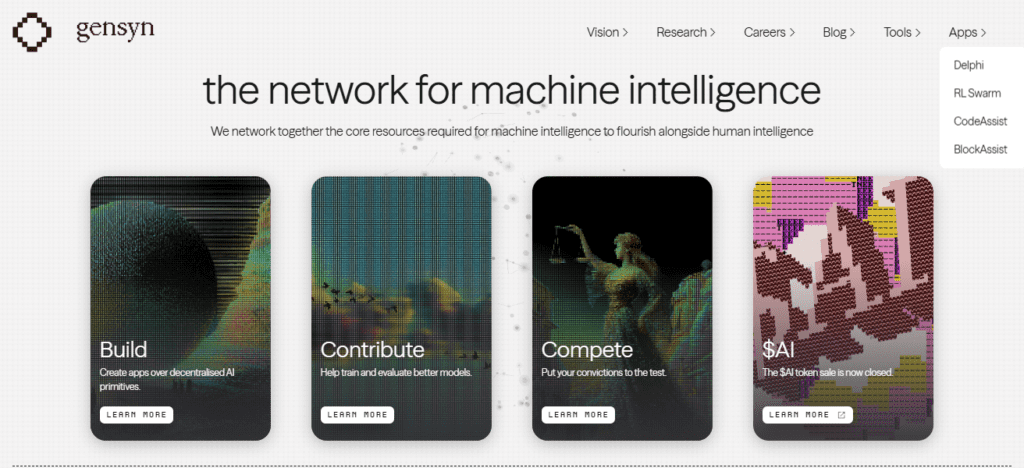
Gensyn The testnet state of Gensyn will be transitioned to mainnet within 2026, with increasing developer engagement.
The focus is on making it reproducible and verifiable, which is what enterprise-grade AI needs, unlike GPU marketplaces. This makes Gensyn fundamental infrastructure for decentralized AI systems that can be trusted.
| Feature | Details |
|---|---|
| Core Focus | Verified AI training |
| Unique Edge | Proof of computation |
| Latest Trend (2026) | Mainnet rollout |
| Use Case | Enterprise AI |
10. iExec RLC
iExec RLC gives the AI & Data focused decentralized cloud computing. It is based on Ethereum and provides a secure way to run computations off-chain, giving developers an alternative way of executing
AI workloads directly without the need for centralized servers. What makes it different is Trusted Execution Environments

Which guarantees that the data is kept confidential during processing. New partnerships regarding enterprise computing and Web3 infrastructure.
Finally, iExec combines centralized Cloud with decentralized AI —having scalable compute while preserving privacy— thus it becomes a solid candidate for enterprise adoption of decentralization in machine learning.
| Feature | Details |
|---|---|
| Core Focus | Decentralized cloud |
| Unique Edge | TEE security |
| Latest Trend (2026) | Enterprise integration |
| Use Case | Secure AI workloads |
Conclsuion
As well as the best decentralized machine learning networks to invest in (Bittensor, Fetch. Some projects—like Singularitynet, Fetch.ai, and Ocean Protocol—are coming up with decentralized forms of data, compute, and intelligence for the future of ai.
These projects have long-term potential but with risks as adoption increases in 2026. By conducting your due diligence, diversifying appropriately, and seeking out tangible use cases, the recently emergent nature of the sector may yet provide opportunities to generate sizeable returns on investments.
FAQ
Blockchain-based platforms distributing AI training, data, and compute across decentralized nodes securely.
Top options include Bittensor, Fetch.ai, and Ocean Protocol.
It improves data privacy, reduces centralized control, and lowers AI infrastructure costs globally.
Bittensor rewards machine learning models based on useful output using proof-of-intelligence.