

How Crypto Is Powering Freelancers in Emerging Markets in this article. With traditional banks, constantly changing currency value, and cross-border payments crashing in fees, global opportunities are permanently limited for freelancers.
Using crypto and stable coins means they can send and receive payments instantly for little to no cost, inflation protects, and they can work with clients in any other country. Along with being a payment solution, crypto encourages economic independence and resiliency, as well as, a global scope and long career span for freelancers.
How Crypto Is Powering Freelancers in Emerging Markets
Overcoming Banking Barriers

In emerging countries, many freelancers do not have bank services. Landing them bank accounts do not enable them to receive payments. Crypto wallets bypass these barriers and allow their clients to pay them directly.
Protecting Against Currency Volatility
Inflation and devaluation of local currencies often leads to loss of value of a freelancer’s earnings. Protecting and holding earnings using stable coins and/or major cryptocurrencies shield them from further limit loss.
Reducing High Transaction Fees
Freelancers tend to receive low payments from services rendered because traditional border crossing payments charge extremely high rates. This causes them to lose high payment fractions. Crypto significantly lowers these rates meaning more money for them.
Enabling Instant Global Payments
Enabling instant global payments through Crypto means that freelancers no longer have to wait for payments to come in from virtually every country in order to reinvest in their business.
Expanding Global Client Access
In developing regions, freelancers have no limits of using banks to access clients in other countries. This is because Crypto facilitates payments which are otherwise limited by traditional bank payments.
Increased Financial Independence
With cryptocurrencies, freelancers can manage their finances, including storing, spending, transacting, and investing their income without using banks or other centralized financial systems.
Connection with Freelance Platforms
LaborX and Bitwage are examples of freelance platforms that allow payment in cryptocurrency. Once integrated, freelancers can invoice, receive, and withdraw payment in cryptocurrency.
Increased Earning Potential
Freelancers can diversify their income by investing their cryptocurrency earnings in other cryptocurrencies or DeFi projects and using their cryptocurrencies to pay for services in different countries.
Risk and Security Management
Freelancers are encouraged to secure their payment wallets and use reliable services to minimize the risks and threats of unregulated cryptocurrencies during the payment process.
Staying Ahead of the Curve
Freelancers are developing countries will benefit the most from the financial improvement the world will have due to the higher use of cryptocurrencies. The financial services will be flexible and the payment systems will be stable. Global payment systems will be available.
Freelancing Challenges in Emerging Markets
Here’s a breakdown with the specific focus on important and differentiated elements detailing the Challenges to Freelancing in Emerging Markets.
Banking Services Are Not Fully Accessible
Lack of access to formal banking systems or services is a frequent hurdle for many freelancers in developing economies and countries. This creates dependency on alternative payment systems or even illegal systems to receive international payments.
Local Markets Are Highly Inflationary and Have Volatile Currency
Developing countries and economies tend to have high inflationary markets. Local currencies depreciate quickly, making income unpredictable. This condition diminishes freelancers’ ability to plan their finances
Transaction and Remittance Costs Are Extremely High
Freelancers often have to put up with high rates on international money transfers, banking and money transfer services, and cross border payment systems. This is also true for payments to freelancers, making them think twice about working with international clients.
Payments Are Subject to Delays
International payments take a long time to be credited in bank accounts, making cash flow a problem for freelancers. This limits them to reinvest in their business, buy new business tools, or even pay their living expenses
Limited Opportunity to Engage with the Global Market
Without the ability to pay digitally, freelancers are forced to work with only local clients or clients from countries with local currencies. This severely limits income and even the potential to grow the business
Incomplete or Weak Financial Ecosystem
Invoicing, payments, and credit systems are often non-existent in many areas. This makes tax compliance and account management difficult for freelancers. Efficient systems for saving money are also lacking.
Regulatory and Tax Problems
Legal risks and tax complications arise from the complexity and opaqueness of regulations regarding international income, the use of cryptocurrency, and the drafting of freelancing contracts.
Trust and Security Issues
Freelancers are at risk of not getting paid as clients may not be trustworthy. Contract enforcement across borders and limited legal options make the risk even more.
Lack of Knowledge of Global Freelancing Websites
Access to better paying jobs is limited due to the fact that many talented freelancers do not know of global freelancing websites.
Lack of Technology
Freelancers poor devices, digital imiteracy, or poor internet can make communicating with clients difficult.
How Crypto Solves Freelancing Challenges in Emerging Markets
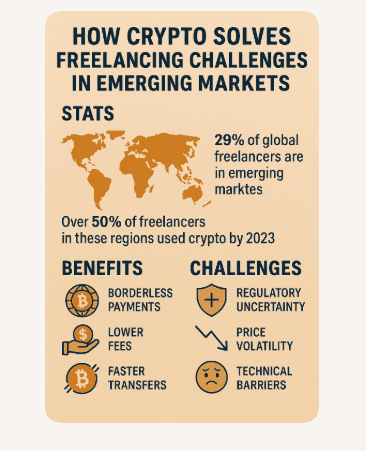
Limited Access to Banking
Wallets are a way to allow a freelancer to get paid without needing a bank account, giving them the chance to be a part of the global economy.
Currency Risks
With regards to currency, the inflation of the currency does not affect the freelancer if they are using a stablecoin or competitor to the USD.
High Fees
For freelancers to keep their funds, they would want to use a service that does not take a lot of money or use the bank.
Delays in Payment
Depending on the reasons for the delays, freelancers want to be able to control the flow of payments with respect to their business and personal cash.
Working with Other Countries
With respect to the sites that they use, freelancers want to be able to choose where they get paid, and they want to be able to choose the countries with the best payments.
Control of Their Money
Via wallets, freelancers have direct ownership of their money, and are in control of their spending, saving, and investing.
Integration of Freelance Platforms Made Easy
Freelancers’ ability to invoice, get, and withdraw payments in crypto at LaborX and Bitwage enables seamless crypto payment integration.
Cryptocurrency increases income streams.
Freelancers can use crypto for other cryptos, stablecoins, or fiat, as well as DeFi investments to enhance their income streams.
Increased Trust and Security
The security of crypto transactions is the blockchain. To ensure payment is made, smart contracts can reduce the losses from scams and the losses from skipped payments.
Inclusion and Financial Technology Increased
Digital literacy is improved by the use of crypto, as well as access to global finance. This gives freelancers the ability to participate in the digital economy.
Platforms and Tools Enabling Crypto Freelancing
LaborX – Crypto Freelance Marketplace
LaborX is a marketplace for freelancers to easily and quickly get paid in a cryptocurrency of their choice for the completion of a contract with a client.
Braintrust – Decentralized Freelance Network
Professionals on Braintrust, a decentralized network, and blockchain-based freelance platform, seek global contracts. Crypto payments authorize the earning of freelancers in developing economies due to cost-effective payment systems.
Ethlance – Ethereum-Based Freelancing
Ethlance is a freelancing platform that is completely built on Ethereum blockchain and allows freelancers to get paid in cryptocurrency. The payments are fully transparent and instantaneous.
Bitwage – Crypto Payroll Solution
Bitwage allows freelancers to receive their wages, invoices, or any part of their payments in cryptocurrency, such as Bitcoin, Ethereum, or stablecoins, as well as in fiat currency.
Coinbase Pay & Crypto.com Pay – Payment Platforms
Due to the very low fees associated with using Coinbase Pay and Crypto.com payments, and the fact that they can imply instant user international payments using digital money without the constraints of traditional banks, freelancers find it very easy to receive international payments. Wallet integration is an additional facilitating element.
MetaMask & Trust Wallet – Cryptocurrency Wallets
Freelancers can utilize digital wallets such as Trust Wallet and MetaMask to manage and conduct transactions of various cryptocurrencies. Wallets offer ease of access of funds to clients around the world.
Ledger & Trezor – Crypto Hardware Wallets
For freelancers, hardware wallets offer offline protection of digital currency which is imperative for protection against hacks. By providing essential protection against hacks, they are good for freelancers who are keeping a lot of digital currency, or for those that will need digital currency for an extended period of time, especially if the currency is in a very volatile state.
Benefits of Crypto for Freelancers in Emerging Markets
Achieving Financial Inclusion
With cryptos, freelancers even without bank accounts can now receive payments, manage their funds, and circumvent their local banking restrictions and other financial constraints.
Earning Protection from Local Currency Devaluation
Earnings in stablecoins or some major cryptos offer protection from inflation or devaluation of a freelancer’s local currency, thus, ensuring steady income to freelancers, irrespective of the economic situation.
Receiving Payments Quicker
Funding delays are a thing of the past. With cryptocurrency, freelancers can receive payments, and improve their cash flow to cater for personal expenses and also reinvest in their businesses.
Paying Lesser Transaction Fees
Compared to other banking and money transfer services, cryptocurrency offers cross-border payment systems at more affordable rates. Hence, freelancers can retain more of their income and intermediaries.
Greater Client Base Access
With cryptocurrency, freelancers no longer have to worry about banking constraints when working with clients from other countries. With this, many prospects will come, especially wide-paying jobs.
Financial Independence
Freelancers no longer have to rely on banks or other third parties to manage their funds. They have full control over their money (i.e. what to store, convert, spend, or invest).
Multiple Sources of Income
Freelancers have the ability to spend, lend, or borrow their money on DeFi (i.e. decentralized finance) platforms put their money to work to earn interest, and convert money on demand to other cryptocurrencies, stablecoins, or even fiat currencies.
Increased Trust
Freelancers can have more trust in international business dealings and payments because of the reduction of payments delayed payments, disputes over contracts, or scams that can be more easily perpetrated, as payments, and contracts, can be automated by smart contracts.
Promotes Digital Skills
Freelancers that choose to pay with cryptocurrency will be motivated to learn and their digital financial skills will improve because they will have to learn to use financial tools, wallets, and blockchain technologies.
Financial Tools That Are Ready For The Future
With the ability to pay with crypto, freelancers will be use advanced cashless payment systems, decentralized finance, digital tokens, international micro payment systems, and other systems that will be developed in the future, which will allow them to take advantage of international work opportunities.
Risks and Considerations
Crypto Volatility
Though stablecoins are less risky than other cryptocurrencies, many have significant volatility. Additionally, freelancers paid in coins that are experiencing volatility may receive less money than expected.
Regulatory Uncertainty
Taxes may not be clear in emerging markets, which poses total legal liability for the freelancers. Different markets have uncertain regulations concerning the legality of paying internationally and cryptocurrency.
Security Threats
Security is very important; money can be lost due to hacks, phishing, and wallets. Freelancers should ensure they secure their private keys and use secure sites.
Limited Adoption by Clients
Clients may not be able to pay by cryptocurrency. Freelancers may have a difficult time persuading clients to use a different means of payment.
Transaction Irreversibility
Payments made through cryptocurrencies are irreversible. The address or amount typed can cause a complete loss of funds.
Technical Complexity
Using and creating wallets and smart contracts, trading on the stock market and using several exchanges can be difficult. The blockchain is complicated, and those without experience will commit many mistakes.
Market Liquidity Issues
Accessing money is usually delayed due to the ability to pay in cryptocurrencies. Digital currencies cannot easily be converted to local government currencies.
Tax Implications
Freelancers need to understand how their local tax laws apply to earnings in cryptocurrency. Misreporting them or misunderstanding tax laws can lead to fines or legal trouble.
Dependence on Technology
To do transactions in cryptocurrency, people need access to a reliable internet connection and a smartphone or computer. Technical issues can cause people to be unable to do transactions and can also lead to people being unable to access their funds.
Psychological Stress
Freelancers are susceptible to stress due to the high price volatility, security issues, and regulatory uncertainties associated with cryptocurrencies and the instability in income that comes with relying on them.
Future Outlook of Crypto for Freelancers in Emerging Markets
Widening Crypto Usage
Freelancers and clients in developing countries will use cryptocurrencies as payment faster with improvement in awareness and infrastructure over crypto payments for cross-border payments.
Rise of Stablecoins
A shift to stablecoins will give freelancers’ earnings more predictability, safe cross-border payments, and protection from volatile local currencies.
Freelance Platforms to Innovate
Emerging freelancers will be able to access more job opportunities as leading freelance markets implement crypto payments, smart contracts, and crypto wallets.
More DeFi Options
Emerging economies will have new financial instruments as decentralized finance (DeFi) provides the ability to lend, borrow, earn interest and hedge in crypto.
Positive Regulatory Changes
Emerging economies will have an environment conducive to safe cross-border freelance payments as regulations on crypto are simplified, thus increasing the government’s confidence toward the freelancers’ legal risks.
Improved Payment Security
Use of smart contracts and other blockchain technologies will streamline payments, prevent late and disputed payments to freelancers and minimize fraud.
Opening New Global Market Opportunities
Because cryptocurrencies have no payment system barriers, freelancers from developing countries can now take on international jobs that were previously for higher pay and inaccessible due to a country’s banking system.
Advanced Digital Skills
With the increased freelancing, the use of cryptocurrencies is on the rise, and the use of these digital currencies and Financial Independnce is taking digital literacy to a completely new level.
Economic Empowerment for the Longer Term
With the ability to earn consistently, freelancers from developing countries are economically empowered, and the ability to earn money creates new opportunities for entrepreneurs, new businesses, and new opportunities, and increases the overall economic level of the country.
Conclusion
Studies indicate that more than 60% of freelancers in developing countries report banking obstacles, and 45% complain about international payments made to them that are delayed and/or expensive. The issues outlined above are resolved via payment systems that utilize cryptocurrency to process payments that are immediate, inexpensive, and borderless.
Local currencies are subject to significant depreciation and/or inflation and may pose a risk to the payment’s value and in such cases, a stablecoin may mitigate the risk. LaborX and Bitwage provide cross-border payments in cryptocurrency and have made more than a few thousand payments to users.
Smart contracts help to solve disputes around payments. All of the above may assist in demonstrating that cryptocurrencies provide freelancers with more than just a payment option; they offer the possibility of a more financially integrated, empowered, and economically-resilient freelance ecosystem.
FAQ
Freelancers can use crypto wallets and platforms like Bitwage, LaborX, and Braintrust to invoice clients and receive payments in Bitcoin, Ethereum, or stablecoins instantly, bypassing traditional banks.
Yes, blockchain technology ensures transparency and security. Smart contracts automate milestone payments, but securing private keys and using trusted platforms is essential to prevent hacks.
Stablecoins like USDT, USDC, and DAI are ideal for consistent income, while Bitcoin and Ethereum can be used for broader investment or savings opportunities despite volatility.
No. Freelancers can operate entirely via digital wallets, allowing financial inclusion even in regions with limited banking access. Bank accounts may only be needed for converting crypto to local fiat.
Traditional international transfers can cost 5–10% in fees, while crypto transactions typically cost less than 1%, allowing freelancers to retain more income.