

How Blockchain Is Revolutionizing Digital Voting Systems: This article will explore how this cutting-edge technology is changing election security, transparency, and trust.
Blockchain provides a decentralized and impenetrable solution for contemporary democracies, prohibiting vote tampering and facilitating safe remote participation. Let’s examine how it is influencing how digital voting will develop globally in the future.
What is Blockchain Technology?
Blockchain technology is a decentralized digital ledger system that securely, openly, and irrevocably records transactions over a network of computers. Instead of depending on a central authority like traditional databases do, each participant (node) has a copy of the ledger.

To ensure tamper-proof records, transactions are organized into blocks, cryptographically linked, and validated using consensus techniques like Proof of Work or Proof of Stake.
Its primary characteristics—decentralization, immutability, transparency, and security—make it perfect for uses outside of cryptocurrencies, including as digital voting systems, supply chain management, finance, and healthcare, where integrity and trust are crucial.
How Blockchain Is Revolutionizing Digital Voting Systems

Increased Security
- Blockchain ledgers are the equivalent of a digital vault. The vault is tamper-proof and deletion is not allowed.
- Voter eligibility is ensured using cryptographic methods (encryption).
Trust and Transparency
- The public ledger allow voting records to be disclosed in a manner that keeps the voter’s identity a secret.
- Trust increases because the election authority and the voters are both able to verify the votes and audit the records.
Faster and More Accurate Data Processing
- Voter records are able to be counted and updated faster, and with fewer mistakes because there is a machine to do the counting and updating.
- This also means that there will be no need to do data reconciliation or vote counting.
Voting Accessibility and the Ability to Vote from Anywhere
- Voting from anywhere in the world will allow displaced people, people with disabilities and people living in isolated rural areas to vote.
- This is also a benefit because there is no risk of losing the voter’s ballot because the voting technology is embedded in the Blockchain.
Election Fraud is Decreased
- The voting system is protected against people altering the vote from a central authoritative position.
- The voting system is equally protected against people voting multiple times.
- This protection is because each voter’s identity is verified (ID verification).
Cost Saving Measures
- Ballots, ballot counting, and ballot transportation has caused election related costs to be high.
- These costs will be less in the future.
Audit Trails that Cannot be Altered
- All votes cast will be able to be audited because they are recorded.
- All voter privacy will be retained.
Benefits of Blockchain-Based Voting Systems
Robust Security
- Voting data cannot be altered or hacked because of the security measures that are taken with blockchain technology.
Confirmation of Votes
- The public ledger remains unchangeable and users can verify the ledger to confirm that all votes were recorded.
Privacy of Voters
- Votes are recorded in an encrypted form so that the identities of voters are protected while still allowing for verification.
Rapid Counting of Votes
- Automated processes can provide instant results compared to the manual processes that can be prone to errors.
Minimized Election Fraud
- Fraudulent behavior such as tampering with votes is eliminated because the blockchain ledger is decentralized.
Voting from Anywhere
- Access to the vote is available online which benefits people who are working in far or remote locations as well as those who are out of the country.
Reduction of Costs
- Administrative costs, costs of manual labor, and costs of the use of paper ballots are all reduced because of the blockchain technology.
Easy to Audit
- Privacy is not compromised because people can vote online, and the records are permanent and can be traced so audits can be conducted.
Public Confidence
- With the use of the technology, the public becomes confident that the elections are true and unbiased.
Is blockchain voting completely secure?
No, voting on a blockchain is still not completely secure, but if designed and executed correctly, it can improve on existing digital voting systems.
The voting process in blockchain still has additional protective measures in place i.e decentralization, cryptographic measures, and blockchains immutable ledger which makes it extremely difficult to alter or tamper with votes once they have been recorded.
In contrast to the protections of the blockchain, there are still identifiable risks associated with voting systems:
- Hacked or infected devices can include user devices.
- Systems for digital identity verification can be breached.
- Security vulnerabilities can be a consequence of software implementation or bugs.
- Human error, social engineering and catfishing are still proven risks.
Real-World Examples and Case Studies
Estonia – e-Residency and i-Voting
- Online voting in Estonia uses blockchain-based techniques for the first time in the world in 2005.
- Voting system in Estonia has high levels of privacy and safety.
West Virginia, USA – Mobile Blockchain Voting Pilot
- Voting through a blockchain-based mobile application was made accessible and secure to military personnel voting from overseas.
- Voting was processed faster, and there was less chance of fraud.
Sierra Leone – 2018 Parliamentary Elections
- Voting in the 2018 Sierra Leone Parliamentary Elections was the first time that blockchain technology was used to count votes.
- Blockchain gave Sierra Leone the first system in its history that guaranteed the accuracy of the vote count.
Moscow, Russia – Digital Voting Experiments
- Digital voting experiments using blockchain for municipal elections in the Russian Federation.
- Voting system in Russia focused on providing transparency and enabled votes to be audited in real-time.
Switzerland – Blockchain Voting Trials
- Voting trials using remote or online voting in Zurich.
- Voting system in Zurich was secure and voting was authenticated.
Dubai – Government Blockchain Initiatives
- Dubai uses secure voting in its digital experiments that use blockchain technology.
- Voting system in Dubai is part of the Smart City digital governance model.
Can blockchain voting prevent election fraud?
Blockchain voting reduces election fraud, but does not eliminate it.
The ways fraud can be committed is fraud is done as follows:
- Immutability: No one can alter a vote once it is registered into the blockchain systems.
- Decentralization: No chap can control it which reduces the likelihood of central fraud.
- Votes are secured by blockchain: No one can change or add any votes.
- All votes are transparent: Independent auditing is available as each vote is registered and can be verified.
- One person one vote: Verified voting can be done through a digital identity system.
Challenges and Limitations
Technical Complexity
- The requirement of advanced infrastructure, well skilled developers, and digital secured identity framework, add a lot to the complexity and cost of implementation of blockchain systems.
Risks in Cybersecurity
- Blockchain in a system is secure, however, the system’s mobile device, app and/or server endpoints can be the target of a hacking and/or malware attack.
Allotment of Scalability
- During a national election multiple votes are cast, therefore there is a risk of public blockchain to perform that task in an efficient manner.
Digital Divide
- Users may be excluded and may not be able to vote as digital literacy, a device and a good internet connection is required.
Concerns of Privacy
- The system can be designed in a way that the identities and patterns of voters that cast their vote can be exposed, and even though the votes cast are encrypted, this may still happen.
Barriers are Legal and Regulatory
- The election systems that are based on blockchain technology are not fully regulated and there are no laws that exist to provide guidance in many jurisdictions.
Tech Trust
- The voting system is a digital system that is new in nature but the public may distrust it, especially in a politically sensitive voting environment.
Costs that are High in the Beginning
- There may be a lot of blockchain voting systems that require investments that are of a large scale for the creation and testing to take place.
Future Outlook
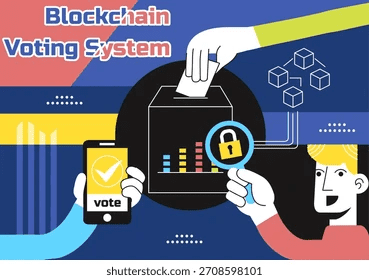
Blockchain-based digital voting systems appear to have a bright future as long as organizations and governments keep researching safe and transparent election technologies.
It is anticipated that improvements in scalability, energy-efficient consensus techniques, and privacy tools like zero-knowledge proofs will improve voter confidentiality and system performance. Election integrity could be preserved while safe, distant participation is made possible through integration with digital identification frameworks.
However, public trust, cybersecurity protections, legal certainty, and the growth of digital infrastructure will all be necessary for broad adoption. Before possibly expanding to national democratic processes, blockchain voting may initially be used in university polls, corporate governance, and municipal elections as technology advances.
Conclusion
In conclusion, by establishing a new benchmark for security, openness, and confidence in the political process, blockchain is transforming digital voting systems. Its immutable and decentralized ledger allows for quicker and more effective vote counting while lowering the possibility of fraud, tampering, and human error.
Blockchain has the ability to boost voter engagement and confidence in election results by enabling secure remote participation and safeguarding voter privacy through cutting-edge cryptography. Even if there are still issues with scalability, regulation, and digital accessibility, with further development and cautious use, blockchain has the potential to revolutionize how democratic elections are conducted around the world.
FAQ
Blockchain voting is a digital voting system that records votes on a decentralized and encrypted blockchain ledger, ensuring transparency, security, and immutability of election results.
Blockchain uses cryptographic encryption and decentralized validation to prevent vote tampering, hacking, and unauthorized access, making election data highly secure.
Yes, blockchain reduces fraud by ensuring one-person-one-vote through secure digital identity verification and by making votes immutable once recorded.
Yes, votes are encrypted and anonymized. While the transaction is visible on the ledger, personal voter information remains confidential.
No system is 100% secure. While blockchain itself is highly secure, vulnerabilities can exist in devices, applications, or identity verification systems.