


In this article, I will analyze Crypto Compliance Tools for Enterprises, examining how companies can enhance compliance, assess risks, and allow safe transactions involving digital assets.
With these tools, enterprises can improve fraud detection, optimize AML/KYC, and strengthen their position with regulators, regardless of the rapidly developing cryptocurrency environment.
Key Points & Crypto Compliance Tools for Enterprises
Elliptic Provides blockchain analytics, transaction monitoring, and AML compliance solutions for exchanges, banks, and regulators.
Chainalysis Offers deep blockchain investigations, transaction tracing, and compliance support for governments, enterprises, and financial institutions.
Phalcon Compliance Real-time risk blocking for DeFi protocols and exchanges, preventing illicit transactions and regulatory violations.
TRM Labs Delivers crypto risk management, wallet screening, and transaction monitoring with AI-powered compliance infrastructure.
Scorechain Provides customizable compliance tools, risk scoring, and blockchain analytics for enterprises handling digital assets globally.
Coinfirm Specializes in AML/KYC compliance, fraud detection, and regulatory reporting for crypto businesses and financial institutions.
IdentityMind Focuses on digital identity verification, KYC onboarding, and transaction monitoring for crypto exchanges and enterprises.
ComplyAdvantage AI-driven AML screening, sanctions monitoring, and transaction risk detection tailored for crypto enterprises worldwide.
CipherTrace Provides blockchain intelligence, transaction tracing, and compliance solutions for enterprises combating crypto-related financial crimes.
Fenergo Enterprise-grade KYC, AML, and client lifecycle management platform supporting crypto compliance and regulatory adherence.
10 Crypto Compliance Tools For Enterprises
1. Elliptic
Elliptic is an advanced blockchain analytic tool that assists businesses with the detection and prevention of financial crime from transactional activity in the crypto space.
Elliptic provides features such as Anti Money Laundering (AML) monitoring, wallet screening, and transactional risk scoring.
With Elliptic, financial institutions (FIs), crypto exchanges, and governmental agencies can detect fraudulent activity and remain compliant with jurisdictions’ requirements in the law.
Elliptic provides the ability to review and customize compliance workflows to the user, and provides continuous monitoring, and automated workflows to users, offering a throughput of an organization’s activity within a given period of time.
Elliptic is one of the most trusted partners when it comes to transparency and security in the digital asset market, and covers billions of addresses associated with high risk activities.
Elliptic Features
- Provides analytics on a broad range of cryptocurrency blockchain technologies.
- For banks and exchanges, offers tools which detect money laundering and other fraudulent activities.
- Includes capability for forensic investigations, which help in following the trail of funds that were illicit.
- Provides integration with compliance workflow systems for monitoring activities in real time.
| Pros | Cons |
|---|---|
| Strong blockchain analytics with wide coverage of crypto assets | Pricing can be high for smaller firms |
| Well-regarded in AML and fraud detection | May require technical expertise to integrate |
| Offers forensic investigation tools | Focused mainly on crypto, less on traditional finance |
2. Chainalysis
Chainalysis provides blockchain data and investigative services as one of the most commonly used crypto compliance tools.
Enterprises regard Chainalysis useful for transaction monitoring, wallet screening, and tracing illicit activities across several blockchains.
Chainalysis also assists governments and regulators with investigations of fraudulent, ransomware, and money laundering activities.
Of the several tools offered by Chainalysis, the real-time transaction risk scoring tool called KYT (Know Your Transaction) as well as the analytical tool for forensic blockchain analysis known as Reactor are most widely used.
In addition, Chainalysis provides training and certifications to support compliance teams with their adaptation to new regulations. This tool is one of the most comprehensive analytical tools for global crypto compliance.
Chainalysis Features
- Provides comprehensive analytics and data visualization tools for blockchain technology.
- Has been employed by governments, regulatory bodies, and exchanges for all countries.
- Provides law enforcement and compliance investigation tools.
- Provides market intelligence on the trends and risks associated with cryptocurrency.
| Pros | Cons |
|---|---|
| Industry leader with broad adoption by governments and exchanges | Expensive compared to competitors |
| Large dataset and strong visualization tools | Some users find UI complex |
| Provides investigation, compliance, and market intelligence | Heavy focus on law enforcement use cases |
3. Phalcon Compliance
Phalcon compliance is centered around blocking risks in real-time for DeFi protocols and crypto exchanges. It focuses on helping enterprises avoid regulatory risks by allowing them to stop fraudulent transactions before they are executed.
Phalcon monitors smart contracts and blockchain and stops high-risk transfers and transactions in real-time. Its system is also built to support enterprise-level compliance across many chains and platforms.
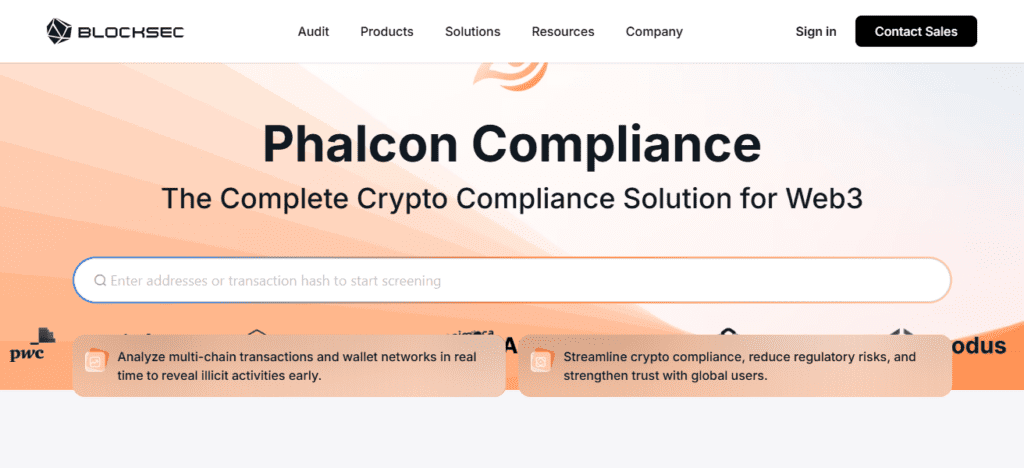
As such, it is designed to support parallel compliance across many chains and platforms. Phalcon is unique because of its ability to identify and manipulate risks in rapidly changing crypto environments.
DeFi projects are especially in need of Phalcon because of how traditional compliance systems are far removed from DeFi compliance ecosystems.
Phalcon Compliance Features
- Focused primarily on monitoring the risks associated with decentralized finance and the analysis of smart contracts.
- Provides the ability to monitor transactions in real time on decentralized finance platforms.
- Provides automated compliance assessment systems for decentralized finance projects.
- Aids in the detection of weaknesses and questionable activities in the associated smart contracts.
| Pros | Cons |
|---|---|
| Specialized in DeFi and smart contract risk monitoring | Less brand recognition compared to larger players |
| Real-time transaction monitoring | May lack coverage outside DeFi ecosystems |
| Focused on compliance automation | Smaller client base, less proven scalability |
4. TRM Labs
TRM Labs offers a complete risk management solution for cryptocurrency businesses. Automated fraud detection, money laundering, and compliance breach detection systems are powered by AI.
Wallet screening, transaction monitoring, and blockchain analytics are some of the other services offered by TRM Labs.
TRM Labs also provides investigative tracing tools, which allow compliance teams to counter illicit threats.
TRM Labs is versatile because it accommodates over 30 blockchains and thousands of tokens, which is crucial for a multitude of cryptocurrency enterprises.
TRM Labs focuses on scalability to simplify regulatory compliance for cryptocurrency enterprises.
TRM Labs has built a reputation for reliability among businesses in complex regulatory jurisdictions.
TRM Labs Features
- Provides risk management services for businesses that operate in the cryptocurrency space.
- Provides tools for detection of fraudulent activities and money laundering and other illegal activities.
- Provides monitoring of sanctions and regulatory compliance.
- Provides a transparent reporting system which builds trust with regulatory agencies.
| Pros | Cons |
|---|---|
| Strong focus on risk management and crypto compliance | Still growing compared to Chainalysis and Elliptic |
| Covers fraud, AML, and sanctions screening | May require customization for enterprise needs |
| Good reputation with regulators and financial institutions | Pricing may be restrictive for startups |
5. Scorechain
Scorechain offers customizable compliance tools for businesses working with digital assets. This platform allows the user to customize risk scoring, transaction monitoring, and blockchain analytics for a particular set of laws.
For businesses working in several jurisdictions, this platform is particularly useful because the user is able to customize Scorechain to meet compliance requirements in a given jurisdiction.
Scorechain covers a wide range of cryptocurrencies and is able to meet the detailed reporting requirements of auditors and other regulatory bodies.
Scorechain’s dash board provides a visual representation of the risk to aid compliance team in monitoring for suspicious activity.
The clear and configurable nature of Scorechain allows enterprise to operate within the confines of regulation and earn the confidence of the customer.
This modular approach allows the platform to be used by new businesses as well as matured financial institutions.
Scorechain Features
- Provides risk assessment systems for cryptocurrency transactions.
- Strong compliance with European laws and regulations for regulatory compliance
- Offers the integration of analytics alongside multiple cryptocurrencies.
- Grants the enterprise the ability to personalize compliance dashboards**.
| Pros | Cons |
|---|---|
| European-based compliance solution with strong regulatory alignment | Smaller global footprint |
| Offers customizable risk scoring | Limited integrations compared to bigger firms |
| Supports multiple crypto assets | Less visibility outside Europe |
6. Coinfirm
Coinfirm is a powerful fraud detection and regulatory reporting tool. They offer compliance solutions for KYC and AML for cryptocurrencies, and provides reporting to regulatory bodies for reporting compliance.
Their extensive analytics are able to assist cryptocurrencies to be compliant with analytics linked to illicit activity.
They assist with reporting analytics, making reporting to the regulators easier. Their analytics are used extensively for reporting KYC/AML compliance at the banks, the exchanges, and custodians.
This makes it easier to limit the reporting of KYC/AML compliance analytics to the banks, the exchanges, and custodians.
They focus on reporting analytics to make it easier for their customers to reduce fraud, financial crime, and other criminal activities to remain
KYC/AML compliant reporting at the regulators for the cryptocurrencies. They focus on their customers’ KYC/AML compliance, along with their reporting analytics.
Coinfirm Features
- Focuses on the automation of compliance with AML and KYC.
- Addresses crypto wallets and transactions with *risk scoring.
- Provides startups and enterprises with flexible options.
- Comes with the tools needed to conduct regulatory reporting for audits.
| Pros | Cons |
|---|---|
| Known for AML and KYC solutions in crypto | Interface can feel less polished |
| Provides risk scoring and compliance automation | Smaller dataset compared to Chainalysis |
| Flexible for enterprises and startups | May lack advanced forensic tools |
7. IdentityMind
Using its KYC and AML reporting for KYC and AML compliance reporting, customers are able to KYC their customers, submit their KYC reports to regulators, and do KYC reporting.
They focus on KYC reporting and KYC fraud detection to remain compliant. This means that KYC is created, KYC is now created, KYC is created, KYC is created, etc.
KYC is a driving factor for KYC frauds. KYC is created, KYC is created, KYC is online based, KYC is created, etc. KYC is created, KYC is created, KYC is created, KYC is created, etc.
KYC is created. KYC is created to assist you remaining KYC compliant with AML, KYC is created to provide compliance for KYC reporting, and KYC is created for KYC reporting.
KYC is created to be able to KYC, to be able to KYC, to be able to KYC, to be able to KYC, to be able to KYC, and to be able to KYC.
Identity Mind Features
- Specializes in the prevention of fraud and the verification of digital identities.
- Offers the KYC/AML compliance tools to banks and fintechs.
- Aids in the identification of synthetic identities and suspicious behaviors.
- Works with the platforms of payment providers and financial institutions.
| Pros | Cons |
|---|---|
| Strong digital identity verification and fraud prevention | Focus more on identity, less on blockchain analytics |
| Good for fintechs and payment providers | May not cover all crypto-specific risks |
| Offers KYC/AML compliance tools | Competes with many identity-focused vendors |
8. ComplyAdvantage
ComplyAdvantage’s compliance solutions for crypto companies utilize artificial intelligence for anti-money laundering (AML) screening, sanction tracking, and identifying risks in transactions.
Compliance automation is achieved via machine learning, which enables threat detection and compliance flexibility in response to changing regulations.
ComplianceAdvantage integrates into enterprise workflows to automate and streamline the compliance process and reduce manual work.
In the event of suspicious activity, organizations must respond to alerts. ComplianceAdvantage’s global coverage to suit multinational companies.
ComplianceAdvantage combines sophisticated technology and knowledge of regulations to balance compliance and risk within a shifting environment.
Comply Advantage Features
- Incorporates AI for the screening of AML to identify sanctions and watchlists.
- Facilitates transaction monitoring in real-time in all fields.
- Frequently used in finance technology and banking.
- Gives clients the ability to access risk databases that cover all regions of the world.
| Pros | Cons |
|---|---|
| AI-driven AML screening with strong sanctions coverage | Less crypto-specific than Elliptic or TRM Labs |
| Real-time monitoring of transactions | May require integration effort |
| Widely used in fintech and banking | Focused more on traditional finance compliance |
9. CipherTrace
CipherTrace has blockchain intelligence and compliance solutions to aid enterprises in responding to crypto-related financial crimes.
CipherTrace’s cross-chain solution offers transaction tracking, wallet screening, and AML monitoring.
CipherTrace aids enterprises in spotting fraud, ransomware, and money laundering. Investigative tools are also utilized by regulators and law enforcement agencies for compliances.
CipherTrace’s global coverage enables enterprises to obtain a quality risk assessment and compliance report.
CipherTrace is committed to combating financial crime in enterprises, and to ensure that enterprises aligned to regulations.
Cipher Trace Features
- Offers the ability to analyze blockchains and trace cryptocurrencies.
- Provides the tools needed to combat fraud and AML for institutions.
- Provides restrictions on cryptocurrencies.
- Limits are enforced by integrations with Mastercard.
| Pros | Cons |
|---|---|
| Strong blockchain analytics, acquired by Mastercard | Integration may be complex post-acquisition |
| Good coverage of crypto transactions | Some users report slower updates compared to rivals |
| Offers AML and fraud detection | Less independent since acquisition |
10. Fenergo
Fenergo is an enterprise-grade compliance platform for KYC, AML, and client lifecycle management. Digital asset businesses are not their primary target, but they assist in addressing regulatory requirements.
Fenergo’s modular compliance platform onboarding, risk assessment, and regulatory reporting, is designed to streamline compliance cost for businesses.
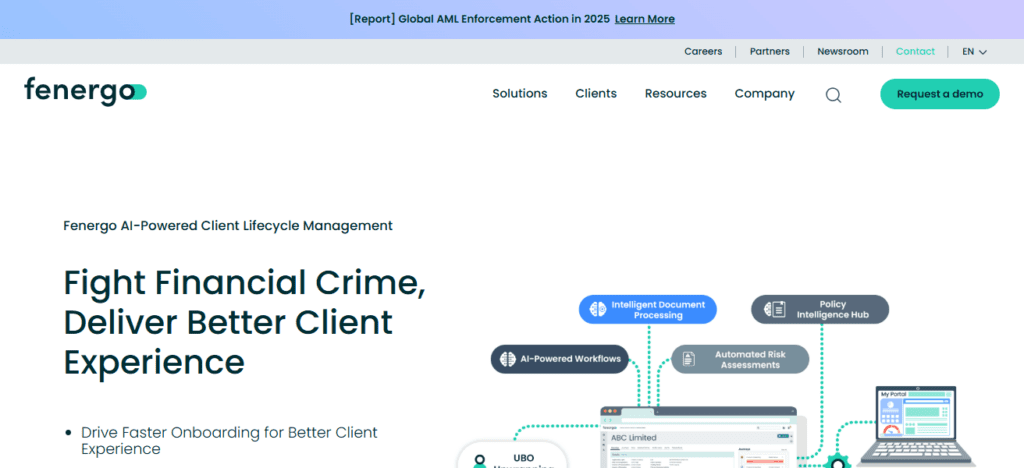
The modular regulatory framework design helps companies adjust to compliance requirements evolving with time and with each region respectively. Integration with blockchain analytical tools enhances the compliance engine for crypto businesses.
The client relationship model helps firm’s build trust with the regulators and clients. Due to the complex regulatory framework, Fenergo is more suited for large businesses.
Fenergo Features
- Focuses on client lifecycle management (CLM) for banks.
- Provides solutions for regulatory compliance, KYC, and AML.
- Used by *big banks all over the world.
- Offers automated workflows to simplify onboarding and monitoring of clients*.
| Pros | Cons |
|---|---|
| Leading provider of client lifecycle management (CLM) | Focused more on traditional finance than crypto |
| Strong KYC, AML, and regulatory compliance tools | Implementation can be resource-intensive |
| Used by major banks and financial institutions | Less specialized in blockchain analytics |
Conclsuion
To sum up, Crypto Compliance Tools for Enterprises are a necessary instrument for managing the evolving regulatory framework for digital assets.
They assist companies with fraud detection, the optimization of AML/KYC procedures, and the ability to keep regulators up to date.
The trust, risk, and safe involvement of enterprises in the rapidly changing cryptocurrency ecosystem will be improved by the use of these tools.
FAQ
They are software solutions that help enterprises meet AML, KYC, and regulatory requirements when dealing with digital assets.
Enterprises use these tools to prevent fraud, detect suspicious transactions, and maintain trust with regulators.
Yes, most leading tools cover a wide range of crypto assets including Bitcoin, Ethereum, and stablecoins.
They monitor transactions, flag risky wallets, and provide automated reporting to meet anti-money laundering standards.