


This article will cover AI-Powered Crypto Risk Management Tools and how they are changing the ways that investors and institutions protect their digital assets.
These tools use AI for fraud detection, compliance monitoring, market sentiment analysis, and risk prediction.
Risk management tools using advanced analytics and the transparency of blockchain technology create new ways of managing risk and protecting portfolios from the continual changes that come with the crypto market.
Key Points & AI-Powered Crypto Risk Management Tools
| Tool | Key Risk Management Feature |
|---|---|
| ChainGPT | AI-driven blockchain analytics for token evaluation and fraud detection |
| Laika AI | Real-time on-chain data analysis to uncover whale moves, CEX/DEX anomalies, and trading risks |
| Web3 AI Token | Portfolio stress testing, token interconnection checks, and automated Value-at-Risk (VaR) metrics |
| Elliptic | AI-based crypto transaction monitoring to detect money laundering and compliance risks |
| Chainalysis KYT | Predictive AI alerts for suspicious wallet activity and regulatory compliance |
| Crystal Blockchain | AI-powered risk scoring for crypto addresses and transaction tracing |
| Scorechain | Automated AML risk assessment using AI for exchanges and institutional investors |
| Coin Metrics ATLAS | AI-enhanced market data feeds to identify systemic risks and anomalies |
| CipherTrace Armada | AI-driven fraud detection and wallet risk profiling for institutions |
| Santiment AI | Behavioral analytics using AI to detect crowd sentiment shifts and potential market risks |
10 AI-Powered Crypto Risk Management Tools
1. ChainGPT
ChainGPT is an AI model trained specifically for use cases in blockchain technology and cryptocurrency. It offers risk management for smart contracts by analyzing and spotting weaknesses and fraud in token ecosystems.
With the help of predictive analytics and automated fraud and bad code auditing, risk exposure is limited, especially for traders and investors.
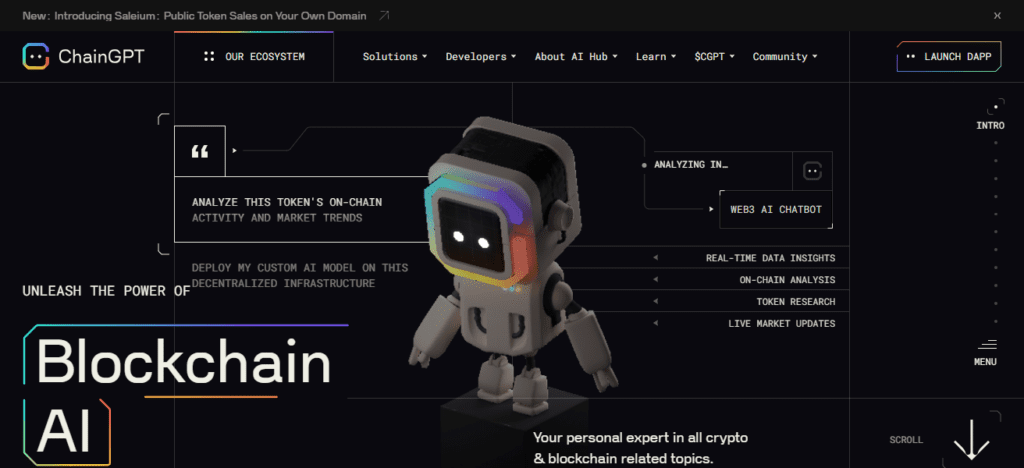
Using NLP and ML, complex blockchain information can be broken down, analyzed and interpreted, while ChainGPT can pinpoint and flag activities that warrant further investigation.
It is therefore a versatile solution for developers, exchanges and investors in the rapidly changing world of cryptocurrency and blockchain, allowing them to reduce their risk exposure.
ChainGPT Features
- Smart contracts analyses to find weaknesses
- Fraud detection for token ecosystems and blockchain projects
- Market trend predictions
- Increased scam loss risk via automated auditing
| Pros | Cons |
|---|---|
| Advanced AI tailored for blockchain and crypto | May require technical expertise to use effectively |
| Detects smart contract vulnerabilities | Limited adoption compared to mainstream compliance tools |
| Helps prevent fraud and scams | Still evolving, so accuracy may vary |
| Useful for developers, exchanges, and investors | May not cover all regulatory requirements |
2. Laika AI
Laika AI specializes in real-time data analysis of potential risks in the crypto market. Constant analysis of transactional patterns of blockchain leads to the detection of potential market crashes.
Unrestricted trading leads to market manipulation, therefore, the analysis of whale trading, CEX and DEX anomalies, and liquidity shifts for the purpose of potential volatility detection becomes paramount.

Carbon AI also assesses portfolio risks to unstable currencies and ecosystems. Along with the analysis of trading patterns
Behavioral analysis allows for the better prediction of the market, thus, improving decision making in terms of investments.
Laika AI Features
- Whale movement and liquidity change detection analytics
- Trade anomalies detection analytics on CEX and DEX
- Risk unstable token analysis on portfolio
- Analytics on trading that is potentially manipulative
| Pros | Cons |
|---|---|
| Real-time monitoring of whale movements | Focused mainly on trading risks, less on compliance |
| Detects anomalies in CEX/DEX activity | May generate false positives in volatile markets |
| Provides portfolio risk assessments | Limited institutional adoption |
| Enhances decision-making with behavioral analytics | Requires constant data feeds for accuracy |
3. Web3 AI Token
Web3 AI Token includes AI-based portfolio stress testing and token connection analysis to manage risk.
It determines Value-at-Risk (VaR) metrics to calculate possible loss in adverse market situations. The tool pinpoints systemic risks in portfolios by revealing previously unrecognized inter-token relationships.

Predictive modeling will also unveil systemic weaknesses in the decentralized finance (DeFi) world, including liquidity, and deficient smart contracts.
With automated risk calculations, Web3 AI Token provides the means to manage risk exposure to the greatest extent, and provides financial institutions and retail investors the ability to withstand liquidity crises in the most sufficiently stressed portfolio situations.
Web3 AI Token Features
- Extreme conditions AI-powered portfolio stress test
- Value-at-Risk (VaR) loss analytics
- Systemic risk analytics through token linkage
- Analytics for forecasting DeFi and liquidity vulnerability
| Pros | Cons |
|---|---|
| Offers portfolio stress testing | Complex for beginners to interpret |
| Calculates Value-at-Risk (VaR) metrics | May not integrate easily with all wallets |
| Identifies token interconnections and systemic risks | Focused mainly on DeFi, less on traditional compliance |
| Helps investors prepare for extreme market conditions | Accuracy depends on quality of input data |
4. Elliptic
Elliptic is an example of AI-driven compliance and risk management for cryptocurrencies. Its focuses include the monitoring of transactions, the detection of money laundering, and the detection of transactional illicit activity.
Using proprietary AI models, Elliptic analyzes blockchain transaction and wallet activity and assigns risk levels.
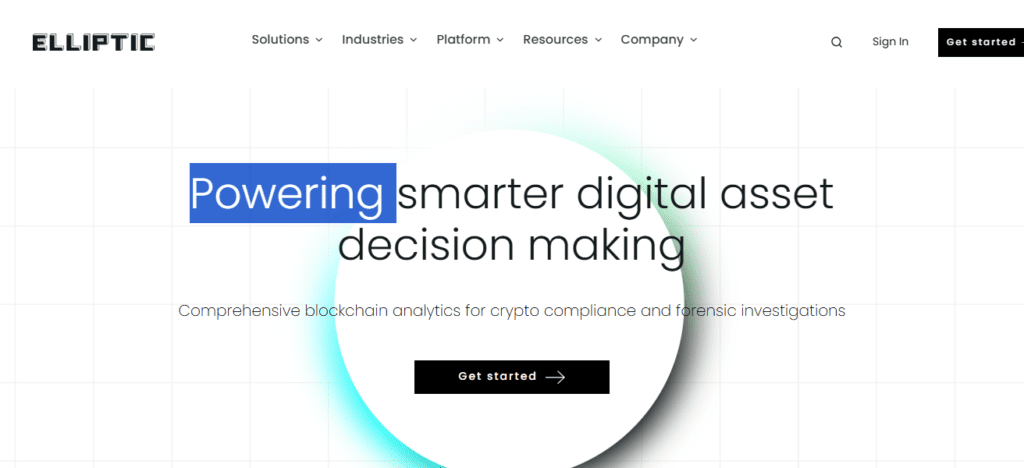
This is used by exchanges and other financial institutions to ensure compliance with anti-money laundering (AML) regulations.
Elliptic has also developed forensics to track, and help to recover, stolen crypto and to detect and investigate fraudulent networks.
Its combination of regulatory compliance intelligence and data analytics, makes Elliptic a leader in protecting an organization’s reputation and legal liability while dealing with cryptocurrencies.
Elliptic Features
- Analytics on compliance monitoring via AI
- Risk and suspicious activity analytics on wallets
- Stolen or laundered funds tracing to forensic tools
- Analytics used by institutions and regulators for AML
| Pros | Cons |
|---|---|
| Strong compliance and AML monitoring | Expensive for smaller firms |
| Detects illicit activity and fraud | Primarily designed for institutions, not retail users |
| Provides forensic tools for stolen funds | Requires integration with compliance systems |
| Trusted by regulators and financial institutions | May be complex to implement |
5. Chainalysis KYT
Chainalysis KYT (Know Your Transaction) uses AI to identify questionable transactions as they happen. It helps identify and block fraudulent and non-compliant transactions.
KYT predicts at what transactions may carry high risk and forwards those alerts to crypto exchanges and other financial institutions so they can take preventive measures.
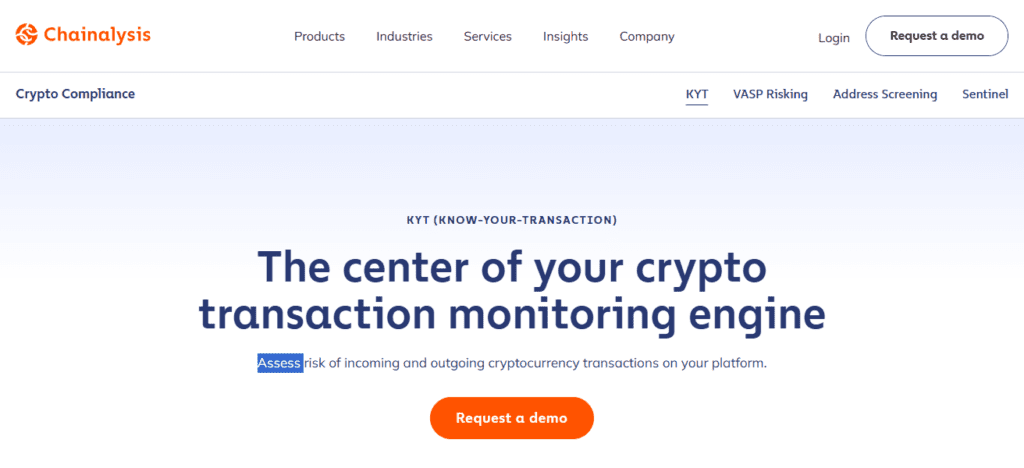
It also offers detailed risk scores and transaction histories. Its AI models learn and adapt using blockchain data allowing them to improve the accuracy of risk evaluations.
They trust Chainalysis to keep them compliant, and KYT enables them to keep ahead of non-compliant threats from deceptive wallets.
Chainalysis KYT Features
- Analytics on real time suspicious risk activity forecasting
- Compliance frameworks auditing
- Blockchain data analyses for self-improving AI models
- Comprehensive histories of transactions and their associated risks
| Pros | Cons |
|---|---|
| Real-time alerts for suspicious activity | High cost for smaller exchanges |
| Seamless integration with compliance frameworks | Focused mainly on AML/KYC, less on trading risks |
| Continuously learns from blockchain data | May require training for effective use |
| Widely adopted by institutions | Limited accessibility for retail investors |
6. Crystal Blockchain
Crystal Blockchain provides transaction tracing and risk scoring for crypto assets powered by Artificial Intelligence. It allows users to manage suspicious wallets, cross-chain fraud, and track potential fraud.
Their analytics dashboard gives users a transaction flow overview to assist compliance divisions in identifying money laundering and terrorist financing risks.
Crystal’s AI models score addresses with risk tier assignments to help risk teams with investigation prioritization.
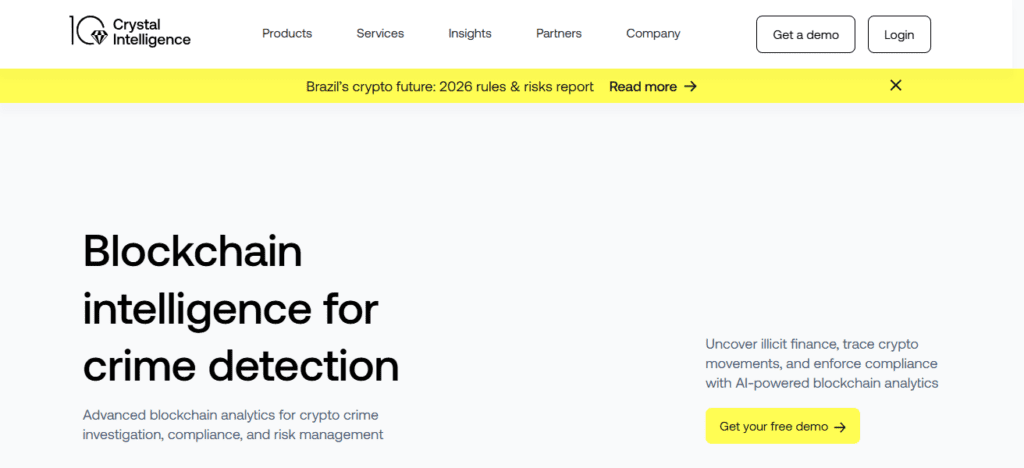
Crystal Blockchain’s analytics visualizes blockchain infrastructure to improve transparency and lower risk exposure.
This provides financial institutions, regulators, and exchanges with a useful solution for managing masked threats.
Crystal Blockchain Features
- Risk assessment of crypto addresses through artificial intelligence
- Transaction tracking through various blockchains
- Tools that help visualize the flow of activities within blockchains
- Support in tools used to identify and prevent money laundering
| Pros | Cons |
|---|---|
| AI-powered risk scoring for wallets | May be too technical for casual users |
| Tracks cross-chain activities | Focused mainly on compliance, less on trading insights |
| Provides visualization of blockchain flows | Requires institutional-level resources |
| Useful for regulators and exchanges | Limited retail adoption |
7. Scorechain
Scorechain is an AI-powered compliance and risk management solution for crypto investors at the institutions level. It streamlines the AML risk assessment process through the analysis of wallets, transactions, and tokens.
The AI models of the platform produce compliance reports, which supports organizations in addressing legal obligations across different jurisdictions.
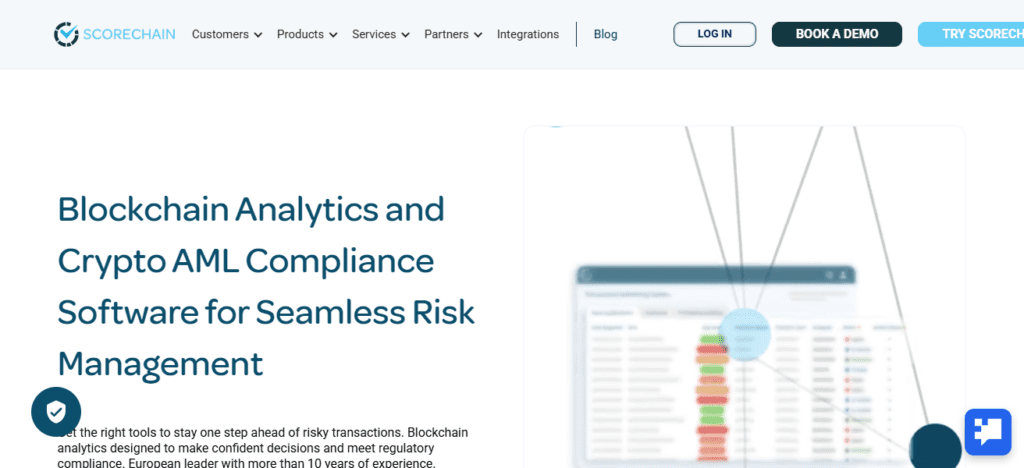
Additionally, Scorechain offers unique risk scoring, which allows businesses to personalize monitoring.
Scorechain lessens the complexity of compliance and operational risk management so that institutions can work with crypto assets in a compliant manner.
Scorechain Features
- Risk assessment of Anti-Money Laundering Compliance through automation directed to law firms
- Risk scoring that can be adjusted according to the particular needs of the business
- Compliance reporting that is detailed and position-based
- Behavioral monitoring of wallets and tokens through artificial intelligence
| Pros | Cons |
|---|---|
| Automates AML risk assessments | Primarily designed for institutions |
| Customizable risk scoring | May be costly for smaller businesses |
| Generates detailed compliance reports | Focused mainly on regulatory risks |
| Supports multiple jurisdictions | Less emphasis on trading behavior analysis |
8. Coin Metrics ATLAS
Coin Metrics ATLAS uses AI technology to improve market intelligence and crypto risk management. ATLAS provides users with top-quality market data feeds.
Its AI technology detects and analyzes systemic risks and anomalies across exchanges and tokens. ATLAS helps its users identify issues with liquidity, price manipulation, and suspicious trading activities.
ATLAS’ AI-based analytics increases the transparency of the crypto market, aiding the crypto market and its users with the management of portfolios and risks.
By providing data of institutional quality, Coin Metrics ATLAS helps traders, asset managers, and regulators identify and manage the extent to which they are exposed to market risks that are not obvious.
Coin Metrics ATLAS Features
- Data feeds of the market for institutional use
- Ability to identify and address issues involving liquidity and risk of the market
- Artificial intelligence used to promote clear trading within the cryptocurrencies
- Tools that help asset managers and regulators reduce risks
| Pros | Cons |
|---|---|
| Institutional-grade market data | May be overwhelming for retail investors |
| Detects liquidity issues and anomalies | Focused mainly on systemic risks, less on fraud |
| Improves transparency in crypto markets | Requires subscription for full features |
| Useful for asset managers and regulators | Limited compliance tools compared to others |
9. CipherTrace Armada
CipherTrace Armada utilizes AI technology to discover fraud in real time and determine risk parameters of wallets.
It enables organizations to pinpoint suspicious wallets, trace international movement of funds, and minimize crime involving cryptocurrencies.
Armada’s AI technologies infiltrate the blockchain to reveal subversive risks, as well as links to darknet markets and schemes.
Additionally, Armada offers compliance solutions to exchanges and banks, ensuring that these financial institutions adhere to the requirements of the AML and KYC regulations.
By offering fraud detection and regulatory compliance, CipherTrace Armada offers a solid solution to minimize the risk of exposure to criminal activity. As a result, confidence in the crypto ecosystem for institutions is enhanced.
CipherTrace Armada Features
- Fraud detection, wallet profiling and Artificial intelligence
- Control of crypto transactions that are cross-border
- Control of transactions that are connected to the Dark Net or illicit markets
- Tools to measure compliance of Anti-Money Laundering and Know Your Customer
| Pros | Cons |
|---|---|
| Strong fraud detection capabilities | Primarily institutional-focused |
| Profiles wallets for risk levels | May not be accessible to retail traders |
| Helps prevent crypto-related financial crimes | Requires integration with compliance systems |
| Supports AML and KYC regulations | Can be resource-intensive |
10. Santiment AI
Santiment AI specializes in behavioral analysis and sentiment tracking in the cryptocurrency market.
Santiment AI’s focus on the analysis of crowd behavior and social media as well as trading patterns gives it the ability to identify emerging risks.
Santiment AI’s AI Predictive Modeling analyzes AI algorithms to identify changes in investor behavior to guide traders AI Predictive Modeling to identify changes in the investor’s emotional behavior so traders can act with art.
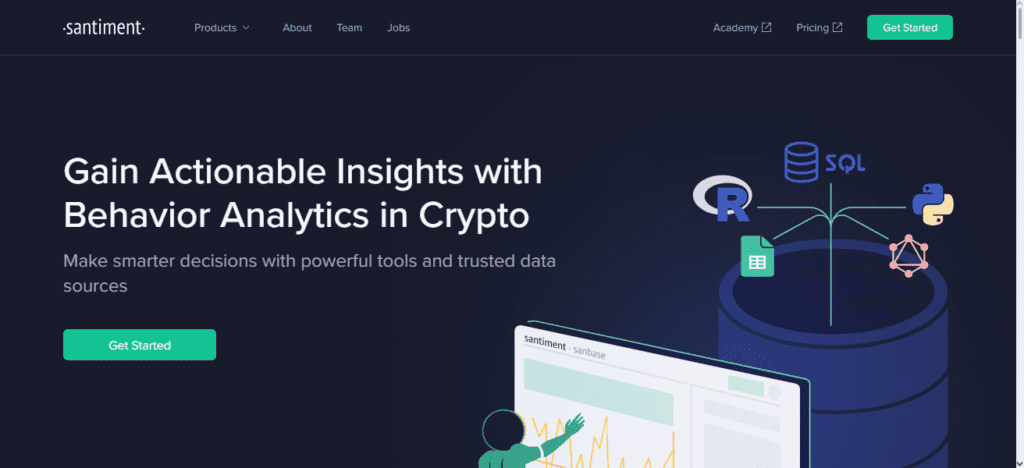
Santiment AI Predictive Models analyzes the market to stimulate behavior and focus on anti-hazard behavior.
By integrating off-chain sentiment analysis with on-chain metrics, Santiment AI’s risk management improves and encourages emotionally-driven trading.
Santiment AI Features
- Evaluation of sentiment through artificial intelligence
- Capture of Social media and trading tendencies
- Control of transactions that are manipulated in the market through collusive behavior
- Risk assessment through the combination of on-chain and off-chain analytics
| Pros | Cons |
|---|---|
| Tracks crowd sentiment and psychology | Less focused on compliance and AML |
| Detects market manipulation attempts | Predictions may be subjective |
| Combines on-chain and off-chain analytics | Requires interpretation skills |
| Helps traders anticipate volatility | May not suit institutional compliance needs |
Conclusion
AI-Powered Crypto Risk Management Tools are transforming investors’ and institutions’ approaches to securing digital assets.
They use AI to enhance fraud detection, compliance monitoring, risk and fraud analysis, and risk prediction.
Volatility can’t be risk eliminated, however these tools provide improved risk management strategies and transparency, as well as portfolio protection strategies, in the rapidly changing world of crypto.
FAQ
They are platforms that use artificial intelligence to analyze blockchain data, detect fraud, monitor compliance, and predict market risks for safer crypto investing.
They provide real-time alerts, portfolio stress testing, and sentiment analysis to reduce exposure to scams, volatility, and systemic risks.
No. While some focus on compliance for exchanges and banks, others like Laika AI and Santiment AI are designed for retail investors too.
Yes. Tools like CipherTrace Armada, Elliptic, and Crystal Blockchain specialize in identifying suspicious wallets and tracing illicit transactions.