


In this article, I will discuss the Best AI Wallets Capable of Self-Managing Digital Assets, highlighting how advanced artificial intelligence is transforming crypto management.
These innovative wallets use automation, machine learning, and smart agents to handle trading, security, and portfolio optimization. As the crypto space evolves rapidly, AI wallets are becoming essential tools for efficient, hands-free digital asset management.
Key Points & Best AI Wallets Capable of Self-Managing Digital Assets
Alpharive Alpharive uses AI agents to autonomously manage, optimize, and rebalance digital asset portfolios securely.
Armor Wallet Armor Wallet leverages AI-driven security protocols to protect assets, detect threats, and automate transactions.
Rasper AI Rasper AI provides intelligent portfolio management, automated trading strategies, and real-time risk assessment tools.
Coinbase Agentic Wallet Coinbase Agentic Wallet uses AI agents for autonomous trading, asset allocation, and seamless decentralized finance interactions.
Safe (formerly Gnosis Safe) Safe enables AI-assisted multisignature asset management with enhanced security, governance, and transaction automation features.
Fetch.ai Wallet Fetch.ai Wallet integrates autonomous agents to execute trades, manage assets, and optimize decentralized ecosystem participation.
Autonolas Autonolas uses AI-powered services to automate blockchain operations, coordination, and digital asset management tasks efficiently.
Lit Protocol Lit Protocol enables programmable wallets with AI logic, secure key management, and automated access control systems.
ASI Wallet ASI Wallet uses artificial superintelligence concepts to automate portfolio decisions, optimize returns, and manage risks.
ZenGo Wallet ZenGo uses AI-enhanced security, keyless cryptography, and automated asset management for safe, user-friendly experiences.
10 Best AI Wallets Capable of Self-Managing Digital Assets
1. Alpharive
Alpharive targets a crypto wallet powered by next generation AI technology that focuses on autonomous asset management and intelligent portfolio optimization for better returns.
By utilizing advanced machine learning models to continuously parse on-chain data, market sentiment and trading signals, it enables real-time decision-making independent of humans.
Adaptive Strategies: Adaptive strategies that adjust to changing market conditions provides a significant advantage as it requires less manual supervision;

Recent integrating updates more specifically Alpharive integration with decentralized finance (DeFi) protocols offer automated yield farming along with liquidity allocation.
Its AI agents, with capabilities to dynamically rebalance portfolios, make it an appealing option for passive investors looking to have a fully automated and self-managing digital asset ecosystem.
| Pros | Cons |
|---|---|
| Fully autonomous portfolio management with adaptive AI strategies | Still emerging, limited real-world adoption |
| Dynamic rebalancing based on market conditions | May lack transparency in AI decision-making |
| Strong DeFi integration for yield optimization | Potential risks in automated DeFi interactions |
| Reduces need for manual trading | Requires trust in AI-driven execution |
| Ideal for passive investors | Limited historical performance data |
2. Armor Wallet
Armor Wallet is a Web3-native AI wallet that uses an advanced multi-agent system to automate and simplify complex crypto operations.
It integrates large language models with specialized agents capable of performing trades, analyzing blockchain data and producing bespoke solutions based on the fly.
With this innovative technology, Armor’s AI agents can even write code to solve user-specific problems, allowing for unprecedented levels of highly personalized automation that traditional context-based wallets are unable to achieve.

Its new architecture combines real-time on-chain and off-chain data with market sentiment and metrics, to deliver optimized decision making.
The Armor Wallet is equipped with inbuilt transaction simulation, vendor blacklist checks and two-factor authentication to create a platform for safe autonomous trading and management of your portfolio.
| Pros | Cons |
|---|---|
| Multi-agent AI system for advanced automation | Complex system may overwhelm beginners |
| Can generate code for custom solutions | Higher risk if AI-generated actions malfunction |
| Real-time on-chain and sentiment analysis | Resource-intensive architecture |
| Built-in security features like blacklist checks | Still evolving, may have stability issues |
| Highly personalized automation | Requires technical understanding for full potential |
3. Rasper AI
Rasper AI acts as a smart financial assistant to automate and predict crypto portfolio management. It employs AI-powered algorithms to evaluate risk, spot lucrative opportunities and trade autonomously across various blockchains.
Its prominent feature is real-time adaptive risk management, which helps limit losses in times of extreme volatility. Latest innovations suggest an increasing interest in predictive
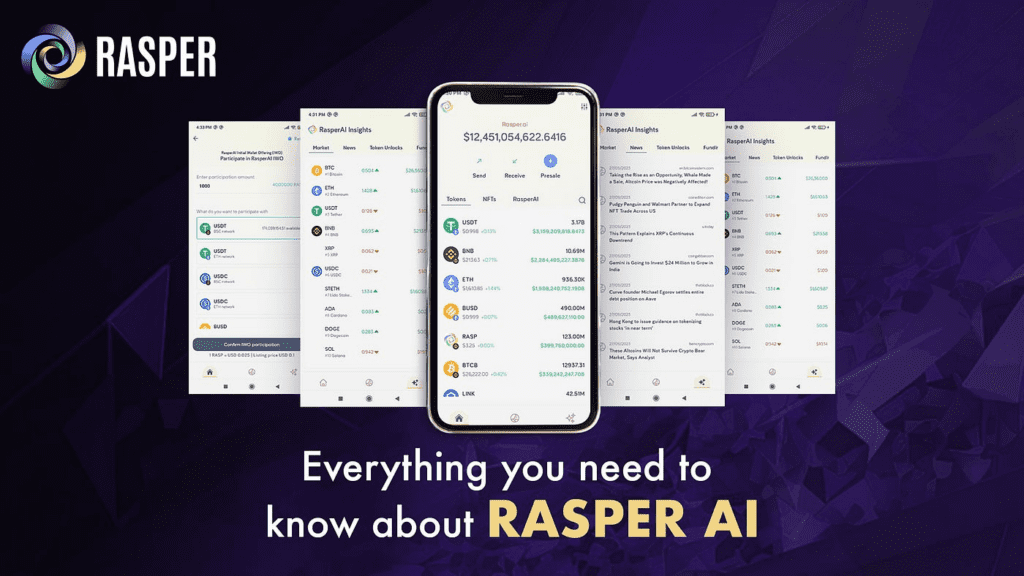
AI models that monitor price movements based on trends anticipated with historical data, but also human behavior triggers.
Rasper AI is also focus on the customization for the user, enabling investor to declare their risk threshold while allowing ai t0 execute, perfect for beginner and advanced trader alike.
| Pros | Cons |
|---|---|
| Strong predictive analytics for trading decisions | AI predictions may fail in extreme volatility |
| Real-time adaptive risk management | Over-reliance on automation |
| Supports multi-chain asset management | Limited public adoption and track record |
| Customizable risk thresholds | May require user configuration knowledge |
| Suitable for beginners and advanced users | Accuracy depends on data quality |
4. Coinbase Agentic Wallet
By allowing AI agents to independently hold, spend and manage crypto assets (without the oversight of a human or corporation), Coinbase Agentic Wallet is an enormous step towards truly self-sovereign finance.
As a protocol built on the x402 — enables tasks such as machine-to-machine payments, automated trading or even participation in DeFi automagically without any human touch.
Among its notable innovations is the introduction of programmable guardrails, such as spending limits and transaction control, which allow for secure autonomous operations.

Gasless transactions on the Base network are a supported feature of the wallet, with interruptions from low fees no longer being an issue.
Set to launch in 2026, it will become the underpinning infrastructure of the oncoming “machine economy” — a future in which AI agents act as autonomous economic actors.
| Pros | Cons |
|---|---|
| Enables fully autonomous AI-driven transactions | New technology with limited long-term testing |
| Machine-to-machine payments capability | Dependence on ecosystem infrastructure |
| Programmable guardrails for safety | Potential regulatory concerns |
| Gasless transactions improve usability | Limited availability in early stages |
| Backed by Coinbase credibility | May centralize aspects of autonomy |
5. Safe (formerly Gnosis Safe)
Safe is the most trusted smart contract wallet framework and will now provide a foundation for AI-based automation.
Safe was designed as a wallet with multi-signature security, but has evolved into programmable wallets that can execute automatic transactions and integrate directly with DeFi protocols.
Having a modular architecture, it enables developers to plug in AI agents that can initiate actions, manage funds and make governance decisions.
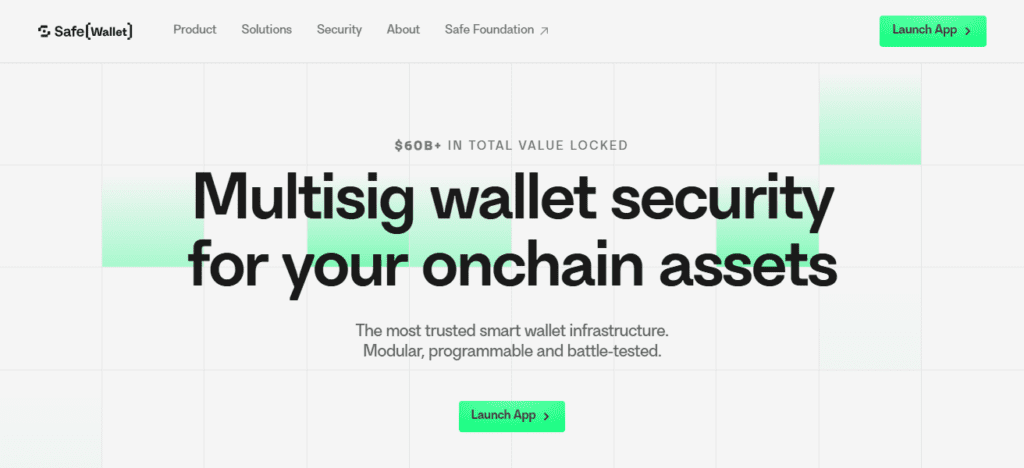
With granularity control mechanisms and layers of security Safe has witnessed wide adoption for agent-based systems recently.
It has billions in assets behind it and underpins a solid platform for voicing trust through autonomy to create financial workflows.
| Pros | Cons |
|---|---|
| Highly secure multi-signature wallet system | Not originally designed for AI automation |
| Modular architecture for customization | Requires technical setup |
| Widely trusted with large asset security | Less user-friendly for beginners |
| Supports programmable transactions | AI integration depends on external tools |
| Strong governance features | Slower innovation compared to newer wallets |
6. Fetch.ai Wallet
Fetch. ai Wallet is a small piece of the bigger picture for autonomous economic agents carrying out trading, data sharing and resource allocation.
This allows AI agents to react autonomously with decentralized networks and perform financial decisions of their own accord. The application is integrated with Fetch, which gives it its unique strength.
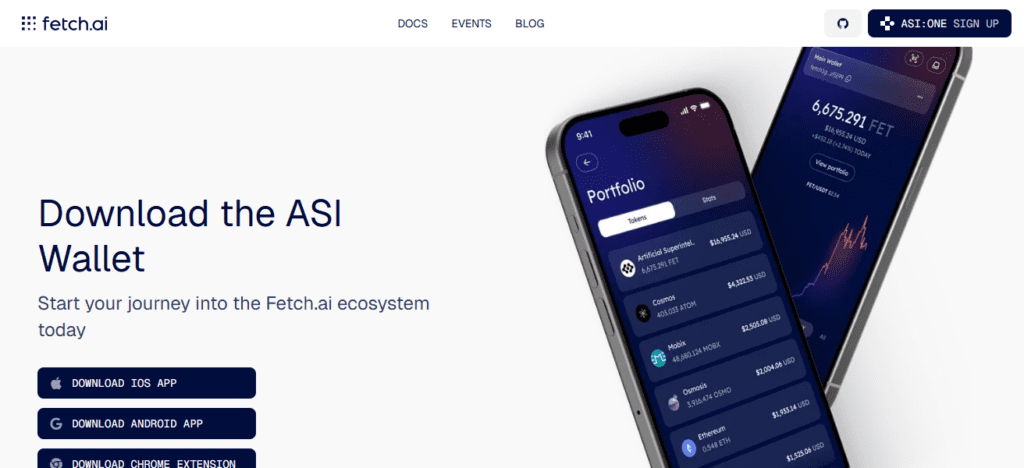
These agents allow users to continuously optimize transactions and strategies on ai’s agent-based infrastructure. Recent developments showcase its place in the fuel for decentralized machine learning and automation of marketplaces.
This positions it as central to the convergence of AI and blockchain in digital economies that operate independently, and instantly.
| Pros | Cons |
|---|---|
| Built for autonomous economic agents | Ecosystem still developing |
| Seamless AI-agent integration | Requires understanding of agent-based systems |
| Enables automated trading and resource allocation | Limited mainstream adoption |
| Supports decentralized machine learning use cases | May be complex for casual users |
| Strong innovation in AI-blockchain convergence | Dependent on Fetch.ai network growth |
7. Autonolas
Autonolas is the foundation for trustless autonomous services — where decentralized AI can autonomously manage core operations on a blockchain.
Also, its wallet functionality is only a small part of the wider macro ecosystem of self-sufficient agents managing functions ranging from trading to governance and infrastructure management.
Its uniqueness lies in emphasizing on collective intelligence, where multiple agents work together to improve the outcome.
Autonolas recently announced an expansion into cross-chain automation and DAO-driven AI services, allowing decentralized ownership of agent systems too.
In doing so, it puts itself at the centre of a critical piece of infrastructure for running autonomous digital assets, where AIs provide services to other autonomous entities on a 24/7 basis without humans.
| Pros | Cons |
|---|---|
| Focus on decentralized autonomous AI services | Niche use case compared to traditional wallets |
| Supports collaborative multi-agent systems | Requires technical expertise |
| Expanding into cross-chain automation | Still evolving infrastructure |
| DAO-driven ownership model | Limited user-friendly interfaces |
| Continuous automated operations | Adoption still in early stages |
8. Lit Protocol
Lit Protocol is pioneering a new breed of AI wallets by enabling programmable key management and decentralised access control.
This allows developers to put logic into wallet activities so that actions can be executed automatically whenever certain conditions are met.
The most outstanding innovation is threshold cryptography, in which control is distributed across multiple nodes and provides security for automated transactions.
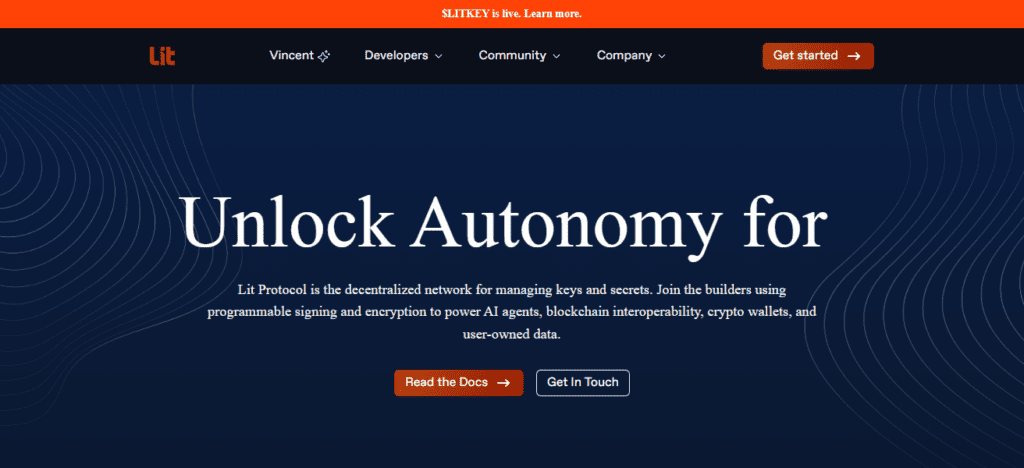
Updates more recently have been focused on its role in providing a method of allowing AI agents to sign transactions securely, without exposing private keys.
Lit Protocol is paving the way for wallets to act as programmable, intelligent systems in decentralised ecosystems, powered by a combination of encryption, identity management and automation.
| Pros | Cons |
|---|---|
| Advanced programmable key management | Complex cryptographic concepts |
| Uses threshold cryptography for security | Not a traditional wallet interface |
| Enables secure AI-based transaction signing | Requires developer-level understanding |
| Strong access control and encryption | Limited appeal for casual users |
| Enhances privacy and automation | Integration needed for full functionality |
9. ASI Wallet
Concepts of artificial superintelligence inspired the birth of ASI Wallet, an open source experimentation on autonomous fully independent financial systems.
Uses advanced AI models able to execute complex investment decisions, optimizing the portfolios and managing their risks without human intervention.
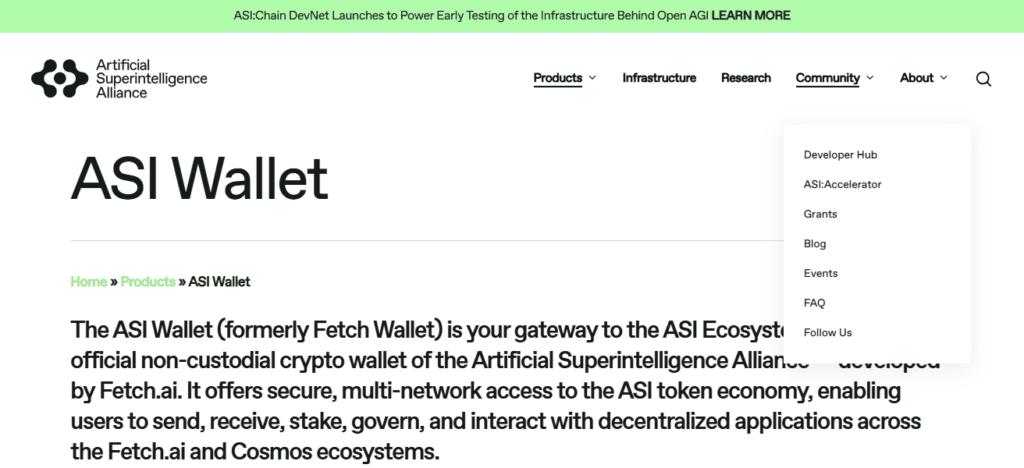
One of its unique features is those predictive intelligence which learns as per the activities in a market and enhances performance.
Recent innovations indicate that these new services enable integration with multi-chain ecosystems, along with advanced analytics dashboards giving deeper insights into which assets are performing best.
ASI Wallet is your first-hand glimpse at the future of AI found finance that replaces the decision-making process in its entirety; all fully automated and optimized for long-term performance.
| Pros | Cons |
|---|---|
| Focus on advanced AI-driven decision making | Concept still futuristic and evolving |
| Predictive intelligence for portfolio growth | Limited real-world validation |
| Multi-chain support and analytics | High reliance on AI accuracy |
| Fully automated asset management | Potential lack of user control |
| Designed for long-term optimization | May face scalability challenges |
10. ZenGo Wallet
ZenGo is a keyless crypto wallet that uses AI-based security and it is particularly easy to use. ZenGo employs multi-party computation (MPC) to avoid single points of failure, a concern with traditional wallets relying on private keys.
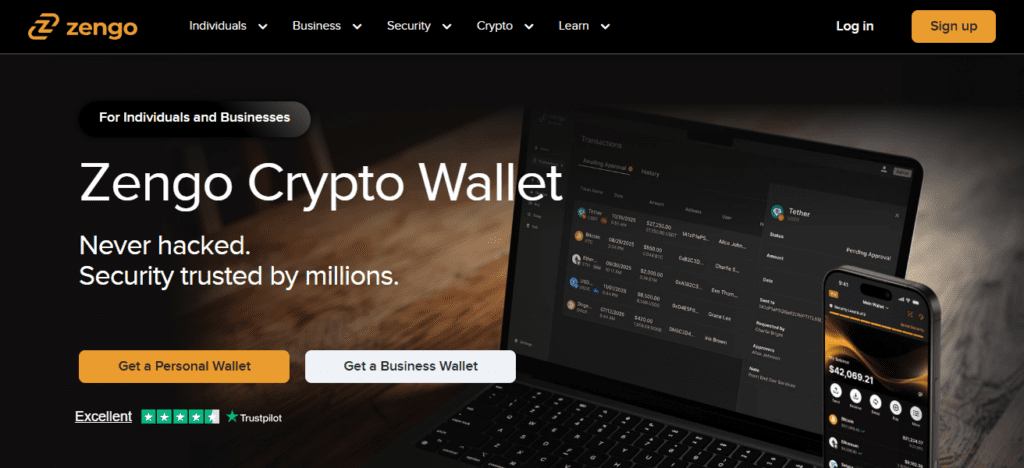
Which greatly minimizes the likelihood of hacks and lost keys. Some of the recent updates involve biometric authentication and specially designed AI threat detection systems that keep the user in a more secure environment.
ZenGo does not aim for a fully agentic wallet but is evolving towards smarter asset management with automation features. That balance between security, simplicity, and innovation is a force that carries it as a strong contender in the AI wallet game.
| Pros | Cons |
|---|---|
| Keyless security using MPC technology | Not fully autonomous like agentic wallets |
| User-friendly interface | Limited advanced automation features |
| Strong security with biometric protection | Fewer DeFi automation capabilities |
| Reduced risk of private key loss | Less customization for advanced users |
| Trusted and widely used wallet | AI features still evolving |
Cocnsluion
ConclusionAI-Powered Wallets Reimagining Digital Asset Management with Automation and IntelligenceWallet becomes the Enabler of Intuition in TradingMake smart decision in seconds
Based on multiple signals directly linked to prices, sophisticated AI algorithms increase operational efficiency and reduce time taken to convert signals into actionable insights.
They range from highly-automated agentic systems through to secure keyless solutions and reduce the manual effort of managing wallets whilst achieving great efficiency.
AI wallets have been an increasingly central component in the future of finance, enabling users everywhere to create smarter, autonomous and scalable crypto ecosystems from now on as technology continues to advance.
FAQ
An AI crypto wallet is a blockchain wallet controlled by AI agents that can manage assets automatically.
They use machine learning and automation to analyze markets, execute trades, and rebalance portfolios in real-time.
AI wallets can be secure with proper safeguards, but risks like hacking and prompt manipulation still exist.
Unlike traditional wallets, AI wallets can act independently, execute transactions, and make financial decisions without manual input.