


This article will focus on Tools That Predict Your Financial Future Using AI. In the case of the tools mentioned in the article, the tools use AI to analyze personal finance and determine an individual’s future financial position based on their current financial behaviors
Which include spending, investing, and credit. Financial forecasting is enhanced through the use of the tools, which encompass everything from budget and forecasting tools to investment tools driven by artificial intelligence.
Key Points & Tools That Predict Your Financial Future Using AI
Wealthfront Automates investing using AI, optimizing portfolios for risk tolerance, goals, and long-term growth.
Betterment AI-driven robo-advisor providing personalized investment strategies, tax-loss harvesting, and retirement planning recommendations.
Zest AI Uses machine learning to improve credit scoring, offering fairer lending decisions and financial opportunities.
Personal Capital AI-powered financial dashboard tracking spending, investments, and retirement readiness with predictive analytics.
YNAB (You Need A Budget) AI helps forecast expenses, guiding users toward savings goals and debt-free financial futures.
Credit Karma Predicts credit score changes, offering AI-based insights into loans, cards, and financial health.
SigFig AI robo-advisor managing investments, predicting market trends, and minimizing risks for better returns.
Cleo AI chatbot analyzing spending habits, predicting cash flow, and offering budgeting advice interactively.
Quicken Simplifi Forecasts future spending patterns using AI, helping users stay financially organized and goal-oriented.
Kavout AI-powered stock analysis tool predicting market movements, ranking equities with predictive “K Scores.
10 Tools That Predict Your Financial Future Using AI
1. Wealthfront
Wealthfront is an AI robo-advisor that automates the management of your investments and financial planning.
The algorithms evaluate your income, expenses, and financial objectives, then optimize personalized investment portfolios.

The AI is programmed to assess the value of and the potential gain to be achieved from rebalancing assets to optimize your investment returns and minimize your investment risks.
The tool Path helps predict your financial future by considering the potential of retirement and the purchase of a home, or the funding of a child’s college education, as well as your spending habits.
Wealthfront Features
- Portfolio Management Automated: AI utilized for constructing investment portfolios with the ability to rebalance portfolios based upon goals and risk tolerance.
- Planning for the Future: Path provides financial planning tools, such as forecasting scenarios for retirement, purchasing a new home, and funding college.
- Tax Optimization: Maximizing tax returns through tax-loss harvesting is included.
- Management of Cash and Savings: An integrated account is provided for easier budgeting and savings tracking.
| Pros | Cons |
|---|---|
| Automated investment management with AI-driven portfolio rebalancing. | Limited human advisory support for complex situations. |
| Forecasts future financial scenarios like retirement, home buying, or college funding. | Fees can accumulate for smaller account balances. |
| Continuous market monitoring helps minimize risk and optimize returns. | Less flexibility for highly customized investment strategies. |
| Easy-to-use interface and goal-based planning tools. | Limited international availability; mainly US-focused. |
| Integrates cash management, investing, and financial planning in one platform. | Dependent on algorithm performance; market downturns can still affect outcomes. |
2. Betterment
Betterment uses AI and complex algorithms for saving and investment optimization. Betterment uses the customer’s risk profile, income, and spending habits to determine the allocation of funds across various portfolios.
Each investment is kept in sync with long term goals by the AI, which modifies the investments based on the changing conditions of the market and the customer’s investment plan.
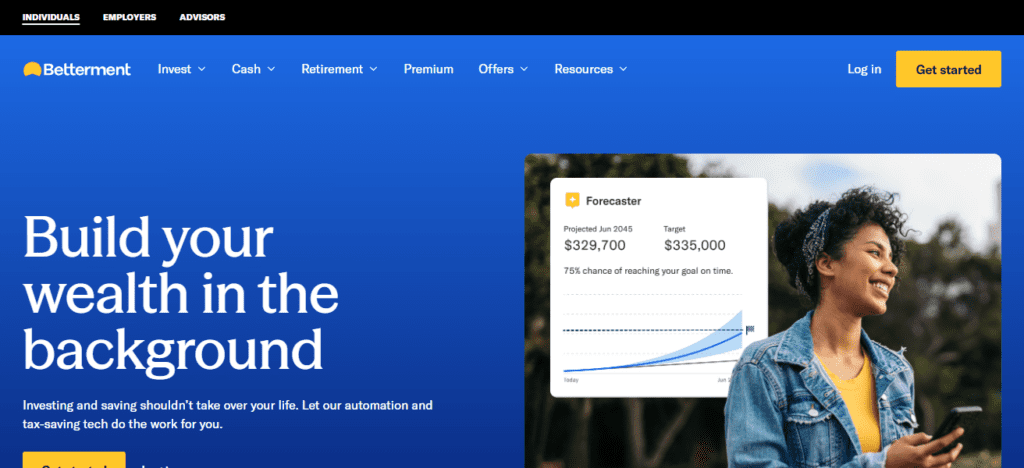
Betterment has planning tools for different goals such as retirement, emergency funds, and large purchases. They also provide active tax-loss harvesting and rebalancing.
The automation and predictive analytics assist customers in the confident planning for the future. The customer’s capital also grows in a strategic and intelligent manner as the analytics focus on the data.
Betterment Features
- Investing for Goals: AI makes investments for your retirement, emergency funds, and large purchases.
- Automatic Rebalancing: Asset allocation is altered without aid as the market shifts.
- Tax-Loss Harvesting: Long-term investments face a decreased liability in taxes.
- Advice Customized: AI generates suggestions via income, spending, and risk tolerance.
| Pros | Cons |
|---|---|
| AI optimizes portfolio allocation and rebalances automatically. | Fees may be higher for smaller account balances. |
| Goal-based planning forecasts retirement, emergencies, and major purchases. | Limited control over individual asset selection. |
| Tax-loss harvesting maximizes after-tax returns. | Less suitable for highly active traders. |
| User-friendly interface with clear data-driven insights. | Mainly US-focused; limited international support. |
| Continuous monitoring adjusts strategies based on risk tolerance and market trends. | Algorithm-based advice may not cover all nuanced financial situations. |
3. Zest AI
Zest AI analyzes and predicts credit risk using machine learning. Its platform utilizes numerous data sets, including non-traditional data sources like payment records, online behavioral data, and alternative financial data, to evaluate loan eligibility.
Zest AI’s predictive AI models, offer lenders the ability to formulate accurate, inclusive decisions while minimizing the risk of default.
Zest AI’s customers benefit from improved access to credit and greater transparency on how their financial decisions affect their creditworthiness.
Additionally, its technology enables individuals and businesses to proactively manage risk, borrow intelligently, and improve their financial situation over time using insights from AI to manage risk better than traditional scoring.
Zest AI Features
- Credit Risk Prediction: Cutting-edge credit assessment algorithms improve the evaluation of credit risk.
- Alternative Data Use: Non-traditional metrics such as online activity and payment behavior are incorporated.
- Inclusive Lending: Access to credit is significantly increased for applicants who are generally disregarded.
- Default Reduction: Lenders benefit from reduced financial risk and improved decision-making.
| Pros | Cons |
|---|---|
| Predicts creditworthiness using machine learning and alternative data. | Primarily designed for lenders, not individual users. |
| Reduces defaults by providing more accurate credit risk analysis. | Limited personal financial planning features. |
| Enables more inclusive access to credit. | May require financial institutions’ adoption for direct benefit. |
| Uses nontraditional indicators for more holistic scoring. | Consumers have less direct control over predictions. |
| Helps anticipate financial challenges and improve long-term credit health. | Reliant on data quality and volume; errors can skew outcomes. |
4. Personal Capital
Personal Capital merges artificial intelligence and human advisors, delivering a unique approach to financial planning.
Its AI technology analyzes user behavior related to income, spending, and investments and predicts future financial outcomes.
Personal Capital’s sophisticated algorithm evaluates users’ retirement preparedness, future cash flow, and net worth growth.

Users can model financial situation changes, like market changes, big purchases, job changes, and others to assess impact on goals.
With investment tracking and recommendations, scenario modeling, and real-time investment monitoring, Personal Capital equips users to make informed decisions and achieve desired financial goals.
Personal Capital Features
- Net Worth Tracking: Income, expenses, and investments can all be tracked in real time.
- Retirement Planning: Predictive AI assesses retirement and financial growth per customer.
- Scenario Simulation: Predictive AI analyzes financial implications of market fluctuations, purchases, and major life events.
- Hybrid Advice: Predictive AI, as well as the integration of human financial advisors, offer a unique approach.
| Pros | Cons |
|---|---|
| Combines AI analytics with human advisors for comprehensive planning. | Premium advisory services can be costly. |
| Tracks income, expenses, and investments to forecast wealth growth. | Free version has limited investment management features. |
| Allows scenario simulation for retirement, purchases, and market changes. | Learning curve for beginners due to extensive features. |
| Real-time investment monitoring with personalized recommendations. | Focused on wealth management, less on everyday budgeting. |
| Empowers data-driven financial decisions aligned with long-term goals. | AI predictions still rely on market conditions, not guarantees. |
5. YNAB (You Need A Budget)
YNAB aims to combat the struggles of budgeting by using AI to develop a budget and overcome potential obstacles by teaching users to budget in the future.
YNAB provides users with a budget by looking at their income and expenditures (including patterns and trends) along with the expenses and bills they have to pay.
YNAB gives users a budget while also teaching users to prepare for their future financial obligations.
YNAB identifies users expenses that do not fall within the boundaries of a predetermined budget and suggests ways to correct the issue by modifying the budget.
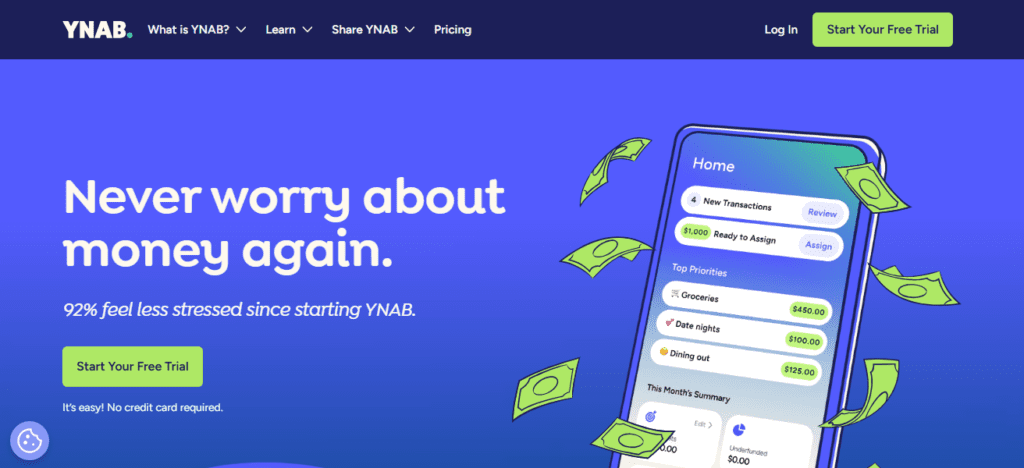
Users can also save money in order for YNAB to adjust the future expenses of the user. YNAB helps users to prepare financially by keeping their goals in mind.
YNAB also uses AI to prepare users financially for the future by helping them to understand the future cost of their daily financial practices.
YNAB uses AI to prepare users financially for the future by helping them to understand the future cost of their daily financial practices.
YNAB (You Need a Budget) Features
- Budget Forecasting: AI analyzes spending and predicts cash flow as well as possible overextension.
- Goal-Oriented Planning: Defines achievable saving goals for emergencies, debt, and future purchases.
- Spending Analysis: Predictive AI analyzes prior spending, identifies spending habits, and determines how to reallocate financial resources.
- Scenario Planning: Empowers customers to assume control over their finances by predicting future financial situations.
| Pros | Cons |
|---|---|
| Helps create forward-looking budgets with predictive insights. | Primarily budgeting-focused; not for investing. |
| Highlights overspending and forecasts cash flow for upcoming months. | Requires active user participation for best results. |
| Encourages goal-setting and intentional financial habits. | Limited AI automation; relies on user input. |
| Provides scenario analysis for emergencies or debt repayment. | Subscription cost may deter casual users. |
| Offers clarity on future financial stability based on current habits. | No direct credit or investment forecasting features. |
6. Credit Karma
Credit Karma uses AI algorithms to offer customers their credit scores, financial advice, and future credit and loan predictions.
The AI analyzes the credit history, spending and borrowing patterns to predict how financial actions impact the credit score and eligibility for loans/credit cards in the future.
The AI offers unique recommendations for improving credit score and gives personalized debt management and credit use recommendations.

Customers are able to see the predictive insights and alerts for updates to their credit record. Using machine learning
Credit Karma and its real time data allow the individual to gain empower and give them the ability to understand their financial health and make the changes that positively impact their future.
Credit Karma Features
- Credit Score Monitoring: Customers receive real-time score updates along with predictive analytics.
- Personalized Recommendations: Suggested actions to improve credit and manage outstanding debt.
- Alerts and Notifications: Predictive analytics identifies factors that may negatively impact the customer’s credit profile.
- Financial Education: Predictive analytics examines the relationship between actions and the health of credit long-term.
| Pros | Cons |
|---|---|
| AI predicts credit score changes and suggests improvement strategies. | Limited investment and wealth management tools. |
| Personalized recommendations for debt repayment and credit optimization. | Accuracy depends on credit bureau updates; slight delays possible. |
| Alerts for credit profile changes and potential financial pitfalls. | Mainly focused on US credit system. |
| Helps understand long-term financial health and borrowing options. | Limited forecasting beyond credit and loans. |
| Free to use with real-time credit monitoring. | Ads and offers can be distracting to some users. |
7. SigFig
SigFig utilizes AI technology to create an algorithmic approach to portfolio management. The technology incorporates individual parameters.
It includes personal risk aversion, financial objectives, and AI predictive modeling. Continual portfolio assessment occurs to limit risk and to increase returns.
SigFig provides the user retirement forecasts, investing goals, and tax-aware forecasts. For investing, financial goals, and market predictive modeling, SigFig provides the user more clarity.
Automated portfolio management, along with predictive modeling and scenario analysis affords consumers long-term financial goals with less effort. It offers more precise and accessible wealth management.
SigFig Features
- Automated Portfolio Management: Predictive AI manages the allocation and rebalancing of customer assets.
- Predictive Analytics: Offers analytics to customers to identify likely retirement or other financial goals.
- Tax-Efficient Investing: Intelligent taxes minimize customer liabilities.
- Scenario Planning: Predictive analytics improve market movement anticipation and optimize customer strategies.
| Pros | Cons |
|---|---|
| AI manages portfolios automatically and rebalances for optimal growth. | Smaller brand recognition compared to major robo-advisors. |
| Provides predictive analytics for retirement and goal tracking. | Limited investment customization for experienced traders. |
| Focus on tax-efficient investing and risk management. | Free version is limited; fees for advisory services apply. |
| Reduces manual effort in wealth management. | Market risks still affect predicted returns. |
| Scenario forecasting allows proactive financial planning. | US-centric platform; limited international support. |
8. Cleo
Designed as a financial assistant and chatbot, Cleo helps users analyze their spending and saving and strategize their financial future.
By using predictive analytics, Cleo is capable of forecasting cash flow, budget limits, and financial risks.
Cleo also analyzes users’ patterns in income and spending to provide personalized insight and recommendations.

Users receive reminders for bill payments, suggestions to save money, and alerts for dangerous spending that can compromise financial goals.
Cleo combines artificial intelligence and predictive insights to foster better spending, saving, and financial decision-making.
Cleo Features
- Spending Analysis: Budgeting is made easier and spending control is increased through spending pattern identification and transaction tracking.
- Cash Flow Forecasting – Identifies future cash flow issues.
- Personalized Recommendations – Provides tailored saving suggestions and financial modifications.
- Interactive Chatbot – Offers financial guidance & send notifications.
| Pros | Cons |
|---|---|
| AI chatbot tracks spending and forecasts cash flow. | Limited investment management capabilities. |
| Provides personalized saving tips and budgeting advice. | Requires linking bank accounts; some users may have privacy concerns. |
| Alerts for overspending and upcoming bills. | Less sophisticated predictive modeling compared to full financial advisors. |
| Engaging, conversational interface encourages habit-building. | Focused mainly on short-term finances. |
| Helps anticipate financial challenges and plan for future goals. | Limited high-net-worth financial planning tools. |
9. Quicken Simplifi
Quicken Simplifi utilizes artificial intelligence to help users strategize and analyze their finances in real-time.
By assessing a user’s income, expenses, and spending behavior, Quicken Simplifi is capable of forecasting cash flow, budgeting, and savings goals.
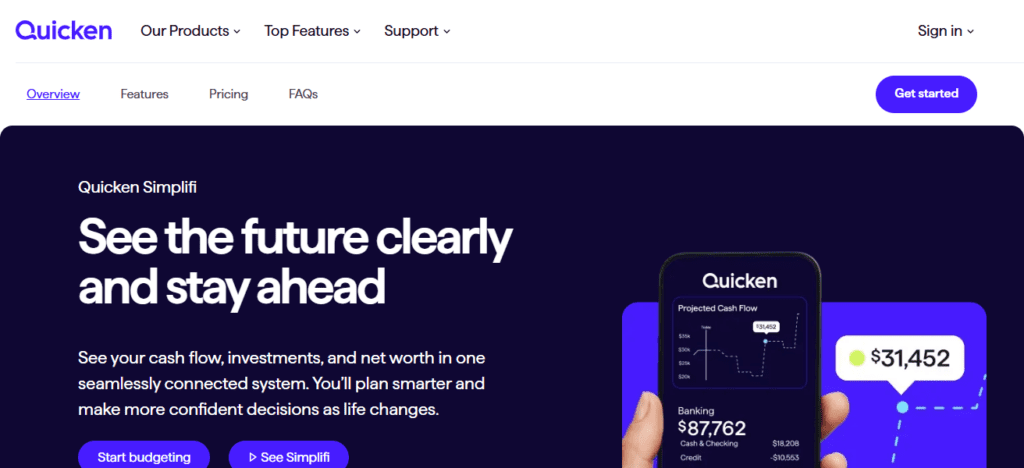
This platform also utilizes AI to predict future expenses and investment changes, as well as major purchases, helping users to stay financially planned.
Simplifi also focuses on predictive budgeting and financial behavior in order to help users feel more financially stable.
Quicken Simplifi Features
- Budget Forecasting – Predicts future cash flow and potentially spending.
- Expense Categorization – Employs AI to classify expenditures and spot patterns.
- Scenario Simulation – Analyses possible future financial scenarios concerning large purchases and market changes.
- Goal Tracking – Assists in preserving financial health and monitors savings.
| Pros | Cons |
|---|---|
| AI predicts cash flow, budgeting outcomes, and savings opportunities. | Limited investment advisory; mainly focused on budgeting. |
| Can simulate future financial scenarios for proactive planning. | Subscription-based pricing may not suit casual users. |
| Categorizes spending and identifies trends for smarter decisions. | Less suitable for complex wealth management. |
| Provides forward-looking insights for long-term financial stability. | Some automation features are basic compared to full robo-advisors. |
| Helps reduce stress and make data-driven financial choices. | US banking focus; limited international integration. |
10. Kavout
Kavout is an investment platform that uses artificial intelligence to learn about people’s investment goals and suggest which stocks people should invest in.
The AI uses powerful algorithms to analyze financial statements and other relevant data to predict the outcomes of investments and assist in making data-driven investment decisions.
Kavout provides predictive analytics to stock ratings, portfolio optimization, and risk assessment.
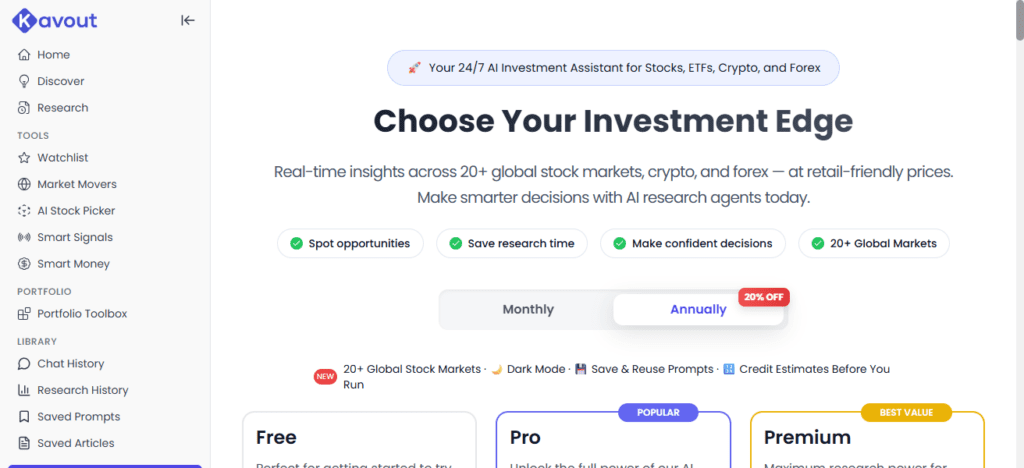
With the help of AI, it anticipates the changes in the market for upcoming opportunities while helping customers to mitigate losses from prior market changes.
Providing retail investors and institutions an edge in the market. The machine learning analytics, predictive analytical models, and risk assessments help investors to make decisions with a clear vision, reducing the uncertainty in a financial decision.
Kavout Features
- Stock Market Predictions – Investment outcomes are predicted by AI.
- Portfolio Optimization – Offers asset allocation guidance grounded in risk and performance.
- Data-Driven Insights – Analyses financial documentation, market trends, and sentiments.
- Risk Management – Recognizes growth opportunities while helping to reduce losses.
| Pros | Cons |
|---|---|
| AI predicts stock market trends and investment outcomes. | Advanced features may overwhelm beginners. |
| Offers predictive stock ratings and portfolio optimization. | Mainly for investors; not suitable for budgeting or daily finance. |
| Analyzes massive datasets including financial statements and sentiment. | Premium tools can be expensive. |
| Helps mitigate risks and identify opportunities strategically. | AI predictions are not guaranteed; market volatility still applies. |
| Useful for both retail and professional investors seeking data-driven decisions. | Limited tools for broader personal finance planning. |
Conclusion
To wrap up, AI-based tools that forecast financial trends assist customers in making better, more informed choices in regard to spending habits.
These tools examine spending, investments, and credit usage, and provide predictions, guidance on budgeting, and individualized recommendations.
These tools do not provide guarantees, but they do make planning easier, decrease uncertainty, and assist customers in better and clearer attainment of their long term financial objectives.
FAQ
They are applications that use artificial intelligence to analyze finances, predict trends, and provide personalized recommendations.
They analyze income, expenses, spending habits, credit scores, and market data to forecast outcomes like savings, investments, and debt management.
Most are secure, using encryption and privacy protocols, but always check the provider’s security policies before linking accounts.
They assist with forecasting and planning, but for complex decisions, combining AI insights with a human advisor is ideal.