


This article will focus on the Best AI + Blockchain Startups To Watch which includes the most interesting companies combining AI and decentralized technologies.
These startups are changing industries by creating innovative and sustainable ways to share data, develop decentralized machine learning, and produce an AI output that can be verified.
These companies show how the combination of AI and blockchain is forging new pathways for digital ecosystems.
Key Poinst & Best AI + Blockchain Startups To Watch
- Fetch.ai (AI Agents Ecosystem) Autonomous agents collaborate, optimize tasks, and enable decentralized digital economy through AI-driven automation.
- Numerai (AI-Crowdsourced Hedge Fund) Data scientists submit predictive models; collective intelligence powers hedge fund strategies using encrypted financial datasets.
- Bittensor (Decentralized Machine Learning) Open network incentivizes machine learning contributions, rewarding participants for valuable models and computational intelligence sharing.
- Ocean Protocol (Data Marketplace) Decentralized marketplace allows secure data sharing, monetization, and AI-driven insights while preserving privacy.
- io.net (AI Compute Infrastructure) Provides decentralized GPU compute power, enabling scalable AI training and inference across distributed networks.
- OriginTrail (Decentralized Knowledge Graph) Blockchain-based knowledge graph organizes trusted data, enhancing transparency, interoperability, and verifiable information exchange globally.
- Grass (Decentralized AI Web Scraping) Community-powered scraping network collects web data, decentralizing access for AI training and research purposes.
- ChainGPT AI model specialized for blockchain, offering smart contract generation, analysis, and crypto-related automation solutions.
- Gaia AI AI platform focused on environmental sustainability, leveraging data to optimize forestry, carbon capture, and conservation.
- Axiom (ZK-AI for Data Integrity) Zero-knowledge proofs ensure AI computations remain verifiable, preserving trust, privacy, and integrity in decentralized systems.
10 Best AI + Blockchain Startups To Watch
1. Fetch.ai (AI Agents Ecosystem)
Fetch.ai is creating a decentralized ecosystem for autonomous software agents to complete tasks, negotiate, and collaborate all without the need for human interaction.
These agents utilize Artificial Intelligence to optimize various industries, including logistics, energy, finance, and many others.
Integrating blockchain technology with Artificial Intelligence allows Fetch.ai to provide secure and trustless interactions between agents while also supporting microtransactions at scale.

This ecosystem allows businesses and individuals to automate complicated tasks and processes, cut down on wastes, and create new streams of economic activity.
Fetch.ai believes the future is a digital economy with intelligent agents where a network of decentralized services is self-sufficient and AI-automated.
| Pros | Cons |
|---|---|
| Enables autonomous agents to optimize logistics, finance, and energy systems. | Complexity of agent-based systems may hinder mainstream adoption. |
| Promotes decentralized digital economy with microtransactions. | Requires strong network effects to achieve scalability. |
| Reduces inefficiencies through AI-driven automation. | Regulatory uncertainty around autonomous economic agents. |
| Encourages collaboration between businesses and individuals. | High technical barrier for developers and users. |
| Combines AI and blockchain for secure automation. | Early-stage ecosystem with limited real-world deployments. |
2. Numerai (AI-Crowdsourced Hedge Fund)
Numerai is a hedge fund that utilizes collective intelligence from a global community of data scientists who build predictive models.
Each participant submits a financial market prediction model in an encrypted format, which ensures participant privacy while still allowing for model accuracy.
For models that fund managers determine to be the best, Numeraire (NMR), the platform’s cryptocurrency, is given to the model owner.
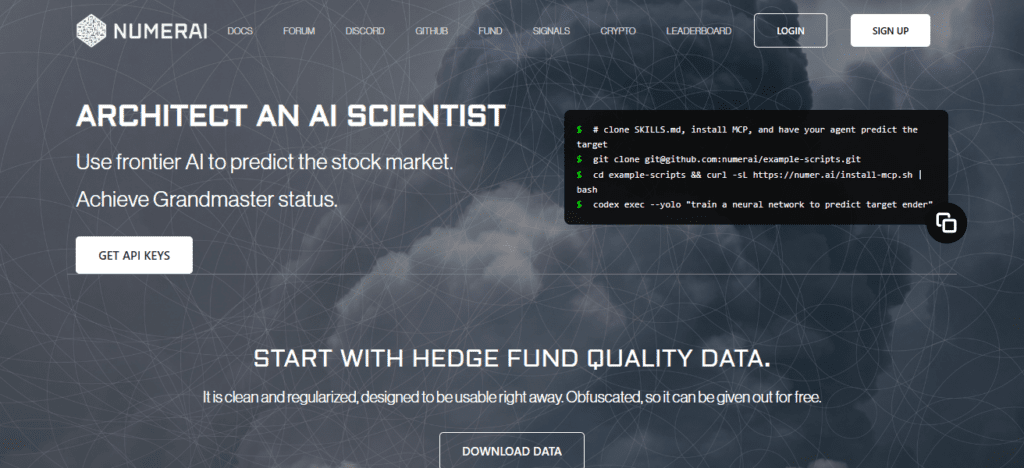
By participating in the platform, participants from all over the world utilize their different collective skill sets to develop predictive models using the latest machine learning methods to outperform other predictive models used by more conventional hedge funds.
Numerai revolutionizes the financial modeling process, gamifying the process of managing hedge funds by using cutting-edge
AI technology to utilize collective intelligence to develop models to predict valuations of different financial market instruments.
| Pros | Cons |
|---|---|
| Harnesses global talent for predictive financial modeling. | Hedge fund performance depends heavily on submitted models’ accuracy. |
| Uses encrypted datasets to ensure privacy. | Limited transparency for contributors regarding fund strategies. |
| Rewards contributors with cryptocurrency (NMR). | Volatility of NMR token may affect incentives. |
| Democratizes hedge fund participation worldwide. | Complex financial domain may discourage casual contributors. |
| Collective intelligence improves investment strategies. | Regulatory challenges in financial markets. |
3. Bittensor (Decentralized Machine Learning)
Bittensor is a decentralized network that uniquely incentivizes machine learning. Through smart contracts, models, datasets, and computing power are bought and sold on an open marketplace.
The contributions are rewarded according to their value, allowing participants to offer their skills to the marketplace while increasing the worldwide intelligence level.
Compared to other centralized systems, it offers more transparency, equity, and more scalability. Using borderless blockchain technology, a collaborative environment

That freely shares and circulates knowledge and computing resources is created. By machine learning innovation, Bittensor offers a more open and more collaborative ecosystem.
| Pros | Cons |
|---|---|
| Incentivizes sharing of AI models and datasets. | Computational costs can be high for contributors. |
| Creates open marketplace for intelligence. | Quality control of shared models may be difficult. |
| Rewards participants fairly through blockchain. | Adoption requires strong technical expertise. |
| Promotes collaboration across borders. | Early ecosystem with limited mainstream awareness. |
| Democratizes access to advanced AI technologies. | Scalability challenges remain unresolved. |
4. Ocean Protocol (Data Marketplace)
Oceans Protocol is a decentralized marketplace for data sharing and monetization. Individuals and enterprises can publish, find and use datasets, and control the privacy and ownership rights to the datasets.
Ocean’s distributed governance model allows data owners to control how their data is used, while AI developers gain access to varied, high-quality datasets.
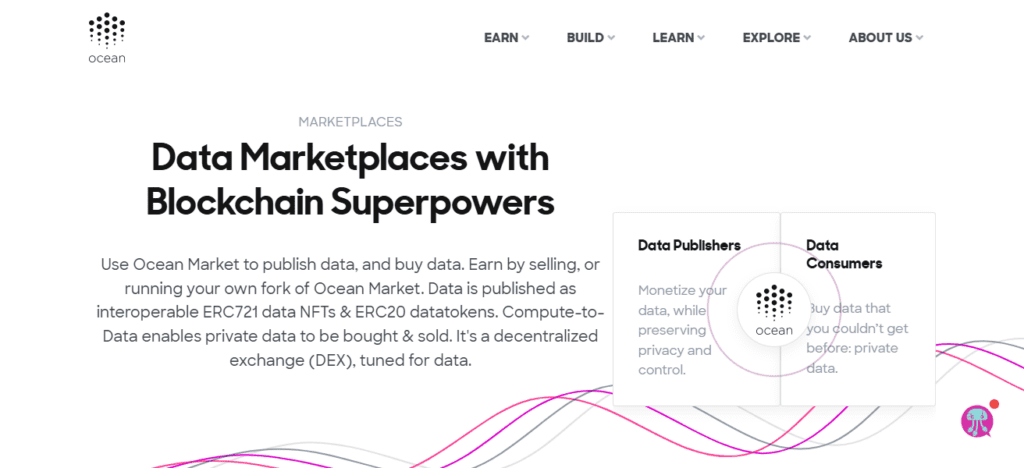
The Ocean Protocol creates a marketplace for data and fuels AI innovatiton by making data a tradable commodity, unlocking the stored value and potential for the data.
AI developers need access to a marketplace to trade data to close the gap for the demand and scarcity of datasets.
| Pros | Cons |
|---|---|
| Enables secure data sharing and monetization. | Data quality varies across providers. |
| Preserves privacy and ownership rights. | Adoption depends on trust in decentralized governance. |
| Provides AI developers with diverse datasets. | Competition from centralized data marketplaces. |
| Transparent transactions via blockchain. | Complexity of onboarding new users. |
| Unlocks value of data as a tradable asset. | Limited mainstream adoption so far. |
5. io.net (AI Compute Infrastructure)
io.net’s mission is to decentralize AI compute access to advanced machine learning technologies, fostering innovation and expanding the AI ecosystem’s frontiers.
Streamlining innovative computation technologies, io.net offers high-performance AI capabilities to researchers, startups, and high-end enterprises while sustaining minimal financial burdens.
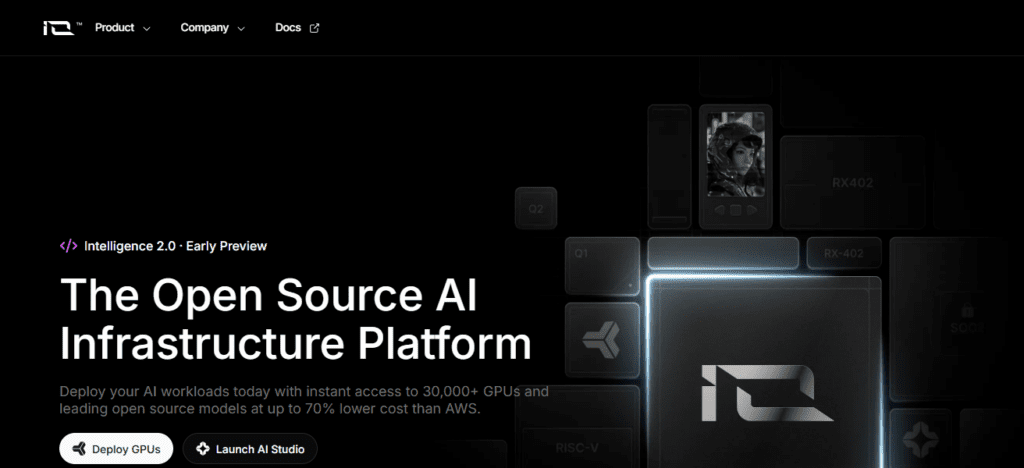
Blockchain technology guarantees the equitable and transparent allocation of resources, and proper remuneration of resource contributors.
io.net’s infrastructure also enables the training and inference of AI technologies across decentralized networks while unlocking the potential of GPU resources of individuals and organizations.
Removing the clouds of centralized computation, io.net provides the decentralized access to computation resources that supports the democratization of compute power.
| Pros | Cons |
|---|---|
| Decentralizes GPU compute power for AI training. | Reliability depends on contributors’ hardware availability. |
| Cost-effective alternative to cloud providers. | Performance may vary across distributed networks. |
| Supports startups and researchers globally. | Integration challenges with existing AI workflows. |
| Transparent resource allocation via blockchain. | Requires large contributor base for scalability. |
| Democratizes access to high-performance compute. | Still early in adoption compared to established cloud giants. |
6. OriginTrail (Decentralized Knowledge Graph)
OriginTrail is a decentralized, blockchain-based knowledge graph that organizes data across multiple industries. It combines multiple datasets into one structured network.
This increases data transparency, interoperability, and verifiability. OriginTrail helps businesses verify product authenticity, maintain integrity in their supply chain, and make data-based decisions.
The knowledge graph is also used in the logistics, healthcare, and sustainability industries, where high-quality information is vital.
The company’s mission is to enhance people and businesses’ access to reliable and interconnected information by developing a decentralized knowledge infrastructure globally.
| Pros | Cons |
|---|---|
| Organizes trusted data across industries. | Complexity of knowledge graph implementation. |
| Enhances transparency and interoperability. | Requires strong partnerships for adoption. |
| Guarantees immutability and verifiability via blockchain. | Limited awareness outside supply chain sector. |
| Useful for logistics, healthcare, sustainability. | Integration with legacy systems can be difficult. |
| Creates global decentralized knowledge infrastructure. | Early-stage ecosystem with gradual adoption. |
7. Grass (Decentralized AI Web Scraping)
Grass is a decentralized network that uses community participation to build an AI-driven web scraping module.
Rather than using a centralized service to web scrape, Grass uses a distributed method where contributors collect and redistribute web data.
Grass’s use of web data scraping distributes the web data across the internet, fostering a democratic approach to web data that can be used to train, test, and further develop AI.

By using Blockchain technology, Grass can assure data is not only accurate, but that contributors are appropriately compensated. Grass uses web scraping’s decentralization to offer AI developers a transparent and unlimited resource.
| Pros | Cons |
|---|---|
| Community-powered scraping democratizes data access. | Legal concerns around web scraping. |
| Provides datasets for AI training and research. | Data quality may vary significantly. |
| Rewards contributors fairly via blockchain. | Requires large contributor base for effectiveness. |
| Reduces reliance on centralized scraping services. | Potential conflicts with website owners. |
| Transparent and scalable data collection. | Still experimental in mainstream AI wor |
8. ChainGPT
ChainGPT is an AI model designed for applications in blockchain and cryptocurrency. It provides services for smart contract creation, auditing, and analysis, and is designed to aid developers in constructing safe and proficient solutions in blockchain technology.
Additionally, beyond code, ChainGPT offers automation, analytic assistance, and compliance solutions related to cryptocurrency, and as such, is a handy tool for the Web3 ecosystem.

The combination of AI technology with blockchain offers precision, and quickness, and ensures consistent performance on intricate activities.
ChainGPT is on a mission to make the development of blockchain technology uncomplicated and provide users with smart technology customized for the cryptocurrency market and is combining AI technology with blockchain to enable a decentralized finance solution.
| Pros | Cons |
|---|---|
| Specializes in blockchain and crypto applications. | Niche focus limits broader AI use cases. |
| Generates and audits smart contracts efficiently. | Accuracy of generated contracts must be carefully verified. |
| Provides crypto-related automation and insights. | Regulatory uncertainty in crypto industry. |
| Simplifies blockchain development for users. | Adoption depends on developer trust. |
| Bridges AI innovation with decentralized finance. | Competition from other blockchain-focused AI tools. |
9. Gaia AI
Gaia AI is an Environmental Sustainability AI platform. Gaia AI uses machine learning and data to optimize forest management
carbon capture, and conservation and combines data streams from satellites and climate and ecological data to provide insights for lowering impact, assisting eco-centered decision-making.
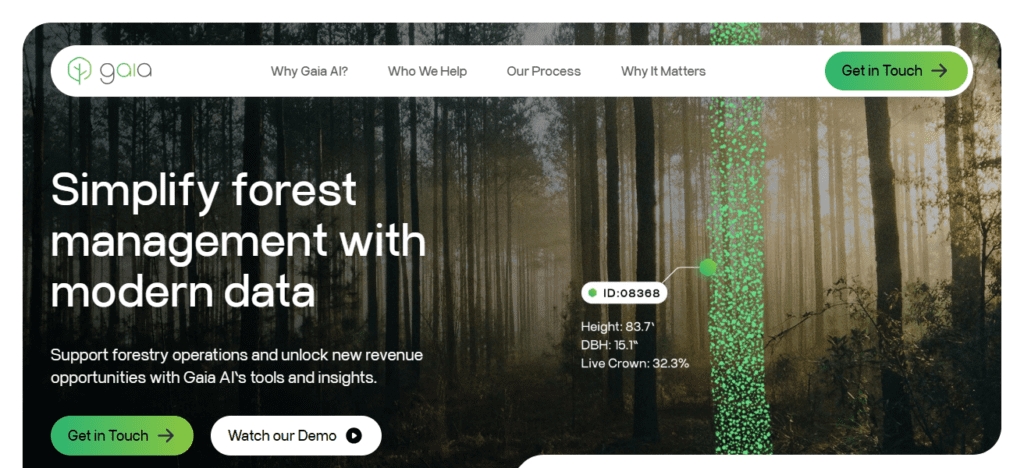
Gaia AI’s platform tools help support reforestation and carbon credit and biodiversity monitoring. Gaia AI is at the crossroad of the sustainable and tech industries and uses blockchain and AI to
shift the environment to a more positive state. Gaia AI is focused on intelligence for a greener and more sustainable Earth.
| Pros | Cons |
|---|---|
| Focused on environmental sustainability. | Limited commercial applications outside sustainability. |
| Optimizes forestry, carbon capture, and conservation. | Requires large datasets for accuracy. |
| Supports reforestation and biodiversity monitoring. | Adoption depends on government and NGO partnerships. |
| Aligns economic incentives with ecological goals. | Funding challenges for environmental projects. |
| Harnesses AI for positive environmental impact. | Still early in scaling globally. |
10. Axiom (ZK-AI for Data Integrity)
Axiom combines zero-knowledge proofs and AI to protect trust and integrity in decentralized environments.
With Axiom’s approach, you can verify computation without disclosing any secret data, thus maintaining both privacy and transparency.
This innovation allows ZK-AI and blockchain technology to create a safe space where the AI outputs can be proven to be correct and protective against any future alterations.
This approach responds to the data manipulation and trust issues associated with AI. Axiom’s goal is to build a future where verifiable, privacy-preserving intelligence exists for decentralized environments.
| Pros | Cons |
|---|---|
| Ensures verifiable AI outputs. | Computationally intensive zero-knowledge proofs. |
| Preserves privacy while maintaining transparency. | Steep learning curve for adoption. |
| Strengthens trust in decentralized environments. | Limited mainstream awareness. |
| Combines blockchain and AI securely. | Integration challenges with legacy systems. |
| Addresses trust and data manipulation issues. | Scalability remains unproven at large scale. |
Conclsuion
In summary, the Best AI + Blockchain Startups To Watch are leading the way in innovation for finance, sustainability, infrastructure, and data integrity.
From autonomous agents at Fetch.ai to zero-knowledge AI at Axiom, these startups illustrate the potential of combining decentralized technology and AI.
Their pioneering solutions illustrate what is possible when trust, efficiency, and intelligence converge within the global digital ecosystem.
FAQ
It enables secure, privacy-preserving data sharing and monetization for AI developers and businesses.
It decentralizes GPU compute power, offering scalable and affordable AI training infrastructure.
Grass uses community-powered scraping to decentralize web data collection for AI training.
It leverages AI to optimize forestry, carbon capture, and conservation for environmental impact.